What Happens in an Online Chess Class for Beginners?

The video call connects. The chess board appears on screen. Your child sits there, half-curious, half-suspicious, and you realize you have no idea what the next 45 minutes are supposed to look like.

That uncertainty is the most common reason parents delay booking a class for weeks after deciding chess is worth pursuing. Nobody wants to pay for something they cannot picture. And for chess especially, the imagination tends to jump straight to grandmaster theory and memorized openings, neither of which describes what a beginner actually does.

Online chess classes for beginners look nothing like a lecture and nothing like a self-paced app. This covers what happens in the first session, what a child can do by week four, and what to check before choosing any programme.

The timing matters too. As of December 2024, India has 85 chess grandmasters with 13 ranked among the world’s top 100 players, and following Gukesh Dommaraju’s World Championship victory, chess academies across major cities and tier-two towns are now running at full capacity (Chess in India, Wikipedia, 2024; WION Year-Ender, 2025). The question for parents is not whether chess is worth pursuing. It is how to make sure the class their child joins is actually worth the screen time.

What Do Kids Actually Learn in Their First Online Chess Classes?

Most parents expect openings. Most beginners get something far more useful: the names and movements of all six pieces, how a game starts and ends, and what it means when a king is under threat. That is enough for a first chess lesson for beginners, and a good coach knows it.

By the end of a typical beginner sequence, a child can set up a board independently, spot checkmate in one move, and play a complete legal game without needing prompts from an adult. These are concrete, testable milestones, not vague improvements that are hard to see from the sofa.

Week| What Gets Covered
Week 1| Names and movement of all six pieces; how a game starts and ends
Week 2| Basic captures; understanding checks and how to escape check
Week 3| Simple tactics: forks, pins and basic checkmate patterns
Week 4| Playing a supervised full game with review and one specific goal

Pace matters as much as content in chess lessons for beginners. A child who feels capable at the end of week one is far more likely to return for week two than one who has been rushed into complicated material.

How Do Online Chess Classes Work for Complete Beginners?

A beginner session runs on a video call paired with a shared interactive chess board. The coach demonstrates a position by moving pieces on the shared board, and the child practises on the same board in real time. Nobody is pointing at a physical board and hoping the camera angle is right.

A well-run session has four clear parts:

Time Block| What Happens
0–10 min| Recap of the last lesson; warm-up puzzle or piece-movement drill
10–25 min| New concept introduced with a live demonstration on the shared board
25–40 min| Child practises: guided play, mini game or tactical exercise while the coach observes
40–45 min| Session review; one specific takeaway the child is asked to remember

Kaabil Kids’ online chess classes for beginners follow this live, interactive structure, with FIDE-rated trainers guiding each child through a curriculum designed by International Grandmaster Tejas Bakre. No beginner is left to navigate a lesson sequence alone.

What Skills Are Taught to Beginners in Online Chess Classes?

Chess lessons for beginners cover more than chess. The skills that show up in classrooms and friendships often develop as a side effect of chess-specific training, but a well-designed programme plans for both columns deliberately.

online chess classes for beginners

Most beginner chess coaching handles the chess column well. Kaabil Kids’ in-house psychologist works on the self-regulation row specifically, supporting children through the emotional side of losing a position, which most online programmes leave entirely to chance.

Why Is Learning Chess With a Coach Better Than Learning Alone?

The realistic alternative a parent compares online chess classes for beginners against is apps and YouTube. Both have value. Neither can replicate a coach watching how a child thinks rather than just which square they click.

A child working through puzzles alone can develop the habit of trying the first move that looks appealing, getting it wrong, and trying the next one, without ever building the discipline of checking before committing. That habit, repeated across hundreds of puzzles, is harder to undo later than it is to prevent early with guided instruction.

Youth registrations on online chess platforms have grown 27% since 2023, driven largely by parental interest in cognitive development and structured learning rather than casual play (Online Chess Instruction and Play Market Report, 2025). Parents researching how to learn chess online for kids are not looking for more screen time. They are looking for a coach who watches, corrects and explains, the one thing an app genuinely cannot provide.

Beginner chess coaching fills exactly that gap. A trainer who asks “why did you play that piece?” after every game builds the habit of reasoning out loud, not just moving. That separates useful chess lessons for beginners from simply moving pieces around without thinking. For families evaluating chess classes for kids online, this distinction is the most useful one to carry into a buying decision.

How Do You Choose the Right Online Chess Programme for Your Child?

Online chess classes for beginners vary enormously in quality, structure and what they actually deliver. A useful framework covers five criteria:

Online chess classes for beginners

Kaabil Kids meets every criterion above: FIDE-rated trainers, a Grandmaster-designed curriculum spanning beginner, intermediate and advanced tracks, small-group live sessions, regular tournaments and an in-house psychologist for mindset support. As a beginner chess coaching platform for children aged 5 to 15, it treats all five areas as part of the same programme rather than optional extras.

A child’s first experience of beginner chess coaching is not complicated when the programme is well-designed. They show up, learn the pieces, and leave having done something concrete. That is how chess classes for kids online are supposed to work: each session building on the one before it.

Explore Kaabil Kids’ online chess coaching for beginners | Book a free trial class

What Do Parents Most Often Ask About Online Chess Classes for Beginners? 

What happens in the first online chess class for a beginner?

A well-run first session covers the names and movements of all six pieces, how a game starts and ends, and usually one simple concept such as how the king gets into check. The child practises on a shared interactive board while the coach watches and corrects in real time. No prior knowledge is needed to join online chess classes for beginners, whether you choose to learn chess online for kids or through a local club.

What age can children start online chess classes?

The best age to learn chess online for kids is generally five or six, when pattern recognition develops quickly. Kaabil Kids covers ages 5 to 15, adjusting pace and complexity for each group. Younger children have fewer ingrained habits to unlearn, which makes earlier starts more efficient than later ones.

How long are online chess lessons for beginners?

Most chess classes for kids online run between 45 and 60 minutes for beginners, split across instruction, supervised practice and review. Children aged five to seven do better with sessions at the shorter end; focus tends to hold well up to about 30 to 40 minutes.

What does a child need to join an online chess class?

A device with a camera and a stable internet connection is enough to get started with beginner chess coaching online. No physical chess board is required, since the shared digital board handles everything during a live session. Some programmes suggest a physical board for practice between lessons, but it is not a requirement for the first class.

How Does Chess Teach Children to Think Before They Act?

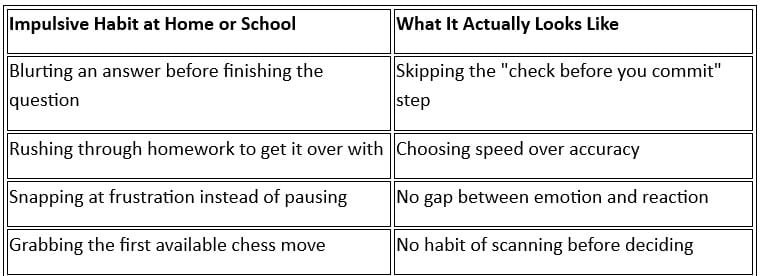
A child grabs the last cookie without checking if it is someone else’s. A homework answer gets written half a second after the question is read, not after. A checkers piece gets slammed down, then regretted out loud. None of this means a child is careless. It usually means the brain’s “wait, let me check” function is still under construction, and most days nothing forces that function to switch on.

Chess does, every single time. More than 25 million children worldwide now play it, according to figures from FIDE, the World Chess Federation, cited in a 2025 Frontiers in Psychology paper (Frontiers in Psychology, 2025). Part of that growth comes from parents who care less about ratings and more about a child who acts first and thinks second.

This is exactly the gap chess teaches children to think before they act, one slow, deliberate move at a time.

Why Do Impulsive Decisions Hold Back a Child’s Learning?

The brain region responsible for pausing before acting, the prefrontal cortex, matures later than the emotional, reactive regions driving a child’s first instinct. That mismatch is not a character flaw, just biology under construction, which is why a seven-year-old can ace a spelling test and still snap at a sibling over a board game the same afternoon.

The stakes are not small. A 2025 study in npj Science of Learning examined how brain structure linked to impulsivity affects academic performance and found that prefrontal cortex activity alone accounted for more than a third of impulsivity’s negative effect on grades (npj Science of Learning, 2025). That research looked at students broadly, not young children specifically, but it describes the same wiring every child is still finishing.

This is precisely the gap that explains why chess teaches children to think before they act more reliably than a lecture about patience ever could: it replaces advice with repetition.

What Does the Decision-Making Process Look Like in a Game of Chess?

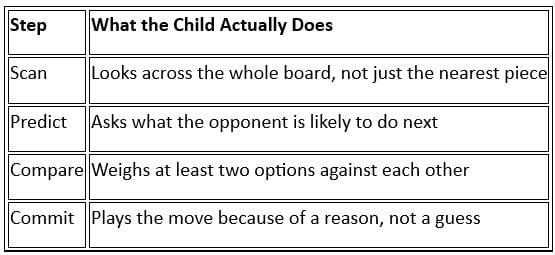
Every legal chess move hides four smaller decisions, and skipping any one gets punished almost immediately on the board.

A hung piece or a missed threat shows up within seconds of skipping a step, a blunter consequence than most schoolwork ever delivers. That bluntness is the entire point behind decision-making in chess for kids: the board, not a parent or teacher, delivers the feedback. Kaabil Kids trains this four-step habit into every lesson rather than hoping a child stumbles onto it, building strategic thinking for kids into the curriculum itself, with trainers regularly pausing a game to ask why a move got played.

How Does Chess Build Patience and Self-Control in Kids?

Patience on a chessboard is not sitting quietly and waiting. It is holding back a move that looks tempting in order to find one that actually works, which takes more discipline than waiting ever does. This active, practised version of chess and patience in children is what separates a calm-looking child from one who has genuinely learned to delay a decision.

A 2025 study published in Frontiers in Psychology compared two groups of kindergarten children, one taught chess as part of regular lessons and one that was not, and recorded measurable gains in patience and self-discipline among the chess group, alongside improvements in attention and logical thinking strong enough that the researchers ruled out chance (Frontiers in Psychology, 2025). The mechanism behind chess and patience in children is straightforward: chess punishes impatience on the spot, through a lost piece or a lost game, far faster than most subjects ever give a child that kind of feedback.

Does This Benefit Apply to Every Child, or Only Naturally Patient Ones?

Parents of restless or easily frustrated kids often assume chess and patience in children only works for someone else’s calmer child. Coaches working with hundreds of children see the opposite. A child who struggles most with pausing usually has the most room to improve, and a chessboard gives that exact skill somewhere safe to be practised, with a result clear within minutes rather than weeks.

None of this happens overnight, and chess should never be framed as a substitute for professional support when a child has a diagnosed condition. Think of it the way a music teacher thinks of scales: progress is gradual, built through repetition.

Where Do These Think-Before-You-Act Skills Show Up in Real Life?

Decision making in chess for kids rarely stays confined to a board. Strategic thinking for kids built through one activity tends to leak into three places parents notice almost immediately.

What Does This Look Like in the Classroom?

A child who has practised scanning a board before moving, the basis of strategic thinking for kids, is more likely to reread a tricky question before answering it, instead of writing down whatever thought arrives first.

What Does This Look Like in Friendships and Sibling Conflict? 

The same gap between impulse and action shows up off the board too. A child who has learned to weigh two responses before committing to one move is more likely to do the same before firing back at a sibling.

What Does This Look Like in Exams and Anything Timed?

Most chess games and puzzles run against a clock, which mirrors the pressure of a timed test far more closely than untimed homework ever could, training a child to decide well under a ticking deadline rather than freeze or rush.

How Does Structured Chess Coaching Reinforce Better Thinking Habits?

Playing chess alone teaches a child to make moves. A coach who asks “why did you play that” after every game is the one who turns the habit into something permanent, since noticing your own impulsive choices without outside feedback is slow and unreliable.

Kaabil Kids builds that feedback loop directly into its online chess classes, treating strategic thinking for kids as a skill to be coached, not assumed. FIDE-rated trainers review a child’s games to flag the moves made without scanning or comparing, turning each into a concrete, repeatable lesson rather than a vague comment. An in-house psychologist supports the emotional side of this, staying composed after a loss instead of reacting to it. Families researching online chess coaching or an online chess tutor for this reason are usually looking for exactly that structured, repeated correction loop.

A pattern this specific does not build itself. It needs a curriculum, designed here by International Grandmaster Tejas Bakre, paired with trainers who treat every game as a chance to catch and correct one impulsive habit at a time, because chess teaches children to think before they act only when someone keeps asking them to explain their thinking.

Frequently Asked Questions

What Do Parents Usually Ask About Chess, Decision-Making and Patience in Kids? Frequently Asked Questions

  1. Does chess actually improve decision-making in children? 

Research backs this up specifically for the skills decision making in chess for kids drills directly: scanning options, predicting consequences, and choosing deliberately rather than guessing. This is the clearest evidence that chess teaches children to think before they act, since a 2025 Frontiers in Psychology study found measurable gains in exactly these areas among children given regular chess instruction.

2. Can chess help an impulsive or hyperactive child? 

It can help build the habit of pausing before acting, since every move offers low-stakes practice at exactly that skill. The link between chess and patience in children works best as a complement to other support, not a replacement for professional guidance where a diagnosed condition is involved.

3. At what age should a child start chess for these benefits?

Most children can begin around age five or six, when the brain is especially responsive to structured practice. Kaabil Kids works with children from age 5 through 15, adjusting pace and complexity to match each stage.

4. How long does it take to see a change in a child’s patience? 

Coaches typically notice early shifts within a few months of regular practice, though change tends to be gradual, the same way any new habit takes repetition before it becomes automatic.


Kaabil Kids turns that repeated correction into a weekly habit rather than a one-off experiment, combining a Grandmaster-built curriculum, FIDE-rated trainers, and in-house psychological support so that the pause a child learns on the board shows up off it, too.

Start with Kaabil Kids’ online chess coaching for kids to see it in practice.

Summer is here, and parents everywhere are searching for ways to keep their kids engaged, learning, and having fun. While summer often brings to mind outdoor sports and family trips, it’s also the best time for children to dive into new hobbies and develop valuable skills. If you’re looking for an activity that combines fun, learning, and convenience, Online Chess is the answer. Let’s explore why summer is the perfect time for your child to master chess through online chess classes and how joining a professional chess academy can make all the difference.

Why Choose Online Chess for Summer Learning?

Why Choose Online Chess for Summer Learning?

Beat the Summer Slide

During summer break, kids can lose some of the academic progress they made during the school year, a phenomenon known as the “summer slide.” Enrolling your child in online chess classes helps prevent this loss. Chess keeps the brain active, sharpens focus, and improves skills in math, reading, and problem-solving, all while being fun and engaging.

Flexible and Convenient Learning

Summer schedules are often unpredictable with vacations, family visits, and other activities. The beauty of online chess classes  is its flexibility. Kids can join classes from anywhere, at home, on vacation, or even at a grandparent’s house. There’s no need to commute or rearrange your summer plans.

Safe and Comfortable Environment

With the heat of summer or unexpected weather, it’s not always possible to be outdoors. Online chess classes offer a safe and comfortable way for kids to learn and interact, all from the comfort of home.

The Benefits of Online Chess Classes in Summer

Mental Gymnastics for Growing Minds

Chess is often called the “gymnasium of the mind.” Every move in chess requires planning, strategy, and foresight. Through online chess classes, kids strengthen their problem-solving, critical thinking, and decision-making skills. These abilities help them not just in chess but in school and everyday life.

Building a Strategic Mindset

Chess teaches children to think ahead, plan carefully, and anticipate their opponent’s moves. These are skills that go far beyond the chessboard. Learning chess in a professional chess academy during the summer helps kids develop a strategic mindset that will benefit them in academics and future careers.

Improving Focus and Concentration

In a world full of distractions, chess demands attention. Regular practice in online chess classes helps kids build the ability to concentrate for more extended periods, which is a valuable skill for school and life.

Strengthening Memory

Chess is more than just moving pieces; it’s about remembering patterns, strategies, and past games. Kids who join online chess camps or classes over the summer see real improvements in their memory and recall skills.

Developing Patience and Resilience

Every chess game has its ups and downs. Kids learn to handle wins and losses with grace, building patience and resilience, qualities that help them in all areas of life.

Social Interaction and Teamwork

Contrary to popular belief, chess is a social game! Online chess classes connect kids with peers from different backgrounds, helping them build friendships, learn teamwork, and develop good sportsmanship.

Accessibility and Affordability

Online chess is accessible to everyone. There’s no need for expensive equipment or travel. Many professional chess academies offer affordable programs, free resources, and trial classes, making it easy for families to get started.

Why a Professional Chess Academy Makes a Difference

Expert Guidance

Learning from experienced coaches at a professional chess academy means your child gets the best instruction possible. Coaches can spot mistakes, offer personalized feedback, and help kids improve faster.

Structured Curriculum

A professional chess academy provides a step-by-step curriculum designed for different skill levels, from beginners to advanced players. This ensures that every child learns at the right pace and builds a solid foundation.

Motivation and Support

Group classes and tournaments keep kids motivated. They get to compete, celebrate their progress, and receive encouragement from both coaches and classmates.

Tournament Preparation

For kids who want to compete, summer is the perfect time to prepare for local and national chess tournaments. Online chess classes often include tournament practice, helping children build confidence and learn to handle competition.

How to Get Started with Online Chess This Summer

1. Find the Right Professional Chess Academy

Look for an academy with experienced coaches, a proven curriculum, and good reviews from other parents. Many offer free demo classes so you can try before you commit67.

2. Choose the Right Class Level

Whether your child is a complete beginner or already knows the basics, there are classes for every level. Starting at the right level ensures your child feels confident and enjoys learning.

3. Set a Summer Chess Schedule

Decide how many classes your child will take each week. Many families find that two or three sessions per week are the perfect balance between learning and summer fun.

4. Encourage Practice and Play

Encourage your child to practice between classes. Many online platforms offer puzzles, games, and challenges to keep kids engaged and improving.

5. Celebrate Progress

Track your child’s progress and celebrate their achievements. Whether it’s mastering a new opening or winning a friendly match, every step forward is worth celebrating.

Comparing Summer Activities for Kids

ActivityFun FactorSkill DevelopmentFlexibilitySocial InteractionCost
Online ChessHighVery HighVery HighHighAffordable
Sports CampHighHighLowHighExpensive
Art ClassesMediumMediumMediumMediumVaries
Video GamesHighLowHighLowVaries
Reading ClubMediumHighMediumMediumAffordable

Conclusion: Make This Summer Count, Enroll in Online Chess Classes!

Summer is the perfect time for your child to master chess online. With the flexibility, convenience, and expert instruction offered by a professional chess academy, your child can develop valuable skills, make new friends, and have fun, all from the comfort of home. Don’t let the summer slide set your child back. Instead, give them the chance to grow, learn, and shine with online chess classes.

Ready to get started?

Let this summer be the season when your child discovers the joy and power of chess. Enrol now and set them on the path to lifelong learning and success!

FAQs: Online Chess and Summer Learning

Is summer really the best time to start online chess classes?

Yes, With more free time and less academic pressure, kids can focus on learning chess and developing new skills without feeling rushed.

Can beginners join online chess classes?

Absolutely. Many academies offer beginner classes, making it easy for kids to start from scratch and build confidence quickly.

How do online chess classes keep kids engaged?

Classes include interactive lessons, games, puzzles, and tournaments, making learning fun and social.

Are online chess classes safe for kids?

Yes. Reputable academies provide a safe, supervised environment with experienced coaches and secure platforms.

What equipment is needed for online chess?

Just a computer or tablet with internet access. No special equipment is required.

Do you ever think how chess can be turned more mind-blowing? Chess has always been a game of skill, patience, and smart moves. Players spend years learning strategies, memorising openings, and perfecting their endgame. But what if chess could be more exciting and less predictable? That’s where Freestyle Chess comes in. This new version makes the game more creative and fun. It’s becoming popular, thanks to world champion Magnus Carlsen. He enthusiastically endorsed this version of chess. At Kaabil Kids, we are excited to bring Freestyle Chess to our online chess classes for kids. It’s a fresh and exciting way to learn and enjoy the game. 

Understanding Freestyle Chess 

Freestyle Chess, also called Chess960, was created by chess legend Bobby Fischer. In regular chess, pieces always start in the same position. But in Freestyle Chess, the back-rank pieces are randomly placed in 960 different ways. This small change makes a big difference. Each game is unique, and players can’t just rely on memorised moves. They have to think on their feet and use the real strategy from the very first move. 

What Makes Freestyle Chess Different? 

This fresh and exciting format makes chess more engaging, challenging players in a way that traditional chess does not. 

Magnus Carlsen’s Influence on Freestyle Chess 

Magnus Carlsen, the world’s highest-rated chess player and multiple-time world champion, is a strong advocate of Freestyle Chess. He believes that this version of the game restores the unpredictability and excitement that can sometimes be missing in classical chess. Carlsen has participated in and won several Chess960 tournaments, demonstrating his extraordinary ability to adapt and think creatively. 

His endorsement has played a crucial role in increasing the visibility and popularity of Freestyle Chess. As more players watch and admire Carlsen’s performances, interest in this version of chess has skyrocketed. Many chess enthusiasts and newcomers are now embracing the game for its thrilling nature and intellectual depth. 

The Growing Popularity of Freestyle Chess 

Freestyle Chess is quickly becoming a global phenomenon. Its appeal lies in its ability to offer something fresh and unique, making it an attractive option for players of all levels. Here’s why more and more chess lovers are turning to Freestyle Chess: 

As the game continues to grow in popularity, chess academies and online learning platforms are beginning to integrate it into their curriculum, ensuring that players are prepared for the modern evolution of chess.  

Why Expert Coaching is Essential for Freestyle Chess 

Freestyle Chess is a fun and creative way to play. Expert coaching can help you improve your skills faster and smarter. Here’s how it can make a difference. 

1. Faster Learning: Expert coaches simplify complex strategies. They show you the quickest path to mastering Freestyle Chess. 

2. Personalized Tips: Coaches understand your unique style. They offer advice that matches your strengths, helping you play better. 

3. Real-World Experience: With years of playing and teaching, experts know the game inside and out. They give you insights that go beyond the basics. 

4. Creative Thinking: Freestyle Chess is all about flexibility. Coaches help you develop creative strategies and adapt to new situations. 

5. Continuous Motivation: Expert coaches keep you motivated. They push you to improve and stay on track with your goals. 

6. Access to Better Tools: Coaches have the best tools and resources. They use them to help you practice and learn more effectively. 

In short, expert coaching in Freestyle Chess speeds up your learning, boosts your creativity, and gives you the confidence to tackle any challenge. Whether you’re a beginner or an experienced player, coaching helps you level up. 

Benefits of Learning Chess Online with Kaabil Kids 

Online learning offers numerous advantages, making it an excellent choice for young chess enthusiasts. Here’s why our online chess classes at Kaabil Kids are the perfect fit: 

If you’re looking for chess for beginners online, our program provides the perfect foundation. Whether your child is just starting or an advanced player, our structured lessons ensure continuous growth and improvement in their chess journey.  

Conclusion 

With Magnus Carlsen, Freestyle Chess is changing the world of chess, making it more unpredictable and exciting. It is with such a modern version of chess that we are eager to introduce at Kaabil Kids to keep the students engaged and challenged continuously. 

Whether it’s for a young one just starting out or in learning to hone one’s skills better, our online chess classes are the ideal setting where both classical and Freestyle Chess would be nicely explored and mastered. 

Join us today, and let’s unlock the exciting possibilities that modern chess has to offer! 

The World Chess Championship 2024 is one of the most desired tournaments in chess history. Two exceptional grandmasters, Gukesh Dommaraju and Ding Liren, are set to clash on the grand stage. This year’s championship isn’t just a test of strategic brilliance but also a captivating narrative of rising stars and seasoned veterans battling for supremacy.  

This event is set to inspire both new and experienced players. It also shows how chess is becoming more popular, thanks to online chess classes and platforms that help players improve their skills. Let’s explore the format, competitors, predictions, and betting odds that make the 2024 championship a thrilling spectacle. 

Format and Key Details of the Championship 

The World Chess Championship 2024 follows a well-established format designed to ensure fair play and excitement for fans and players alike. Here are the critical details: 

  1. Schedule: The championship will span 14 rounds. 
  2. Scoring: The first player to score 7.5 points or more will be declared the winner. Each game awards one point for a victory and half a point for a tie. 
  3. Rules for Draws: Players cannot agree to a draw before Black’s 40th move. 
  4. Tiebreak: If both players are tied after 14 rounds, four rapid games (25 minutes per side) will determine the winner. The first player to score 2.5 points beats the tiebreak. 
  5. Time Control
  6. Each participant has 120 minutes to accomplish the first 40 moves, followed by 60 minutes for the next 20.  
  7. 15 minutes per player for the remaining game. 

Meet the Competitors 

Gukesh Dommaraju: The Genius on the Rise 

Gukesh Dommaraju, who is only 18, is becoming famous in the chess world. Gukesh, who had just won the FIDE Candidates Tournament, became the tournament’s youngest winner in history.  

As the second Indian to qualify for the World Chess Championship, after the legendary Viswanathan Anand, Gukesh carries the hopes of a nation eager for another world champion.  

His success has inspired many young players to start learning chess. Parents are now choosing online chess classes for kids to help their children develop their skills. 

Key Achievements: 

Strengths: 

Challenges: 

Ding Liren: The Defending Champion 

Ding Liren, the reigning FIDE World Chess Champion, enters the 2024 championship with both experience and a point to prove. He clinched the title in 2023 after defeating Ian Nepomniachtchi in a thrilling tiebreak. However, Ding has faced a challenging year, with critics questioning his current form and competitive drive. 

Key Achievements: 

Strengths: 

Challenges: 

Analysis and Predictions 

Why Gukesh Could Win: 

Why Ding Could Win: 

While Gukesh is the favorite, Ding’s experience and strategic depth could make this a closer contest than the odds suggest. Expect a tightly fought match, potentially decided in a rapid tiebreak. 

Conclusion 

The World Chess Championship 2024 promises to be a thrilling spectacle, showcasing the clash of talent, strategy, and determination. Will Gukesh’s meteoric rise culminate in a historic victory, or will Ding Liren draw on his experience to defend his title? The chess world waits with bated breath as these two grandmasters prepare to write the next chapter in chess history. 

Whether you’re cheering for the young prodigy or the defending champion, this match will undoubtedly be one for the ages. Inspired by these legendary players, many enthusiasts are turning to professional chess academy to master the game. 

The Chess Olympiad 2024 is here, and India is indeed making waves. The enthusiasm of fans and the bravery of players are igniting the spirit. The unthinkable has become possible-it is no longer just a game for India but a journey to greatness. Let’s explore how our chess heroes are holding the flag high.

The chess battleground is scorching hot in India. Mention Gukesh Dommaraju, Arjun Erigaisi, and Praggnanandhaa, Divya Deshmukh and you know precisely what we are talking about. Each one of them has been striking gold with their immeasurable skills and vigorous determination.

Gukesh Dommaraju: A Force to Be Reckoned With

Gukesh is really a standout. At the age of 17, he has already hogged headlines. His strategic play and timely skill on the board are actually making him a strong contender. Many feel he has the best bet to challenge the current World Champion Ding Liren from China. How lovely would it be if Gukesh also brought the title home! The excitement would just be off the charts!

Arjun Erigaisi: The Tactical Genius

Arjun Erigaisi is the next player. He is known for strategic brilliance. There is a veiled talent of Arjun to visualize the game from different angles. His creativity, or rather ingeniousness, helps him to come up with unexpected moves that amaze the opponents. In this Chess Olympiad, he plays crucially for India. His fans are waiting to see how he will prove himself in the following rounds.

Praggnanandhaa: The Young Prodigy

Praggnanandhaa, or Pragg as fans call him, is another chess sensation. It was the time he entered into success at such a young age of just 18 years. He has faced all the top players and stood against them. Calm under pressure is his speciality. Many think he can make it to the trophy for India this year. Youthfulness, along with skill together, becomes a great advantage.

Divya Deshmukh

The 18-year-old Divya Deshmukh was an absolute key player from India in the 2024 Olympics. She surely proved to be an excellent player as her brilliant strategic skills have had stabilized her position in the tournament. With each match, she ensures inspiring young female players, and just a period of time makes them realize the potential for victory on the Olympic stage.

Vantika Agrawal

At just seventeen, Vantika Agrawal is cutting a sharp figure in the run-up to 2024 Olympics. Known for her tactical brilliance and cool-under-pressure credentials, she plays a very crucial role in the Indian women’s chess team. Vantika’s journey reflects the promise of young women in chess, inspiring generations to come to dream big in this sport.

The Road to Success

The success of India is not just about stars and marvelous players. It is about team efforts and strategy. Coaches and support staff play a key role. They help build up the player and increase their confidence.

Team Spirit and Collaboration

Chess appears to be an individual game; however at the Olympiad, it’s all about a team. Every player depends on others. They share insights and strategies. The motivation, too, comes from this synergy, which is one of the reasons why India has done well so far.

Analyzing opponents

Before the actual match, the team analyzes their opponents. It analyzes matches from the past and identifies their weaknesses. This process gives them an advantage over their opponents. It is all about one step ahead of them on the board.

Thrilling Matches and Close Calls!

It is not merely an intense match since each game is a battle of wits. Cheering and zip characterize the atmosphere as fans cheer for their favorites. Let’s take a look at some of these thrills from this year’s event.

Nail-Biting Finishes

This has been the toughest India has faced in years. All matches were neck and neck, sometimes even going down to the wire. Gukesh’s games had edge-of-the-seat thrills written all over them. The kid’s ability to not lose cool is commendable. Fans can’t get enough of those nail-biting finishes for him!

Unforgettable Comebacks

Arjun also had some stunning comebacks. There were matches in which it seemed he was getting himself into trouble. But his tactical skills gave him the victory. It’s such moments that make the game of chess so thrilling. Every game is a story of its struggle and triumph.

Looking Ahead: The Final Push

As the tournament progresses, each match counts. All players are in their senses and on the toes. They realize they are playing for India. Much pride there is in wearing the national jersey on the board.

Role of Spectators

Fans are playing a very large role on this journey. The cheers and motivation they are offering to the player. Social media has just gone all out with updates and cheers. Well, it is great to be a chess fan in India!

Battling for Gold

Now, it is India’s turn to eye the gold medal. There is already enough talent and motivation to do so. With Gukesh, Arjun, Praggnanandhaa, Divya and Vantika Agrawal heading it, it sure as hell must be within their reach. The excitement here is palpable!

The Future of Indian Chess!

Inspired by the performance of India at the Chess Olympiad 2024, it has been a journey so far that has showcased the huge talent in our young lot of players Gukesh Dommaraju, Arjun Erigaisi, Praggnanandhaa, Divya and Vantika Agrawal the road to the future of Indian chess.

This is a journey where we cheer for them. Whatever happens in the end, these players have already made us very proud. The future looks bright for Indian chess, and we await much in the coming days. Cheers, keep your eyes on the board best is yet to come!

At Kaabil Kids, we believe in nurturing young talents like these chess stars. 

Keep your eyes on the board—the best is yet to come!

Chess is one of the world’s oldest and most intellectually engaging games, having a millennia-long history. Despite its basic principles, chess may be fairly difficult, particularly for new or casual players. Many chess players, even experienced ones, sometimes face misinterpreted rules, which cause annoyance or bewilderment throughout a game. In this article, we’ll look at the top five most misunderstood chess rules and provide advice on how to avoid them so you may play comfortably and properly.

Misunderstood Chess Rules And Ways to Avoid Them

1. En Passant is a tricky pawn move

According to the professionals offering online chess classes, one of the most often misunderstood chess rules is en passant (French for “in passing”), a particular move involving pawns. It’s an unusual but important rule that permits a pawn to capture an opponent’s pawn in extremely precise situations.

How It Works

The en passant move happens when your opponent advances a pawn two squares ahead of its starting position and lands alongside your piece. On the very next move, capture the opponent’s pawn as if it had simply progressed one square ahead. The capture must occur immediately after the opponent’s pawn has moved two squares; otherwise, the chance is gone.

How to Avoid Misunderstandings

Understanding the patient’s timing is critical for preventing misunderstanding. You can only execute en passant after your opponent has moved their pawn two squares ahead. If you wait one more move, the choice will be unavailable. Pay close attention to your opponent’s pawn movements and be aware of the potential to execute en passant.

2. The 50-Move Rule is Not an Endless Game

Another widely misinterpreted rule is the 50-move rule, which is intended to prevent a game from going on indefinitely without advancement. According to the rule, if no pawn has been moved and either side has captured no piece in 50 consecutive moves, any player may claim a draw.

Why it exists

The 50-move restriction prevents players from shuffling pieces across the board endlessly in a drawn-out position, bringing closure to games that are essentially equal.

How to Avoid Misunderstandings

It’s easy to lose count of how many moves have elapsed without a pawn move or capture, particularly in extended endgames. Keep track of moves using chess clocks or notations. Remember that the rule only applies if no captures or pawn movements have occurred in the previous 50 moves. Understanding when and how to claim a draw under the 50-move rule will help you avoid unwanted games and stress.

3. Insufficient Mating Material: Determine When It’s a Draw

Insufficient mating material is one of the less well-known criteria. This rule applies when neither player has enough pieces to complete the checkmate, resulting in an inevitable draw. However, many players, particularly novices, are unsure what constitutes inadequate mating material.

What is insufficient mating material?

King versus. King: Neither player can checkmate the other with just their king.

King and Bishop versus. King: A single bishop cannot cause a checkmate.

King and Knight versus. King: A knight alone cannot achieve checkmate.

King and Two Knights versus. King: Even with two knights, forcing a checkmate requires help from the opposing side.

How to Avoid Misunderstandings

To minimize misunderstanding, constantly review the content on the board. If your opponent only has one king remaining, you should still examine if you have enough material to checkmate. For example, a king and a queen can readily give checkmate, but a king and a lone knight cannot. When in doubt, examine the endgame carefully to see if a draw is unavoidable.

4. Casting: Special Safety Conditions

Castling is a key defensive move in chess, allowing a player to protect their king while developing a rook. However, it has special requirements that, if not understood, might lead to unlawful movements.

The Conditions for Casting

Neither the king nor the rook engaged in castling can have moved earlier in the game.

The king cannot be checked.

The squares between the king and rook must be unoccupied.

The king is unable to cross through an under-attack square.

The king and rook cannot land in a square, which would put them under check or threat.

How to Avoid Misunderstandings

A typical misconception occurs when players attempt to castle while their king is under check or while crossing through an assaulted square. Remember that castling is a delicate technique requiring exact circumstances. Before trying to castle, be sure that all of the prerequisites have been satisfied. Whether you’re unclear about whether castling is legal, check the board to see whether the king has moved or if there are any threats along the way.

5. Touch-Move Rule: Respecting Your Move

The touch-move rule is basic but sometimes misinterpreted, particularly in casual gaming. It specifies that if you touch a piece, you must move it if it can be moved legally. This rule guarantees that participants thoroughly consider their movements before acting.

How It Works

When you touch a piece, you commit to moving it. If you contact an opponent’s piece, you must capture it, if feasible. If you touch a piece and realize there is no legal move for it, you will be warned and then free to pick another move.

How to Avoid Misunderstandings

In casual games, players may loosen the touch-move restriction, but in formal competitions, it is rigidly enforced. To prevent making inadvertent or hasty movements, don’t touch your pieces until you’re certain of your choice. If you’re adjusting a piece on the board, say “adjust” (or “j’adoube” in French) to indicate that you don’t plan to make a move. This helps to avoid misunderstandings and ensures easier gaming.

Tips for Preventing Chess Rule Confusion

Study the rules regularly: Even experienced players might benefit from a quick review of the official chess rules. Understanding the complexities of regulations like en passant and castling might help you avoid improper movements during games.

Practice with Friends or Online Platforms: Many chess for beginners online platforms carefully follow the rules, making them ideal practice grounds for learning how to prevent blunders. Playing in a controlled atmosphere can help you improve your knowledge of complicated rules.

Use Chess Notation: Recording your movements in traditional chess notation is a great way to ensure you’re following the rules properly, particularly the 50-move rule.

Watch Tutorial Videos: Websites like Kaabil Kids provide great online chess for beginners that explain difficult rules. Watching specialists explain these guidelines might dispel any remaining uncertainties.

Request Clarification in Tournaments: If you’re playing in a formal situation, don’t hesitate to ask the judge or referee for clarification on a rule. It is usually preferable to verify than to make an unlawful action.

Final Thoughts 

Chess is a game of strategy and accuracy, and even little misunderstandings of the rules may have serious effects. En passant, the 50-move rule, inadequate mating material, castling, and the touch-move rule are the top five misunderstood chess rules. By learning them from professionals at Kaabil Kids, provider of the best Online chess classes, you may play confidently and avoid frequent problems. Whether you’re playing informally with friends or in a formal tournament, a thorough grasp of these rules can enhance your game and let you concentrate on your strategy rather than the technical aspects of the game. Happy playing!

Chess is a game that entertains us while sharpening the mind, improving concentration, and enhancing problem-solving skills. 

Teaching your child chess can be a rewarding experience, especially when using simple and engaging lessons. 

After mastering the fundamentals, the child can resume playing the game, just as learning to swim or ride a bike leaves a lasting impression on the mind.

Whether you’re a parent, teacher, or chess enthusiast, these ten easy chess lessons will help you guide your child through the basics of the game. 

Learning chess for beginners online has always been challenging, thanks to the availability of beginner-friendly online chess programs. 

Kaabil Kids has some excellent materials for online chess for beginners making the game enjoyable and interactive.

Introduce the  Chess Pieces

The first step in teaching chess is introducing your child to the chess pieces. Each piece has its unique movement and role on the board. Start by introducing the six different pieces: King, Queen, Rook, Bishop, Knight, and Pawn. Explain how each piece moves:

By understanding these movements, your child can start to see how each piece contributes to the game. Use visual aids or online chess games. This will make learning chess for beginners online easy.

Setting Up the Chessboard

The next lesson involves setting up the chessboard correctly. The chessboard consists of 64 squares, alternately light and dark. Explain to your child that the board should be placed so that a white square is on their right-hand side.

Teach them to place the pieces in their correct starting positions:

This step helps your child to understand the game structure. We offer interactive tools to help children practice setting up the board, making it easier to learn chess online.

Basic Rules and Objectives

Before playing, it’s crucial to teach your child the basic rules and objectives of chess. Explain that the goal of chess is to checkmate the king of the other team. It happens when the king is in a position to be captured (“in check”) and cannot escape.

Here are some essential rules to cover:

By understanding these rules, your child will be ready to play their first complete game of chess. Online chess for beginners often includes tutorials on these basic concepts, making it easier for children to grasp the rules. 

The Importance of Pawn Structure

Pawns may seem insignificant, but they play a critical role in the game. Teach your child about pawn structure and how it can impact the flow of the game. Explain concepts like:

Understanding pawn structure helps children see the strategic depth of chess. Kaabil Kids provides resources that explain these concepts in a child-friendly manner, helping them learn chess online at their own pace.

Understanding Piece Coordination

Chess is more than about moving individual pieces. It’s about coordinating them to work together. Teach your child how to develop their pieces and create strong formations. Key points to cover include:

Focusing on piece coordination will help your child build a strong position and prepare for tactical opportunities. Chess classes online for kids often emphasize these principles and provide exercises to practice piece coordination.

Tactics and Combinations

Tactics are the short-term calculations that lead to immediate advantages, such as winning material or delivering checkmate. Introduce your child to basic tactics like:

These tactical patterns are essential for success in chess. Encourage your child to practice these tactics through puzzles and games. Kaabil Kids offers interactive lessons that make learning chess for beginners engaging and fun.

The Opening Principles

In the opening, where players establish their pieces and fight for control of the board. Teach your child the basic principles of opening play:

Understanding these principles will give your child a solid foundation for starting the game. Online chess for beginners often includes tutorials on popular opening strategies, which can be an excellent way for your child to learn chess online.

Endgame Fundamentals

The endgame is the final phase of the game, when a few pieces are left on the board. Teach your child the basics of endgame strategy, including:

By learning these endgame fundamentals, your child will be better prepared to finish games successfully. Chess classes online for kids often include endgame training, helping children build confidence in this critical phase of the game.

Chess Etiquette and Sportsmanship

Chess is not just about winning; it’s also about playing with respect and good sportsmanship. Teach your child the importance of:

These lessons in etiquette are essential for developing a well-rounded chess player. Kaabil Kids emphasizes the importance of sportsmanship in their chess classes online for kids, promoting a positive learning environment.

Practice and Play

The final lesson is the most important: practice and play regularly. Encourage your child to play chess, whether it’s with family, friends, or online opponents. The more they play, the more they’ll internalize the lessons and strategies they’ve learned.

We offer a variety of online chess for beginners, including interactive games, puzzles, and challenges. These resources provide a fun and engaging way for children to practice and improve their skills.

Conclusion

Teaching your child to play chess is a journey that can bring lifelong benefits. By following these ten easy lessons, you’ll help them build a strong foundation in the game. 

Whether you’re using online chess for beginners or enrolling them in chess classes online for kids, Kaabil Kids provides the tools and resources needed to make learning chess for beginners an enjoyable experience. 

With patience, practice, and encouragement, your child will soon be navigating the chessboard with confidence and skill.

Chess, the game of kings, has enthralled people for millennia. Whether you’re a novice trying to learn the fundamentals or an experienced player looking to improve your abilities, a professional chess school may make a significant difference in your chess journey. This blog article investigates how enrolling in a chess school may significantly enhance your game, including information on the advantages, techniques, and long-term effects of a professional chess academy.

The Foundations of Chess Mastery

A professional chess school offers a regulated atmosphere in which players of all skill levels may develop a firm foundation in chess. Unlike self-study or casual play, an academy provides a structured way to study the game. Even experienced players might benefit from reviewing the basics. A chess school guarantees that you have a thorough knowledge of fundamental principles, including piece movement, board management, and basic tactics. This foundation is essential for gaining more sophisticated talents later on.

Ways of professional chess academies helps in improving the game. 

Strategic Thinking Development

Chess schools concentrate on teaching strategic thinking rather than merely memorizing moves. You’ll learn how to assess situations, plan many actions, and grasp the long-term consequences of your board choices. This strategic approach distinguishes casual gamers from serious opponents.

Tactical Awareness

Tactics are the building elements of chess strategy. A decent school will teach you common tactical concepts like forks, pins, skewers, and discovered assaults. Regular tactical training improves your ability to identify these possibilities in actual games, providing you with a massive advantage over opponents who lack this concentrated experience.

Expert instruction and personalized feedback

One of the most important benefits of attending a chess school is the opportunity to get expert instruction. Professional academies use experienced trainers, who often include named players like International Masters (IMs) and Grandmasters (GMs). Learning from high-level players may bring essential insights and motivation.

Unlike online courses or books, a chess school provides individualized comments on your games. Coaches can identify your skills and shortcomings, allowing you to concentrate your training on the areas that need the most significant progress. This personalized strategy guarantees that you’re constantly focusing on the most critical areas of your gameplay.

Structured Curriculum and Progressive Learning

A professional chess school usually provides a well-structured program that gradually builds abilities. Starting with simple principles and progressing to more complex methods, this systematic approach guarantees that you are continually pushing yourself without feeling overwhelmed. An excellent school covers all areas of the game, from opening theory to middlegame strategy, endgame approaches, and even the psychological aspects of competitive play.

Exposure to various playing styles

One of the primary advantages of a chess school is exposure to a range of playing styles. Academies often conduct regular sparring sessions in which you may compete against opponents of different skill levels. This experience prepares you to adapt to diverse playing styles and increases your flexibility as a player. Furthermore, analyzing games played by chess masters is an essential component of chess instruction. Academies often feature sessions where historical and recent master games are dissected, allowing you to grasp high-level strategic and tactical principles.

Tournament Preparation and Competition Experience

Academies provide crucial training for individuals who want to play competitive chess. You’ll learn how to prepare for tournaments, manage your time during games, and deal with the psychological stress of competitive play. Many schools hold internal competitions, which provide a secure atmosphere for gaining competitive experience without the burden of official ratings. After competitions, academy instructors may help you assess your games, suggest areas for growth, and celebrate your accomplishments.

Access to Advanced Tools and Resources

Professional chess academies often give access to materials that would be difficult or costly to gain independently. Many schools employ professional-level chess software for analysis and teaching. These tools may give in-depth insights about positions and help you uncover tiny improvements in your game, especially online chess for beginners. Access to substantial chess libraries, which include both ancient materials and recent publications, may help you expand your chess knowledge.

Creating a Chess Community

Aside from the technical components, a chess school provides something equally valuable: a community of like-minded people. Interacting with other chess enthusiasts may speed up your learning. Discussing games, solving riddles, and exchanging experiences all help to create a rich learning environment. Being part of a community helps you stay motivated and responsible. Regular lessons and the presence of peers may promote constant practice and growth.

Long-Term Advantages of Academy Training

The advantages of professional chess school instruction go beyond immediate game enhancement. Chess training develops analytical skills that may be used in a variety of situations, improving general critical thinking ability. Chess practice promotes attention and focus, which are helpful in both academic and professional situations. In a chess school, students learn to manage victories and losses graciously and to keep calm under pressure, both of which are crucial life skills.

Enhance Your Problem-Solving Skills 

Chess training at a professional chess academy sharpens problem-solving abilities beyond the board. Engaging with complex positions and strategic challenges stimulates creative thinking while developing multifaceted problem-solving abilities. Chess can become invaluable in many spheres of life, from academic pursuits to professional careers; its systematic approach of breaking down chess positions into manageable pieces with optimal solutions translates well to real-life situations, making you an efficient decision-maker in any arena.

Memory and Pattern Recognition

Chess academy training significantly strengthens memory and pattern recognition skills. By repeatedly being exposed to different chess positions and game scenarios, you gain an intuitive understanding of board patterns and piece configurations – something which carries over into other aspects of your life, helping you identify trends more efficiently or make connections between disparate situations. Furthermore, practising memorizing opening lines, tactical motifs, and endgame techniques strengthens overall memory capacity – providing additional cognitive functions beyond chess!

Decision-Making Under Pressure

Professional chess academies provide valuable lessons in time management and decision-making under pressure. Timed games and clock management exercises teach players to manage their thinking time efficiently while making critical decisions with limited information—skills directly transferrable into academic, professional, and personal environments where pressure builds quickly. Remaining calm, quickly analyzing options, and making sound choices is an invaluable skills that any fast-paced environment must rely on for success.

Choosing the Right Chess Academy

When choosing an online chess Classes, evaluate its reputation and track record, teacher quality, curriculum structure, facilities and resources, and scheduling compatibility. Look for academies with a solid reputation and a history of producing successful athletes. Ensure that the academy’s teachers are certified and experienced and that the program is appropriate for your objectives and learning style.

Conclusion

A professional chess school may provide a transforming experience for chess players of all skill levels. From laying a firm foundation and getting excellent training to acquiring competitive experience and joining a supportive group, the advantages are vast and far-reaching. Whether you want to be a titled player or wish to appreciate the game at a higher level, systematic instruction in a professional chess academy online like Kaabil Kids will help you advance and expand your passion for the beautiful game of chess. We have come a long way in helping businesses prepare for chess effectively. Connect us for more details.

Chess, a game of strategy, skill, and intelligence, has fascinated people for ages. While many individuals love playing chess recreationally, there is a substantial difference between casual play and professional chess instruction. Professional chess instruction classes are meant to help you comprehend the game, develop your abilities, and prepare for competitive play. Professional chess instruction may be very beneficial for both beginners and experienced players wishing to improve their abilities and strategy. This article will explain what to anticipate from professional chess training sessions and how they may help you improve your game.

Things to Expect in Professional Chess Training

Personalized Coaching and Assessment

One of the key advantages of professional chess instruction is customized teaching. Unlike generic educational resources, expert trainers customize their teaching techniques to meet your specific requirements. Here’s what to expect:

Initial evaluation

Your training will start with an evaluation of your present skill level. This helps the coach identify your skills, shortcomings, and opportunities for progress.

Customized Training Plan

Based on the evaluation, your coach will create a training plan that is tailored to your requirements. This strategy will include academic information, practical tasks, and game analysis.

One-on-One Sessions

Personalized coaching often includes one-on-one sessions in which the coach may give you undivided attention, answer your questions, and provide fast feedback.

In-depth Game Analysis

Analyzing chess games is a vital step toward developing your abilities in online chess classes. Professional instruction sessions will include an in-depth examination of your previous games as well as those played by grandmasters. This technique involves:

Identifying errors

Your coach will assist you in identifying errors and lost chances throughout your games. Understanding these faults is critical to preventing them in the future.

Analyzing games 

This enables you to see patterns and repeating themes in chess. This information may help you think more strategically and make better decisions.

Learning from Grandmasters

Studying games performed by elite players allows you to grasp advanced tactics and approaches. Your instructor will lead you through these games, explaining the reasoning behind each action.

Open Repertoire Development

The first phase of a chess game establishes the foundation for the remainder of the game. Professional instruction will help you build a powerful opening repertoire. This involves:

Choosing Openings

Your coach will help you determine which openings best suit your playing style and preferences. Whether you favor aggressive or defensive techniques, some opportunities match your abilities.

Learning philosophy

Understanding the philosophy behind different openings is critical. Your coach will teach you the key lines, variations, and typical traps for your selected openings.

Practical Application

Knowing the theory isn’t enough; you also need to experience implementing it in actual games. Your coach will provide you with workouts and simulations to assist you in strengthening your opening knowledge.

Middlegame Strategy

The middle game is where the actual combat of chess occurs. Professional instruction focuses on improving your middle techniques through:

Improving your tactical talents is critical for success in the middle game. Your coach will assign riddles and exercises to help you improve your ability to identify tactical chances.

Positional Understanding

In addition to tactics, you must comprehend positional principles such as pawn structure, piece activity, and control over crucial squares. Your coach will show you how to analyze and improve your position.

Planning and execution are critical in the middle game. Your coach will assist you in developing programs tailored to the specifics of your job.

Endgame Techniques

Mastering the endgame is frequently what distinguishes decent players from great ones. Professional chess instruction offering online chess classes will involve a complete endgame study.

Basic Endgames

You’ll begin with simple endgames like king and pawn vs. king, then advance to more challenging situations. Your coach will guarantee that you learn the fundamentals of endgame play.

Advanced Endgames

 As you progress, you will learn increasingly complex endgames with many pieces. This involves mastering fundamental methods like opposition, triangulation, and zugzwang.

Practical Endgames

Your coach will provide you with practical tasks to help you improve your endgame understanding. These tasks will help you apply theoretical principles in real-world scenarios.

Psychological Preparation

Chess is a game of both talent and mental grit. Professional training sessions will focus on the psychological elements of chess:

Managing Pressure

Competing in competitions may be difficult. Your coach will educate you on how to handle pressure and remain focused during vital situations.

Building Confidence

Success in chess requires confidence. Your coach will help you develop confidence via practice, positive reinforcement, and mental conditioning activities.

Developing a Winning Mindset

A good attitude is critical for attaining your objectives. Your coach will help you establish a resilient and positive mentality, allowing you to overcome obstacles and remain motivated.

Regular Practice and Homework

Chess improvement demands constant practice and perseverance. Professional training sessions will include frequent practice assignments and homework.

Practice Games

You will play practice games regularly to apply what you’ve learned. Your coach will examine these games and provide comments and coaching.

Puzzles and Exercises

Your coach will offer tactical puzzles, endgame exercises, and other practice materials to help you improve your abilities.

Study Plans

You will get study plans that are suited to your specific requirements. These programs will contain reading materials, video lectures, and other tools to help you study beyond your training sessions.

Participating in tournaments

Competitive play is a critical component of chess progress. Professional training sessions will prepare you to participate in tournaments.

Tournament Preparation

Your coach will walk you through the process of preparing for tournaments, such as creating a game plan, researching your opponents, and scheduling your time.

Game Analysis

Following each event, your coach will review your games to help you learn from your experiences and find areas for growth.

Technology Integration

Modern chess teaching sometimes includes technology to improve learning:

Chess Software

You will use chess software to analyze games, research openings, and practice strategies. Your coach will show you the best tools available.

Online Resources

Several online chess classes include instructional videos, puzzles, and practice activities. Your coach will offer materials that are relevant to your training objectives.

Virtual Coaching

Many experienced coaches offer virtual coaching in addition to in-person meetings. This enables flexible scheduling and access to elite instructors regardless of location.

Goal Setting and Progress Tracking

Professional chess training is a journey, and establishing objectives is vital for remaining motivated and tracking progress.

Short-Term Objectives

Your coach will assist you with setting attainable short-term objectives, such as increasing your rating, mastering a specific opening, or completing a certain amount of puzzles each week.

Long-term objectives—These may include hitting a certain rating milestone, winning a tournament, or earning a title such as FIDE Master or Grandmaster.

Development Tracking

 Your coach will provide you with regular evaluations and comments to help you measure your development. This involves examining your game performance, identifying areas for growth, and making adjustments to your training plan as appropriate.

Conclusion

Professional chess coaching classes provide an immersive and structured experience designed to strengthen your game. No matter whether you are just learning the fundamentals or an experienced player looking for ways to perfect their strategies, Kaabil Kids provides invaluable insights and personalized guidance – making the investment worth its weight in gold! Expect a blend of theoretical instruction, practical exercises, and real-time feedback tailored to your unique strengths and weaknesses. With the assistance of our experienced coaches, you’ll hone critical thinking skills, improve decision-making under pressure and deepen your understanding of this timeless game. 

Currency
INR Indian rupee