How Does Chess Teach Children to Think Before They Act?

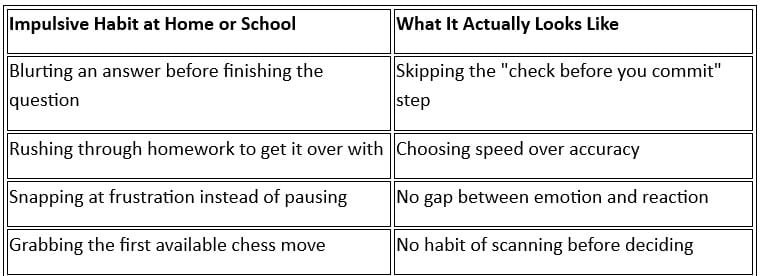
A child grabs the last cookie without checking if it is someone else’s. A homework answer gets written half a second after the question is read, not after. A checkers piece gets slammed down, then regretted out loud. None of this means a child is careless. It usually means the brain’s “wait, let me check” function is still under construction, and most days nothing forces that function to switch on.

Chess does, every single time. More than 25 million children worldwide now play it, according to figures from FIDE, the World Chess Federation, cited in a 2025 Frontiers in Psychology paper (Frontiers in Psychology, 2025). Part of that growth comes from parents who care less about ratings and more about a child who acts first and thinks second.

This is exactly the gap chess teaches children to think before they act, one slow, deliberate move at a time.

Why Do Impulsive Decisions Hold Back a Child’s Learning?

The brain region responsible for pausing before acting, the prefrontal cortex, matures later than the emotional, reactive regions driving a child’s first instinct. That mismatch is not a character flaw, just biology under construction, which is why a seven-year-old can ace a spelling test and still snap at a sibling over a board game the same afternoon.

The stakes are not small. A 2025 study in npj Science of Learning examined how brain structure linked to impulsivity affects academic performance and found that prefrontal cortex activity alone accounted for more than a third of impulsivity’s negative effect on grades (npj Science of Learning, 2025). That research looked at students broadly, not young children specifically, but it describes the same wiring every child is still finishing.

This is precisely the gap that explains why chess teaches children to think before they act more reliably than a lecture about patience ever could: it replaces advice with repetition.

What Does the Decision-Making Process Look Like in a Game of Chess?

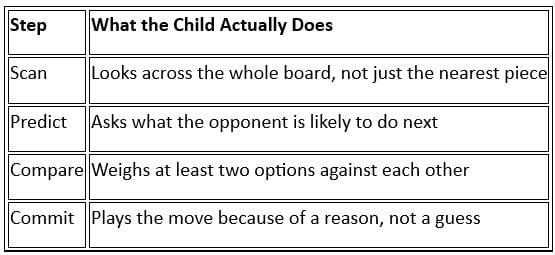
Every legal chess move hides four smaller decisions, and skipping any one gets punished almost immediately on the board.

A hung piece or a missed threat shows up within seconds of skipping a step, a blunter consequence than most schoolwork ever delivers. That bluntness is the entire point behind decision-making in chess for kids: the board, not a parent or teacher, delivers the feedback. Kaabil Kids trains this four-step habit into every lesson rather than hoping a child stumbles onto it, building strategic thinking for kids into the curriculum itself, with trainers regularly pausing a game to ask why a move got played.

How Does Chess Build Patience and Self-Control in Kids?

Patience on a chessboard is not sitting quietly and waiting. It is holding back a move that looks tempting in order to find one that actually works, which takes more discipline than waiting ever does. This active, practised version of chess and patience in children is what separates a calm-looking child from one who has genuinely learned to delay a decision.

A 2025 study published in Frontiers in Psychology compared two groups of kindergarten children, one taught chess as part of regular lessons and one that was not, and recorded measurable gains in patience and self-discipline among the chess group, alongside improvements in attention and logical thinking strong enough that the researchers ruled out chance (Frontiers in Psychology, 2025). The mechanism behind chess and patience in children is straightforward: chess punishes impatience on the spot, through a lost piece or a lost game, far faster than most subjects ever give a child that kind of feedback.

Does This Benefit Apply to Every Child, or Only Naturally Patient Ones?

Parents of restless or easily frustrated kids often assume chess and patience in children only works for someone else’s calmer child. Coaches working with hundreds of children see the opposite. A child who struggles most with pausing usually has the most room to improve, and a chessboard gives that exact skill somewhere safe to be practised, with a result clear within minutes rather than weeks.

None of this happens overnight, and chess should never be framed as a substitute for professional support when a child has a diagnosed condition. Think of it the way a music teacher thinks of scales: progress is gradual, built through repetition.

Where Do These Think-Before-You-Act Skills Show Up in Real Life?

Decision making in chess for kids rarely stays confined to a board. Strategic thinking for kids built through one activity tends to leak into three places parents notice almost immediately.

What Does This Look Like in the Classroom?

A child who has practised scanning a board before moving, the basis of strategic thinking for kids, is more likely to reread a tricky question before answering it, instead of writing down whatever thought arrives first.

What Does This Look Like in Friendships and Sibling Conflict? 

The same gap between impulse and action shows up off the board too. A child who has learned to weigh two responses before committing to one move is more likely to do the same before firing back at a sibling.

What Does This Look Like in Exams and Anything Timed?

Most chess games and puzzles run against a clock, which mirrors the pressure of a timed test far more closely than untimed homework ever could, training a child to decide well under a ticking deadline rather than freeze or rush.

How Does Structured Chess Coaching Reinforce Better Thinking Habits?

Playing chess alone teaches a child to make moves. A coach who asks “why did you play that” after every game is the one who turns the habit into something permanent, since noticing your own impulsive choices without outside feedback is slow and unreliable.

Kaabil Kids builds that feedback loop directly into its online chess classes, treating strategic thinking for kids as a skill to be coached, not assumed. FIDE-rated trainers review a child’s games to flag the moves made without scanning or comparing, turning each into a concrete, repeatable lesson rather than a vague comment. An in-house psychologist supports the emotional side of this, staying composed after a loss instead of reacting to it. Families researching online chess coaching or an online chess tutor for this reason are usually looking for exactly that structured, repeated correction loop.

A pattern this specific does not build itself. It needs a curriculum, designed here by International Grandmaster Tejas Bakre, paired with trainers who treat every game as a chance to catch and correct one impulsive habit at a time, because chess teaches children to think before they act only when someone keeps asking them to explain their thinking.

Frequently Asked Questions

What Do Parents Usually Ask About Chess, Decision-Making and Patience in Kids? Frequently Asked Questions

  1. Does chess actually improve decision-making in children? 

Research backs this up specifically for the skills decision making in chess for kids drills directly: scanning options, predicting consequences, and choosing deliberately rather than guessing. This is the clearest evidence that chess teaches children to think before they act, since a 2025 Frontiers in Psychology study found measurable gains in exactly these areas among children given regular chess instruction.

2. Can chess help an impulsive or hyperactive child? 

It can help build the habit of pausing before acting, since every move offers low-stakes practice at exactly that skill. The link between chess and patience in children works best as a complement to other support, not a replacement for professional guidance where a diagnosed condition is involved.

3. At what age should a child start chess for these benefits?

Most children can begin around age five or six, when the brain is especially responsive to structured practice. Kaabil Kids works with children from age 5 through 15, adjusting pace and complexity to match each stage.

4. How long does it take to see a change in a child’s patience? 

Coaches typically notice early shifts within a few months of regular practice, though change tends to be gradual, the same way any new habit takes repetition before it becomes automatic.


Kaabil Kids turns that repeated correction into a weekly habit rather than a one-off experiment, combining a Grandmaster-built curriculum, FIDE-rated trainers, and in-house psychological support so that the pause a child learns on the board shows up off it, too.

Start with Kaabil Kids’ online chess coaching for kids to see it in practice.

A daily chess practice routine for kids doesn’t need hours. Learn how to split 20–30 minutes across puzzles, games and review so your child actually improves.

Most chess parents know this routine: lessons on Tuesday, a flurry of games before Saturday’s tournament, then silence until next Tuesday. The board collects dust, the puzzle app sits unopened, and everyone wonders why progress feels slow despite a child who clearly loves the game.

Online chess has exploded well past hobby status. Chess.com alone crossed 200 million members in April 2025, with more than 20 million games played on the platform every single day as per reports. Your child isn’t just playing a board game anymore. They’re stepping into one of the fastest-growing online communities on the planet.

Here’s the reassuring part. A real chess practice routine for kids doesn’t need hours. It needs a rhythm that survives school nights, siblings, and the occasional Tuesday meltdown, the same rhythm that good online chess coaching is designed to reinforce.

Why Does Consistency Matter More Than Natural Talent in Chess? 

Parents often assume some kids are simply “chess kids,” wired for the game in a way others aren’t. Coaches who have watched thousands of students disagree. Chess improvement behaves like a skill, not a gift, so it responds to repetition far more than to raw aptitude.

A 2025 study published in Frontiers in Psychology found that young children who received regular, structured chess instruction showed statistically significant gains in attention, memory, logical thinking, and even math scores compared with children who didn’t, with results strong enough that the researchers ruled out chance entirely (Frontiers in Psychology, 2025).

Translate that for a Tuesday-to-Saturday household: a child who plays 15 to 20 focused minutes daily for a year will usually out-improve a child who plays for two hours once a week. The brain treats chess the way it treats a language or an instrument, which is exactly why a proper chess practice routine for kids beats sporadic marathon sessions. Small, frequent reps beat occasional long ones.

What Does an Ideal Daily Chess Practice Routine Look Like for a Beginner? 

Forget elaborate study plans. A beginner’s daily chess practice routine for kids fits into three short blocks totaling roughly 30 minutes.

Time| Activity| Why It Works
5-10 min| Tactics puzzles| Sharpens pattern recognition before the real game begins
10-15 min| One full game| Forces real decision-making instead of theory
5-10 min| Reviewing that game| Turns a loss into a lesson instead of a forgotten memory

The order matters more than the exact minutes. Puzzles warm up the brain, the game applies it, and the review locks in whatever almost worked. Skip the review step, and a child can play hundreds of games while repeating the same three mistakes.

This is the exact rhythm Kaabil Kids builds into its beginner track, with weekly assignments and live sessions following the same warm-up, play, review structure, so a child isn’t left guessing what to do with their 30 minutes.

How Should Kids Split Practice Time Between Tactics, Games and Analysis? 

Once the basics are solid, the split deserves more thought.

Practice Activity| What It Builds
  • Tactics puzzles
| Pattern recognition and faster calculation
  • Playing full games
| Decision-making under real-time pressure
  • Reviewing and analysing games
| Spotting the mistake that keeps repeating

Most kids default to puzzles because solving one feels like an instant win. Analysis gets skipped because it feels like homework. That is a problem, since reviewing games is the activity most directly tied to actual rating improvement. Good daily chess practice for kids gives roughly equal time to all three, with a tilt toward analysis once a child starts taking tournaments seriously.

How Long Should a Daily Chess Session Be at Different Ages?

A five-year-old and a fourteen-year-old should not be handed the same practice schedule. Most child development guidelines suggest kids can hold focused attention for roughly two to three minutes per year of their age, so a daily chess practice routine for kids works best when it respects that ceiling instead of fighting it.

Age Group| Suggested Daily Practice Time
5-7 years| 10-15 minutes
8-10 years| 15-25 minutes
11-13 years| 25-40 minutes
14-15 years| 40-60 minutes

These are starting points, not contracts. A consistent 10 minutes beats an ambitious 40 that quietly stops happening by week two.

What Mistakes Do Kids Most Often Make When Practising Chess on Their Own?

Five mistakes show up again and again in independent practice:

None of these means a child lacks talent. They usually just mean nobody has shown them what a useful chess practice routine for kids, built on daily chess practice for kids rather than occasional bursts, actually looks like.

How Can Parents Help Kids Stick to a Daily Chess Routine?

Parents cannot force consistency, but they can remove the friction that kills it, the same friction that pushes many families toward chess classes for kids once home routines start slipping.

Pick a fixed slot tied to something that already happens daily; right after breakfast works far better than “sometime today.” Save corrections for the review step instead of pausing mid-game, since constant interruptions teach a child to wait for answers rather than find them. Praise the habit itself, not just the wins; a losing streak followed by quitting is worse than a losing streak followed by Tuesday’s session happening anyway. A simple sticker chart works wonders for younger kids, who chase a visible streak rather than an abstract rating number.

When Does a Child Need Structured Coaching Instead of Just Independent Practice? 

A home routine carries most kids a long way, until it doesn’t. The common stalling point looks like this: a child keeps playing, keeps solving puzzles, and somehow keeps making the same three mistakes without realising it, because nobody is flagging the pattern. This is usually when families first start researching online chess coaching.

That is the gap that structured chess classes for kids are built to close. Kaabil Kids runs an online chess coaching programme for children aged 5 to 15, with a curriculum designed by International Grandmaster Tejas Bakre and delivered by FIDE-rated trainers across beginner, intermediate and advanced levels. Weekly assignments slot into that same daily rhythm, tournaments give the practice somewhere to go, and an in-house psychologist supports focus and mindset alongside the chess itself.

It helps to remember the scale of what these kids are stepping into. The reigning World Chess Champion, Gukesh Dommaraju, is Indian. The next name on that list is probably finishing homework somewhere right now.

Frequently Asked Questions

What Do Parents Most Often Ask About Daily Chess Practice for Kids? 

How much should a kid practice chess every day?

Most beginners do well with 10 to 30 minutes a day, depending on age, split between a tactics warm-up, one game, and a short review. A workable chess practice routine for kids depends more on showing up most days of the week than on hitting an exact number of minutes.

What is the best daily chess practice routine for a beginner? 

A simple three-part routine works best: 5-10 minutes of tactics puzzles, one full game of 10-15 minutes, and 5-10 minutes reviewing that game afterward. This keeps daily chess practice for kids short enough to repeat every single day without burnout.

How can parents help kids stay consistent with chess practice?

Attach practice to an existing daily habit, save feedback for after the game instead of during it, and praise showing up rather than only winning. A visible streak tracker often does more for motivation than talk of ratings.

Is daily practice better than just taking a weekly chess class?

A weekly class introduces new ideas, but without daily practice between classes those ideas rarely stick. The two work best together, with short home sessions reinforcing what a coach teaches each week, whether that coach comes from a school programme, chess classes for kids, or dedicated online chess coaching.


A chess practice routine for kids does not need to be long, dramatic, or supervised down to the minute. It needs to be short, daily, and occasionally reviewed, which is a far easier habit to maintain than a two-hour Sunday session that quietly falls off by spring.

Kaabil Kids gives kids aged 5 to 15 that exact structure through chess classes built around a Grandmaster-designed curriculum, FIDE-rated trainers, and a weekly rhythm that turns daily practice into measurable progress instead of one more thing to nag about.

Explore Kaabil Kids’ online chess coaching for kids to get started

Chess is more than just a game; it is a battle of the mind, requiring strategy, foresight, and discipline. With the increasing popularity of online chess platforms, young players have the opportunity to refine their skills with the help of expert coaches. A trusted platform recognizes the importance of structured training and offers chess lessons online to help students excel in competitive play. 

The Importance of Online Chess Learning 

Many beginners start their chess journey by playing casually with friends or family. However, to improve and compete at higher levels, proper coaching is a must. A chess coach online provides personalized guidance, helping students understand strategies, tactics, and essential gameplay principles that are not when playing alone. 

1. Expert Coaches with Proven Experience 

Online chess coaching provides experienced coaches who have competed in national and international tournaments. These experts guide students through the following: 

2. Flexible Scheduling for Convenience 

Unlike traditional chess classes, online chess coaching offers flexible scheduling. Students can: 

3. Safe and Interactive Learning Environment 

Safety is a top priority.  The online platform ensures a friendly learning environment where students can: 

4. Personalized Training for Faster Improvement 

Unlike self-learning, where players may struggle to identify mistakes, online coaching provides structured lessons tailored to the student’s strengths and weaknesses. With a chess coach online, students receive individual attention, allowing them to grasp complex concepts more effectively. 

5. Developing Critical Thinking and Strategic Planning 

Chess is a game of logic and decision-making. Learning under a coach ensures that players develop critical thinking skills and strategic planning abilities. A coach guides students on: 

6. Learning the Importance of Openings, Middle Game, and Endgame 

One of the key aspects of chess training is understanding the three phases of the game—openings, middle game, and endgame. Many players struggle because they lack structured knowledge in these areas. 

Through chess lessons online, students can systematically improve their understanding of these phases under expert guidance. 

How Online Chess Coaching Prepares for Competitive Play 

Competing in chess requires a high level of discipline, mental stamina, and practice. Online chess coaching provides a competitive edge by equipping students with the right training. 

1. Exposure to a Competitive Environment 

A chess coach online helps students simulate real tournament conditions by: 

These factors prepare students mentally and strategically for real-world competitions. 

2. Access to Advanced Training Resources 

Online Chess Class provides access to valuable learning materials, including: 

These resources ensure that students have the best possible training for competitive chess. 

3. Developing Consistency and Discipline 

To excel in any competitive field, consistency is key. Online chess coaching infuses discipline by: 

Conclusion 

In today’s world, online chess coaching is important for anyone looking to improve their game. Kaabil Kids offers top-notch chess lessons online, ensuring that students develop strong analytical skills, strategic thinking, and competitive discipline. 

Whether your child is just starting or already playing at an advanced level, a chess coach can make all the difference in achieving excellence in the game. Invest in the future of your child’s chess journey with us and watch them grow into confident and competitive players. 

Do you ever think how chess can be turned more mind-blowing? Chess has always been a game of skill, patience, and smart moves. Players spend years learning strategies, memorising openings, and perfecting their endgame. But what if chess could be more exciting and less predictable? That’s where Freestyle Chess comes in. This new version makes the game more creative and fun. It’s becoming popular, thanks to world champion Magnus Carlsen. He enthusiastically endorsed this version of chess. At Kaabil Kids, we are excited to bring Freestyle Chess to our online chess classes for kids. It’s a fresh and exciting way to learn and enjoy the game. 

Understanding Freestyle Chess 

Freestyle Chess, also called Chess960, was created by chess legend Bobby Fischer. In regular chess, pieces always start in the same position. But in Freestyle Chess, the back-rank pieces are randomly placed in 960 different ways. This small change makes a big difference. Each game is unique, and players can’t just rely on memorised moves. They have to think on their feet and use the real strategy from the very first move. 

What Makes Freestyle Chess Different? 

This fresh and exciting format makes chess more engaging, challenging players in a way that traditional chess does not. 

Magnus Carlsen’s Influence on Freestyle Chess 

Magnus Carlsen, the world’s highest-rated chess player and multiple-time world champion, is a strong advocate of Freestyle Chess. He believes that this version of the game restores the unpredictability and excitement that can sometimes be missing in classical chess. Carlsen has participated in and won several Chess960 tournaments, demonstrating his extraordinary ability to adapt and think creatively. 

His endorsement has played a crucial role in increasing the visibility and popularity of Freestyle Chess. As more players watch and admire Carlsen’s performances, interest in this version of chess has skyrocketed. Many chess enthusiasts and newcomers are now embracing the game for its thrilling nature and intellectual depth. 

The Growing Popularity of Freestyle Chess 

Freestyle Chess is quickly becoming a global phenomenon. Its appeal lies in its ability to offer something fresh and unique, making it an attractive option for players of all levels. Here’s why more and more chess lovers are turning to Freestyle Chess: 

As the game continues to grow in popularity, chess academies and online learning platforms are beginning to integrate it into their curriculum, ensuring that players are prepared for the modern evolution of chess.  

Why Expert Coaching is Essential for Freestyle Chess 

Freestyle Chess is a fun and creative way to play. Expert coaching can help you improve your skills faster and smarter. Here’s how it can make a difference. 

1. Faster Learning: Expert coaches simplify complex strategies. They show you the quickest path to mastering Freestyle Chess. 

2. Personalized Tips: Coaches understand your unique style. They offer advice that matches your strengths, helping you play better. 

3. Real-World Experience: With years of playing and teaching, experts know the game inside and out. They give you insights that go beyond the basics. 

4. Creative Thinking: Freestyle Chess is all about flexibility. Coaches help you develop creative strategies and adapt to new situations. 

5. Continuous Motivation: Expert coaches keep you motivated. They push you to improve and stay on track with your goals. 

6. Access to Better Tools: Coaches have the best tools and resources. They use them to help you practice and learn more effectively. 

In short, expert coaching in Freestyle Chess speeds up your learning, boosts your creativity, and gives you the confidence to tackle any challenge. Whether you’re a beginner or an experienced player, coaching helps you level up. 

Benefits of Learning Chess Online with Kaabil Kids 

Online learning offers numerous advantages, making it an excellent choice for young chess enthusiasts. Here’s why our online chess classes at Kaabil Kids are the perfect fit: 

If you’re looking for chess for beginners online, our program provides the perfect foundation. Whether your child is just starting or an advanced player, our structured lessons ensure continuous growth and improvement in their chess journey.  

Conclusion 

With Magnus Carlsen, Freestyle Chess is changing the world of chess, making it more unpredictable and exciting. It is with such a modern version of chess that we are eager to introduce at Kaabil Kids to keep the students engaged and challenged continuously. 

Whether it’s for a young one just starting out or in learning to hone one’s skills better, our online chess classes are the ideal setting where both classical and Freestyle Chess would be nicely explored and mastered. 

Join us today, and let’s unlock the exciting possibilities that modern chess has to offer! 

The World Chess Championship 2024 is one of the most desired tournaments in chess history. Two exceptional grandmasters, Gukesh Dommaraju and Ding Liren, are set to clash on the grand stage. This year’s championship isn’t just a test of strategic brilliance but also a captivating narrative of rising stars and seasoned veterans battling for supremacy.  

This event is set to inspire both new and experienced players. It also shows how chess is becoming more popular, thanks to online chess classes and platforms that help players improve their skills. Let’s explore the format, competitors, predictions, and betting odds that make the 2024 championship a thrilling spectacle. 

Format and Key Details of the Championship 

The World Chess Championship 2024 follows a well-established format designed to ensure fair play and excitement for fans and players alike. Here are the critical details: 

  1. Schedule: The championship will span 14 rounds. 
  2. Scoring: The first player to score 7.5 points or more will be declared the winner. Each game awards one point for a victory and half a point for a tie. 
  3. Rules for Draws: Players cannot agree to a draw before Black’s 40th move. 
  4. Tiebreak: If both players are tied after 14 rounds, four rapid games (25 minutes per side) will determine the winner. The first player to score 2.5 points beats the tiebreak. 
  5. Time Control
  6. Each participant has 120 minutes to accomplish the first 40 moves, followed by 60 minutes for the next 20.  
  7. 15 minutes per player for the remaining game. 

Meet the Competitors 

Gukesh Dommaraju: The Genius on the Rise 

Gukesh Dommaraju, who is only 18, is becoming famous in the chess world. Gukesh, who had just won the FIDE Candidates Tournament, became the tournament’s youngest winner in history.  

As the second Indian to qualify for the World Chess Championship, after the legendary Viswanathan Anand, Gukesh carries the hopes of a nation eager for another world champion.  

His success has inspired many young players to start learning chess. Parents are now choosing online chess classes for kids to help their children develop their skills. 

Key Achievements: 

Strengths: 

Challenges: 

Ding Liren: The Defending Champion 

Ding Liren, the reigning FIDE World Chess Champion, enters the 2024 championship with both experience and a point to prove. He clinched the title in 2023 after defeating Ian Nepomniachtchi in a thrilling tiebreak. However, Ding has faced a challenging year, with critics questioning his current form and competitive drive. 

Key Achievements: 

Strengths: 

Challenges: 

Analysis and Predictions 

Why Gukesh Could Win: 

Why Ding Could Win: 

While Gukesh is the favorite, Ding’s experience and strategic depth could make this a closer contest than the odds suggest. Expect a tightly fought match, potentially decided in a rapid tiebreak. 

Conclusion 

The World Chess Championship 2024 promises to be a thrilling spectacle, showcasing the clash of talent, strategy, and determination. Will Gukesh’s meteoric rise culminate in a historic victory, or will Ding Liren draw on his experience to defend his title? The chess world waits with bated breath as these two grandmasters prepare to write the next chapter in chess history. 

Whether you’re cheering for the young prodigy or the defending champion, this match will undoubtedly be one for the ages. Inspired by these legendary players, many enthusiasts are turning to professional chess academy to master the game. 

In today’s fast-paced environment, finding time to explore personal hobbies might be difficult. Most individuals struggle to find time for activities that will help them grow intellectually or acquire new abilities, whether it’s because of job, school, or family obligations. Chess, long regarded as a game of strategy and intelligence, is one of those skills that many people want to acquire but don’t have the time. Fortunately, the emergence of online learning platforms has made studying chess simpler and more accessible than ever before.

This article delves into why learn chess online is ideal for hectic schedules. It enables flexibility, ease, and tailored learning routes while encouraging mental development and providing an engaging activity.

1. Learn Chess Online: Flexible Learning Anytime, Anywhere

One of the most significant benefits to learn chess online is the freedom it provides. In-person chess lessons involve a specific time, a place, and adherence to a schedule. This might be quite challenging for someone who has a hectic lifestyle. Online chess platforms, on the other hand, allow you to access lessons whenever it is convenient for you—during a lunch break, while commuting, or late at night after everything else has been completed.

Online chess tools, such as websites, apps, and video lessons, let you study at your own speed. There is no need to attend a class at a certain hour. You may decide when to play when to learn, and how long you want to spend on each session. This degree of flexibility is excellent for somebody with a hectic schedule who just has a few minutes to spare each day.

2. Various Learning Tools

Learning chess online gives you access to a variety of tools and materials that can be customised to various learning styles and levels of expertise. Whether you’re a novice or want to improve your expert strategy, online chess platforms provide something for everyone.

Interactive Lessons: Many chess websites include interactive lessons that walk you through the fundamentals or advanced strategies. These classes often contain quizzes and activities to enhance learning.

Video lessons: For visual learners, video lessons offered by chess experts break down complicated concepts into manageable pieces.

Chess problems: Online platforms commonly provide daily chess problems that may be completed in minutes, offering mental stimulation even during brief pauses.

AI-Powered Matches: Students can practice without the strain of confronting another person by playing against computer-generated opponents at varying skill levels. AI also analyses movements and suggests areas for development.

Using these tools, students may concentrate on their deficiencies and improve their abilities in areas that they find most difficult, all in their own time.

3. Self-paced learning

In typical chess sessions, the speed is often set by the group or the teacher, which may not be suitable for everyone. If you’re juggling other responsibilities, you may require extra time to comprehend particular ideas or skip classes that seem simple. Online chess learning programs provide you with total control over the pace at which you study.

If you’re having trouble grasping a subject, such as a pawn structure or opening theory, you may go over it again until it makes sense. Conversely, if you already grasp the fundamentals, you may go on to more complex subjects in chess for beginners online. This degree of customisation is critical for those with limited time, enabling you to make the most of each learning session.

4. Cost-effective and accessible

Enrolling in in-person chess sessions or hiring a private tutor may be costly, with expenses adding up over time. For those with busy schedules, the expense of transportation and the time spent getting to and from courses may mount up. Online chess platforms, on the other hand, provide a much more economical option.

Many online chess platforms are free or provide premium subscriptions for a fraction of the cost of conventional teaching. Platforms like Kaabil Kids offering chess coach online, with the possibility of unlocking extra features via subscription plans. With so many resources available, studying chess online becomes a cost-effective choice while still providing high-quality training.

5. Opportunity for Social Interaction

A widespread misperception about studying chess online is that it is a solitary pastime. In truth, internet chess groups are thriving and very engaging. Many systems allow you to play against real opponents from all over the globe, compete in live tournaments, and join forums or discussion groups to exchange techniques and game insights.

Live Games and Tournaments: Whether you have 5 minutes or 2 hours, there’s always time to play a live game or join a tournament, regardless of your skill level. This might help you develop your abilities and stay motivated.

Forums and Chat Groups: Most online platforms have community elements, such as forums or chat rooms, where users may ask questions, debate strategies, and even meet new friends. You may learn from others and share your progress, fostering a feeling of community that will drive your chess adventure.

These elements provide the social side of learning that you would find in a regular chess club but without the need for physical presence or schedule issues.

6. Mental benefits and cognitive flexibility

For people with hectic schedules, mental clarity and cognitive sharpness are essential for efficiently handling various responsibilities. Chess is recognised for sharpening the intellect, increasing memory and problem-solving abilities, and promoting creativity. By adding online chess lessons from chess coach online into your daily routine, you may reap cognitive benefits in little doses.

Memory Improvement: Chess needs complicated patterns and tactics, which aids in both short-term and long-term memory.

Problem-Solving Skills: Each chess move involves critical thinking and evaluation of various potential outcomes, which improves decision-making ability.

Cognitive Flexibility: Chess teaches you to adjust to changing conditions, which is a valuable ability in daily life, particularly when dealing with the unexpected.

Playing online chess for even 10-15 minutes each day may serve as a mental exercise, clearing your thoughts and preparing you for future duties.

7. Stress Reduction and Enjoyment

Taking a mental break from a hurried existence is essential, and chess may be a peaceful but intellectually interesting method of decompressing. Chess academy online lets you enjoy the game without worrying about time limits. The ease of accessing it on your phone or laptop allows you to play a brief game anytime you need a break from your hectic schedule.

Many individuals believe that playing chess relieves stress by distracting their thoughts from their everyday tasks. The game involves attention and planning, enabling you to temporarily divert your focus away from any stressors or problems in your life.

Conclusion

Integrating chess into your hectic schedule is no longer a pipe fantasy. Because of the flexibility, affordability, and customised experiences provided by online platforms, anybody may learn chess at their own speed, regardless of how busy their schedule is. With its many mental and social advantages, online chess study is an excellent activity for people wishing to better their lives while maintaining their daily duties.

Whether you want to enhance your problem-solving skills, discover a peaceful activity, or push yourself intellectually, Kaabil Kids the top chess academy online strikes the ideal combination of ease and advancement. So, why not learn chess this year from the comfort of your own home?

Chess, a game of strategy, skill, and intelligence, has fascinated people for ages. While many individuals love playing chess recreationally, there is a substantial difference between casual play and professional chess instruction. Professional chess instruction classes are meant to help you comprehend the game, develop your abilities, and prepare for competitive play. Professional chess instruction may be very beneficial for both beginners and experienced players wishing to improve their abilities and strategy. This article will explain what to anticipate from professional chess training sessions and how they may help you improve your game.

Things to Expect in Professional Chess Training

Personalized Coaching and Assessment

One of the key advantages of professional chess instruction is customized teaching. Unlike generic educational resources, expert trainers customize their teaching techniques to meet your specific requirements. Here’s what to expect:

Initial evaluation

Your training will start with an evaluation of your present skill level. This helps the coach identify your skills, shortcomings, and opportunities for progress.

Customized Training Plan

Based on the evaluation, your coach will create a training plan that is tailored to your requirements. This strategy will include academic information, practical tasks, and game analysis.

One-on-One Sessions

Personalized coaching often includes one-on-one sessions in which the coach may give you undivided attention, answer your questions, and provide fast feedback.

In-depth Game Analysis

Analyzing chess games is a vital step toward developing your abilities in online chess classes. Professional instruction sessions will include an in-depth examination of your previous games as well as those played by grandmasters. This technique involves:

Identifying errors

Your coach will assist you in identifying errors and lost chances throughout your games. Understanding these faults is critical to preventing them in the future.

Analyzing games 

This enables you to see patterns and repeating themes in chess. This information may help you think more strategically and make better decisions.

Learning from Grandmasters

Studying games performed by elite players allows you to grasp advanced tactics and approaches. Your instructor will lead you through these games, explaining the reasoning behind each action.

Open Repertoire Development

The first phase of a chess game establishes the foundation for the remainder of the game. Professional instruction will help you build a powerful opening repertoire. This involves:

Choosing Openings

Your coach will help you determine which openings best suit your playing style and preferences. Whether you favor aggressive or defensive techniques, some opportunities match your abilities.

Learning philosophy

Understanding the philosophy behind different openings is critical. Your coach will teach you the key lines, variations, and typical traps for your selected openings.

Practical Application

Knowing the theory isn’t enough; you also need to experience implementing it in actual games. Your coach will provide you with workouts and simulations to assist you in strengthening your opening knowledge.

Middlegame Strategy

The middle game is where the actual combat of chess occurs. Professional instruction focuses on improving your middle techniques through:

Improving your tactical talents is critical for success in the middle game. Your coach will assign riddles and exercises to help you improve your ability to identify tactical chances.

Positional Understanding

In addition to tactics, you must comprehend positional principles such as pawn structure, piece activity, and control over crucial squares. Your coach will show you how to analyze and improve your position.

Planning and execution are critical in the middle game. Your coach will assist you in developing programs tailored to the specifics of your job.

Endgame Techniques

Mastering the endgame is frequently what distinguishes decent players from great ones. Professional chess instruction offering online chess classes will involve a complete endgame study.

Basic Endgames

You’ll begin with simple endgames like king and pawn vs. king, then advance to more challenging situations. Your coach will guarantee that you learn the fundamentals of endgame play.

Advanced Endgames

 As you progress, you will learn increasingly complex endgames with many pieces. This involves mastering fundamental methods like opposition, triangulation, and zugzwang.

Practical Endgames

Your coach will provide you with practical tasks to help you improve your endgame understanding. These tasks will help you apply theoretical principles in real-world scenarios.

Psychological Preparation

Chess is a game of both talent and mental grit. Professional training sessions will focus on the psychological elements of chess:

Managing Pressure

Competing in competitions may be difficult. Your coach will educate you on how to handle pressure and remain focused during vital situations.

Building Confidence

Success in chess requires confidence. Your coach will help you develop confidence via practice, positive reinforcement, and mental conditioning activities.

Developing a Winning Mindset

A good attitude is critical for attaining your objectives. Your coach will help you establish a resilient and positive mentality, allowing you to overcome obstacles and remain motivated.

Regular Practice and Homework

Chess improvement demands constant practice and perseverance. Professional training sessions will include frequent practice assignments and homework.

Practice Games

You will play practice games regularly to apply what you’ve learned. Your coach will examine these games and provide comments and coaching.

Puzzles and Exercises

Your coach will offer tactical puzzles, endgame exercises, and other practice materials to help you improve your abilities.

Study Plans

You will get study plans that are suited to your specific requirements. These programs will contain reading materials, video lectures, and other tools to help you study beyond your training sessions.

Participating in tournaments

Competitive play is a critical component of chess progress. Professional training sessions will prepare you to participate in tournaments.

Tournament Preparation

Your coach will walk you through the process of preparing for tournaments, such as creating a game plan, researching your opponents, and scheduling your time.

Game Analysis

Following each event, your coach will review your games to help you learn from your experiences and find areas for growth.

Technology Integration

Modern chess teaching sometimes includes technology to improve learning:

Chess Software

You will use chess software to analyze games, research openings, and practice strategies. Your coach will show you the best tools available.

Online Resources

Several online chess classes include instructional videos, puzzles, and practice activities. Your coach will offer materials that are relevant to your training objectives.

Virtual Coaching

Many experienced coaches offer virtual coaching in addition to in-person meetings. This enables flexible scheduling and access to elite instructors regardless of location.

Goal Setting and Progress Tracking

Professional chess training is a journey, and establishing objectives is vital for remaining motivated and tracking progress.

Short-Term Objectives

Your coach will assist you with setting attainable short-term objectives, such as increasing your rating, mastering a specific opening, or completing a certain amount of puzzles each week.

Long-term objectives—These may include hitting a certain rating milestone, winning a tournament, or earning a title such as FIDE Master or Grandmaster.

Development Tracking

 Your coach will provide you with regular evaluations and comments to help you measure your development. This involves examining your game performance, identifying areas for growth, and making adjustments to your training plan as appropriate.

Conclusion

Professional chess coaching classes provide an immersive and structured experience designed to strengthen your game. No matter whether you are just learning the fundamentals or an experienced player looking for ways to perfect their strategies, Kaabil Kids provides invaluable insights and personalized guidance – making the investment worth its weight in gold! Expect a blend of theoretical instruction, practical exercises, and real-time feedback tailored to your unique strengths and weaknesses. With the assistance of our experienced coaches, you’ll hone critical thinking skills, improve decision-making under pressure and deepen your understanding of this timeless game. 

Are you seeking out ways to ensure your child’s summer days are both enjoyable and enriching? Consider the remarkable option of online chess classes. While the mention of summer camps typically brings to mind images of outdoor escapades and physical activities, including chess, into the mix introduces a whole new dimension of benefits that go well beyond the confines of the chessboard. Let’s delve into why online chess training deserves a prime spot on your child’s summer camp agenda.

Mental Gymnastics

The mental workout provided by chess is unparalleled. Each move requires players to engage in a complex interplay of strategy, foresight, and calculation. Through online chess classes, your child will exercise their cognitive muscles, honing skills such as problem-solving, critical thinking, and decision-making. These mental gymnastics not only enhance their chess proficiency but also have a ripple effect, positively impacting their academic performance and everyday problem-solving abilities.

Strategic Mindset

In chess, every move counts, and every decision has consequences. Through online summer vacation classes for kids, your child will cultivate a strategic mindset – learning to analyse the board, plan ahead, and anticipate their opponent’s moves. These skills are not confined to the chessboard; they transcend into various aspects of life, from academic pursuits to career endeavours. Your child will benefit greatly from early mastery of the skill of strategic thinking, as it will help them navigate the challenges of the real world. 

Focus and Concentration

In a world inundated with distractions, chess demands unwavering concentration. Your youngster will improve their ability to stay focused for extended periods by taking online chess classes. Whether it’s analysing intricate positions or devising long-term strategies, the concentration skills honed through chess transcend the boundaries of the game board, benefiting their academic endeavours, professional pursuits, and daily tasks.

Memory Mastery

Chess is not just about making moves; it’s about remembering patterns, strategies, and past games. By regularly engaging in online summer camps, your child will sharpen their memory skills. From recalling different opening variations to analysing their opponent’s previous moves, chess exercises the memory muscles in a way that translates into tangible benefits in academic endeavours, professional pursuits, and everyday life tasks.

Patience and Resilience

In the game of chess, victories and defeats are part of the journey. Losing a game teaches resilience while winning instills humility. Through online summer vacation classes for kids, your child will learn to accept defeat gracefully, bounce back from setbacks, and carry on in the face of challenges. These invaluable life lessons extend far beyond the chessboard, shaping your child into a resilient individual capable of going through the ups and downs of life with grace and perseverance.

Social Interaction

Despite its reputation as a solitary pursuit, chess is inherently social. Through online platforms, your child will interact with peers from diverse backgrounds, fostering social skills, empathy, and a sense of camaraderie. Online chess classes provide a platform for meaningful interactions, where friendships are forged, ideas are exchanged, and bonds are strengthened, enriching your child’s social experience and expanding their worldview.

Accessibility and Flexibility

Online classes offer unparalleled accessibility and flexibility. Your child can partake in classes from the comfort of home, eliminating the need for transportation and accommodating busy schedules. Whether it’s a midday session or a late-night match, online platforms offer convenience without compromising on quality, making chess education accessible to children from all walks of life.

Global Exposure

One of the most fascinating aspects of online chess is its global reach. Through virtual platforms, your child can compete against opponents from around the world, gaining exposure to diverse playing styles, cultures, and perspectives. This global exchange fosters adaptability, creativity, and a broader worldview, enriching your child’s understanding of the world beyond their immediate surroundings. Incorporating online chess into summer vacation classes for kids adds an international dimension to their learning experience, making it both educational and exciting.

Lifelong Learning

Chess is not just a game for the summer; it’s a lifelong pursuit. By starting early, your child can develop a lifelong passion for this intellectually stimulating activity. Online chess classes provide a gateway to a world of endless learning, exploration, and growth, instilling in your child a love for learning and a curiosity that transcends the boundaries of the chessboard.

Academic Advantages

Numerous studies have demonstrated a correlation between chess and academic success. The skills acquired through chess – such as logical reasoning, spatial awareness, and pattern recognition – can translate into improved performance in subjects like mathematics, science, and language arts. By integrating chess into your child’s summer camp experience, you’re laying a solid base for their academic journey, raising them in school and beyond.

Cost-Effective Learning

Compared to traditional summer camp activities, online chess classes are often more affordable. Many platforms offer free resources, tutorials, and trial sessions, making them accessible to families of all socioeconomic backgrounds. Investing in your child’s intellectual development through these classes is not just a wise decision – it’s a cost-effective one, too, offering high-quality education without breaking the bank.

Personalised Instruction

Online classes often provide personalised instruction tailored to your child’s skill level and learning style. Experienced instructors guide students through lessons, offer feedback on gameplay, and provide individualised support when needed. This personalised approach makes sure that your child receives the attention and guidance necessary to thrive in their chess journey, maximising their potential and fostering a lifelong love for the game.

Tournament Preparation

For the more competitive-minded, online chess classes offer preparation for local and national tournaments. These events provide an opportunity for your child to showcase their skills, compete against peers, and gain recognition for their achievements. Additionally, tournaments foster sportsmanship, resilience, and a healthy competitive spirit – qualities that are invaluable both on and off the chessboard, preparing your child for success in all areas of life.

Safety and Convenience

In today’s fast-paced world, safety is paramount. Online chess classes provide a safe and convenient learning environment, minimising the risk of exposure to illness, accidents, or other hazards. Whether it’s a burning summer day or a rainy afternoon, your child can embark on their chess journey from the comfort and safety of home, allowing them to focus on learning and growth without any unnecessary distractions or concerns.

Conclusion 

Online chess classes offer a myriad of benefits that enrich your child’s summer camp experience. From enhancing cognitive skills to fostering social interaction, the advantages of chess extend far beyond the game board. By integrating these classes into your child’s summer itinerary, you’re providing them with a platform for intellectual growth, personal development, and lifelong learning.

With Kaabil Kids, the best online chess training platform, your child will experience online chess coaching from professional chess trainers. Our platform offers personalised instruction tailored to your child’s skill level and learning style, ensuring they receive the attention and guidance needed to thrive in their chess journey.

So why wait? Enrol your child in Kaabil Kids’ online chess classes today and watch as they embark on a journey of discovery, exploration, and mastery. Give your child the gift of chess and set them on the path to success both on and off the chessboard.

Hey there, chess enthusiasts! Feeling excited to conquer the chessboard and master the game? We get it. Chess is a thrilling game of strategy, logic, and a whole lot of fun. But sure, it takes time and practice to become a chess champion. That’s where these six quick chess tricks come in—they’ll give you a head start and help you see those victories flourishing on the board!

Learning chess online is a fantastic way to begin your chess journey. It offers flexibility, access to experienced trainers, and a safe environment to practice in. Platforms like Kaabil Kids provide structured courses and interactive learning to learn chess online. Now you can take chess training online and master it all from the comfort of your home!

So, let’s get started then! Here are six powerful chess tips to elevate your game:

1. Master the Art of the Checkmate: The Ultimate Goal

This might seem obvious, but understanding how to checkmate your opponent is crucial. There are different ways to achieve checkmate, but most involve strategically trapping the opponent’s king with no escape route. Familiarize yourself with the various checkmate patterns—king and queen, king and rook, etc. This knowledge will guide your moves and help you identify winning opportunities in the blink of an eye.

How to Practice:

Dedicate some time to learning the most common checkmate patterns. There are plenty of resources online and in chess books that showcase these patterns with clear explanations.

Look for online chess puzzles or grab a chess book with tactical exercises specifically focused on checkmates. Solving these puzzles will train you to recognize checkmate opportunities in real games.

As you play, don’t just focus on the immediate moves. Try to visualize potential checkmating scenarios a few moves ahead. This will help you plan your strategy with a clear end goal in mind.

2. Think Like Your Opponent

Chess is all about outsmarting your opponent. A great way to do this is to think from their perspective. Ask yourself: “If I were in their shoes, what move would I make?” By anticipating their moves, you can plan your own strategy more effectively and counter their attacks before they even happen.

How to Develop This Skill:

Look at your opponent’s pieces and ask yourself: “What are their threats?” Are they trying to control the center? Launch an attack on your kingside? Identifying their potential moves will help you formulate your defense.

Some players are aggressive, while others are more methodical. Understanding your opponent’s style will give you clues about their next move.

Before making a move, take a moment to consider what would happen if you played a different option. Analyzing these “what if” scenarios will help you predict your opponent’s response and choose the best move for the situation.

3. Control the Center of the Board

The center squares (d4, d5, e4, and e5) are like prime real estate on the chessboard. Controlling them gives you more space to maneuver your pieces and launch attacks. Aim to occupy these squares with your pawns or knights early in the game. This will give you a strong foundation for your next moves.

Why is the Center So Important?

By controlling the center, you restrict your opponent’s movement and open up more squares for your own pieces. This allows you to develop your pieces quickly and launch attacks from multiple angles.

Center pawns provide a solid foundation for your piece’s development. They can also be used to create pawn chains, further restricting your opponent’s options.

Controlling the center helps protect your king, as it creates a shield of pawns and pieces around it.

4. Develop Your Pieces Quickly: Get Your Army on the Move!

Don’t leave your pieces hiding at the back of the board – get them into the game! Early development allows you to control more squares and launch attacks on your opponent’s weaknesses. Focus on bringing your knights, bishops, and queen out early, so they can contribute to your strategy.

How to Develop Your Pieces Effectively:

Knights and bishops are more mobile than rooks and queen, so they can be brought out earlier in the game.

Aim to develop your pieces towards the center squares, where they will have the most influence on the board.

While developing your pieces quickly is important, avoid making unnecessary pawn moves that weaken your pawn structure.

5. Don’t Fall for Sacrifices: Outsmarting Bait

Sometimes, your opponent might offer a piece as bait. This could be a trap! Before capturing that juicy piece, take a moment to analyze the situation. Is there a hidden threat waiting for you? Always look two moves ahead and ensure capturing that piece doesn’t put you in a worse position.

How to Avoid Sacrifices:

Before capturing a piece, take some time to think about your opponent’s next move and the potential consequences. Is there a hidden checkmate threat? Will losing that piece weaken your position?

Don’t get greedy and focus solely on capturing material. Sometimes, sacrificing a piece can lead to a better position in the long run. However, only make such sacrifices if you have a clear plan and understand the potential risks.

If you fall for a sacrifice, analyze the game afterward and see where you went wrong. This will help you avoid similar traps in the future.

6. Practice, Practice, Practice! Sharpen Your Chess Skills

The more you play, the better you’ll become. Look for opportunities to practice your skills – play against friends, family, or even online opponents on platforms like Kaabil Kids for chess training online. 

Analyze your games after you play, identify your mistakes, and learn from them. The more you practice, the more comfortable and confident you’ll feel on the chessboard.

How to Make Practice Fun and Effective:

Set aside some time each week to play chess. The more you play, the more ingrained the strategies and tactics will become.

After each game, take some time to analyze your moves. Identify your mistakes and missed opportunities. This will help you improve your decision-making skills.

Playing against different players will expose you to various playing styles and help you develop a well-rounded skillset.

As you improve, seek out challenges that will push you to your limits. This could involve playing against stronger opponents, participating in online tournaments, or trying out new chess puzzles.

There you have it, future chess masters! Remember, these are just a few tricks to kickstart your chess journey. As you practice and learn chess online, you’ll discover even more strategies and tactics. Keep these tips in mind, keep practicing, and you’ll see your chess skills skyrocketing!

Want to explore more?

Join chess training online and check out the amazing courses and resources at Kaabil Kids, India’s best online chess coaching platform for beginners. Follow our trainers’ insights and tips to learn chess online.

Currency
INR Indian rupee