What Happens in an Online Chess Class for Beginners?

The video call connects. The chess board appears on screen. Your child sits there, half-curious, half-suspicious, and you realize you have no idea what the next 45 minutes are supposed to look like.

That uncertainty is the most common reason parents delay booking a class for weeks after deciding chess is worth pursuing. Nobody wants to pay for something they cannot picture. And for chess especially, the imagination tends to jump straight to grandmaster theory and memorized openings, neither of which describes what a beginner actually does.

Online chess classes for beginners look nothing like a lecture and nothing like a self-paced app. This covers what happens in the first session, what a child can do by week four, and what to check before choosing any programme.

The timing matters too. As of December 2024, India has 85 chess grandmasters with 13 ranked among the world’s top 100 players, and following Gukesh Dommaraju’s World Championship victory, chess academies across major cities and tier-two towns are now running at full capacity (Chess in India, Wikipedia, 2024; WION Year-Ender, 2025). The question for parents is not whether chess is worth pursuing. It is how to make sure the class their child joins is actually worth the screen time.

What Do Kids Actually Learn in Their First Online Chess Classes?

Most parents expect openings. Most beginners get something far more useful: the names and movements of all six pieces, how a game starts and ends, and what it means when a king is under threat. That is enough for a first chess lesson for beginners, and a good coach knows it.

By the end of a typical beginner sequence, a child can set up a board independently, spot checkmate in one move, and play a complete legal game without needing prompts from an adult. These are concrete, testable milestones, not vague improvements that are hard to see from the sofa.

Week| What Gets Covered
Week 1| Names and movement of all six pieces; how a game starts and ends
Week 2| Basic captures; understanding checks and how to escape check
Week 3| Simple tactics: forks, pins and basic checkmate patterns
Week 4| Playing a supervised full game with review and one specific goal

Pace matters as much as content in chess lessons for beginners. A child who feels capable at the end of week one is far more likely to return for week two than one who has been rushed into complicated material.

How Do Online Chess Classes Work for Complete Beginners?

A beginner session runs on a video call paired with a shared interactive chess board. The coach demonstrates a position by moving pieces on the shared board, and the child practises on the same board in real time. Nobody is pointing at a physical board and hoping the camera angle is right.

A well-run session has four clear parts:

Time Block| What Happens
0–10 min| Recap of the last lesson; warm-up puzzle or piece-movement drill
10–25 min| New concept introduced with a live demonstration on the shared board
25–40 min| Child practises: guided play, mini game or tactical exercise while the coach observes
40–45 min| Session review; one specific takeaway the child is asked to remember

Kaabil Kids’ online chess classes for beginners follow this live, interactive structure, with FIDE-rated trainers guiding each child through a curriculum designed by International Grandmaster Tejas Bakre. No beginner is left to navigate a lesson sequence alone.

What Skills Are Taught to Beginners in Online Chess Classes?

Chess lessons for beginners cover more than chess. The skills that show up in classrooms and friendships often develop as a side effect of chess-specific training, but a well-designed programme plans for both columns deliberately.

online chess classes for beginners

Most beginner chess coaching handles the chess column well. Kaabil Kids’ in-house psychologist works on the self-regulation row specifically, supporting children through the emotional side of losing a position, which most online programmes leave entirely to chance.

Why Is Learning Chess With a Coach Better Than Learning Alone?

The realistic alternative a parent compares online chess classes for beginners against is apps and YouTube. Both have value. Neither can replicate a coach watching how a child thinks rather than just which square they click.

A child working through puzzles alone can develop the habit of trying the first move that looks appealing, getting it wrong, and trying the next one, without ever building the discipline of checking before committing. That habit, repeated across hundreds of puzzles, is harder to undo later than it is to prevent early with guided instruction.

Youth registrations on online chess platforms have grown 27% since 2023, driven largely by parental interest in cognitive development and structured learning rather than casual play (Online Chess Instruction and Play Market Report, 2025). Parents researching how to learn chess online for kids are not looking for more screen time. They are looking for a coach who watches, corrects and explains, the one thing an app genuinely cannot provide.

Beginner chess coaching fills exactly that gap. A trainer who asks “why did you play that piece?” after every game builds the habit of reasoning out loud, not just moving. That separates useful chess lessons for beginners from simply moving pieces around without thinking. For families evaluating chess classes for kids online, this distinction is the most useful one to carry into a buying decision.

How Do You Choose the Right Online Chess Programme for Your Child?

Online chess classes for beginners vary enormously in quality, structure and what they actually deliver. A useful framework covers five criteria:

Online chess classes for beginners

Kaabil Kids meets every criterion above: FIDE-rated trainers, a Grandmaster-designed curriculum spanning beginner, intermediate and advanced tracks, small-group live sessions, regular tournaments and an in-house psychologist for mindset support. As a beginner chess coaching platform for children aged 5 to 15, it treats all five areas as part of the same programme rather than optional extras.

A child’s first experience of beginner chess coaching is not complicated when the programme is well-designed. They show up, learn the pieces, and leave having done something concrete. That is how chess classes for kids online are supposed to work: each session building on the one before it.

Explore Kaabil Kids’ online chess coaching for beginners | Book a free trial class

What Do Parents Most Often Ask About Online Chess Classes for Beginners? 

What happens in the first online chess class for a beginner?

A well-run first session covers the names and movements of all six pieces, how a game starts and ends, and usually one simple concept such as how the king gets into check. The child practises on a shared interactive board while the coach watches and corrects in real time. No prior knowledge is needed to join online chess classes for beginners, whether you choose to learn chess online for kids or through a local club.

What age can children start online chess classes?

The best age to learn chess online for kids is generally five or six, when pattern recognition develops quickly. Kaabil Kids covers ages 5 to 15, adjusting pace and complexity for each group. Younger children have fewer ingrained habits to unlearn, which makes earlier starts more efficient than later ones.

How long are online chess lessons for beginners?

Most chess classes for kids online run between 45 and 60 minutes for beginners, split across instruction, supervised practice and review. Children aged five to seven do better with sessions at the shorter end; focus tends to hold well up to about 30 to 40 minutes.

What does a child need to join an online chess class?

A device with a camera and a stable internet connection is enough to get started with beginner chess coaching online. No physical chess board is required, since the shared digital board handles everything during a live session. Some programmes suggest a physical board for practice between lessons, but it is not a requirement for the first class.

How Does Chess Teach Children to Think Before They Act?

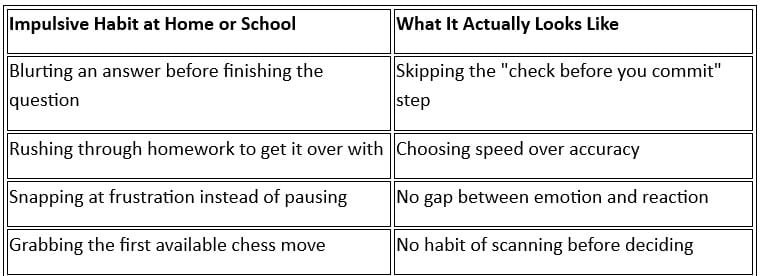
A child grabs the last cookie without checking if it is someone else’s. A homework answer gets written half a second after the question is read, not after. A checkers piece gets slammed down, then regretted out loud. None of this means a child is careless. It usually means the brain’s “wait, let me check” function is still under construction, and most days nothing forces that function to switch on.

Chess does, every single time. More than 25 million children worldwide now play it, according to figures from FIDE, the World Chess Federation, cited in a 2025 Frontiers in Psychology paper (Frontiers in Psychology, 2025). Part of that growth comes from parents who care less about ratings and more about a child who acts first and thinks second.

This is exactly the gap chess teaches children to think before they act, one slow, deliberate move at a time.

Why Do Impulsive Decisions Hold Back a Child’s Learning?

The brain region responsible for pausing before acting, the prefrontal cortex, matures later than the emotional, reactive regions driving a child’s first instinct. That mismatch is not a character flaw, just biology under construction, which is why a seven-year-old can ace a spelling test and still snap at a sibling over a board game the same afternoon.

The stakes are not small. A 2025 study in npj Science of Learning examined how brain structure linked to impulsivity affects academic performance and found that prefrontal cortex activity alone accounted for more than a third of impulsivity’s negative effect on grades (npj Science of Learning, 2025). That research looked at students broadly, not young children specifically, but it describes the same wiring every child is still finishing.

This is precisely the gap that explains why chess teaches children to think before they act more reliably than a lecture about patience ever could: it replaces advice with repetition.

What Does the Decision-Making Process Look Like in a Game of Chess?

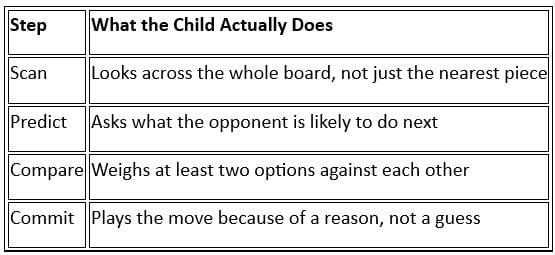
Every legal chess move hides four smaller decisions, and skipping any one gets punished almost immediately on the board.

A hung piece or a missed threat shows up within seconds of skipping a step, a blunter consequence than most schoolwork ever delivers. That bluntness is the entire point behind decision-making in chess for kids: the board, not a parent or teacher, delivers the feedback. Kaabil Kids trains this four-step habit into every lesson rather than hoping a child stumbles onto it, building strategic thinking for kids into the curriculum itself, with trainers regularly pausing a game to ask why a move got played.

How Does Chess Build Patience and Self-Control in Kids?

Patience on a chessboard is not sitting quietly and waiting. It is holding back a move that looks tempting in order to find one that actually works, which takes more discipline than waiting ever does. This active, practised version of chess and patience in children is what separates a calm-looking child from one who has genuinely learned to delay a decision.

A 2025 study published in Frontiers in Psychology compared two groups of kindergarten children, one taught chess as part of regular lessons and one that was not, and recorded measurable gains in patience and self-discipline among the chess group, alongside improvements in attention and logical thinking strong enough that the researchers ruled out chance (Frontiers in Psychology, 2025). The mechanism behind chess and patience in children is straightforward: chess punishes impatience on the spot, through a lost piece or a lost game, far faster than most subjects ever give a child that kind of feedback.

Does This Benefit Apply to Every Child, or Only Naturally Patient Ones?

Parents of restless or easily frustrated kids often assume chess and patience in children only works for someone else’s calmer child. Coaches working with hundreds of children see the opposite. A child who struggles most with pausing usually has the most room to improve, and a chessboard gives that exact skill somewhere safe to be practised, with a result clear within minutes rather than weeks.

None of this happens overnight, and chess should never be framed as a substitute for professional support when a child has a diagnosed condition. Think of it the way a music teacher thinks of scales: progress is gradual, built through repetition.

Where Do These Think-Before-You-Act Skills Show Up in Real Life?

Decision making in chess for kids rarely stays confined to a board. Strategic thinking for kids built through one activity tends to leak into three places parents notice almost immediately.

What Does This Look Like in the Classroom?

A child who has practised scanning a board before moving, the basis of strategic thinking for kids, is more likely to reread a tricky question before answering it, instead of writing down whatever thought arrives first.

What Does This Look Like in Friendships and Sibling Conflict? 

The same gap between impulse and action shows up off the board too. A child who has learned to weigh two responses before committing to one move is more likely to do the same before firing back at a sibling.

What Does This Look Like in Exams and Anything Timed?

Most chess games and puzzles run against a clock, which mirrors the pressure of a timed test far more closely than untimed homework ever could, training a child to decide well under a ticking deadline rather than freeze or rush.

How Does Structured Chess Coaching Reinforce Better Thinking Habits?

Playing chess alone teaches a child to make moves. A coach who asks “why did you play that” after every game is the one who turns the habit into something permanent, since noticing your own impulsive choices without outside feedback is slow and unreliable.

Kaabil Kids builds that feedback loop directly into its online chess classes, treating strategic thinking for kids as a skill to be coached, not assumed. FIDE-rated trainers review a child’s games to flag the moves made without scanning or comparing, turning each into a concrete, repeatable lesson rather than a vague comment. An in-house psychologist supports the emotional side of this, staying composed after a loss instead of reacting to it. Families researching online chess coaching or an online chess tutor for this reason are usually looking for exactly that structured, repeated correction loop.

A pattern this specific does not build itself. It needs a curriculum, designed here by International Grandmaster Tejas Bakre, paired with trainers who treat every game as a chance to catch and correct one impulsive habit at a time, because chess teaches children to think before they act only when someone keeps asking them to explain their thinking.

Frequently Asked Questions

What Do Parents Usually Ask About Chess, Decision-Making and Patience in Kids? Frequently Asked Questions

  1. Does chess actually improve decision-making in children? 

Research backs this up specifically for the skills decision making in chess for kids drills directly: scanning options, predicting consequences, and choosing deliberately rather than guessing. This is the clearest evidence that chess teaches children to think before they act, since a 2025 Frontiers in Psychology study found measurable gains in exactly these areas among children given regular chess instruction.

2. Can chess help an impulsive or hyperactive child? 

It can help build the habit of pausing before acting, since every move offers low-stakes practice at exactly that skill. The link between chess and patience in children works best as a complement to other support, not a replacement for professional guidance where a diagnosed condition is involved.

3. At what age should a child start chess for these benefits?

Most children can begin around age five or six, when the brain is especially responsive to structured practice. Kaabil Kids works with children from age 5 through 15, adjusting pace and complexity to match each stage.

4. How long does it take to see a change in a child’s patience? 

Coaches typically notice early shifts within a few months of regular practice, though change tends to be gradual, the same way any new habit takes repetition before it becomes automatic.


Kaabil Kids turns that repeated correction into a weekly habit rather than a one-off experiment, combining a Grandmaster-built curriculum, FIDE-rated trainers, and in-house psychological support so that the pause a child learns on the board shows up off it, too.

Start with Kaabil Kids’ online chess coaching for kids to see it in practice.

A daily chess practice routine for kids doesn’t need hours. Learn how to split 20–30 minutes across puzzles, games and review so your child actually improves.

Most chess parents know this routine: lessons on Tuesday, a flurry of games before Saturday’s tournament, then silence until next Tuesday. The board collects dust, the puzzle app sits unopened, and everyone wonders why progress feels slow despite a child who clearly loves the game.

Online chess has exploded well past hobby status. Chess.com alone crossed 200 million members in April 2025, with more than 20 million games played on the platform every single day as per reports. Your child isn’t just playing a board game anymore. They’re stepping into one of the fastest-growing online communities on the planet.

Here’s the reassuring part. A real chess practice routine for kids doesn’t need hours. It needs a rhythm that survives school nights, siblings, and the occasional Tuesday meltdown, the same rhythm that good online chess coaching is designed to reinforce.

Why Does Consistency Matter More Than Natural Talent in Chess? 

Parents often assume some kids are simply “chess kids,” wired for the game in a way others aren’t. Coaches who have watched thousands of students disagree. Chess improvement behaves like a skill, not a gift, so it responds to repetition far more than to raw aptitude.

A 2025 study published in Frontiers in Psychology found that young children who received regular, structured chess instruction showed statistically significant gains in attention, memory, logical thinking, and even math scores compared with children who didn’t, with results strong enough that the researchers ruled out chance entirely (Frontiers in Psychology, 2025).

Translate that for a Tuesday-to-Saturday household: a child who plays 15 to 20 focused minutes daily for a year will usually out-improve a child who plays for two hours once a week. The brain treats chess the way it treats a language or an instrument, which is exactly why a proper chess practice routine for kids beats sporadic marathon sessions. Small, frequent reps beat occasional long ones.

What Does an Ideal Daily Chess Practice Routine Look Like for a Beginner? 

Forget elaborate study plans. A beginner’s daily chess practice routine for kids fits into three short blocks totaling roughly 30 minutes.

Time| Activity| Why It Works
5-10 min| Tactics puzzles| Sharpens pattern recognition before the real game begins
10-15 min| One full game| Forces real decision-making instead of theory
5-10 min| Reviewing that game| Turns a loss into a lesson instead of a forgotten memory

The order matters more than the exact minutes. Puzzles warm up the brain, the game applies it, and the review locks in whatever almost worked. Skip the review step, and a child can play hundreds of games while repeating the same three mistakes.

This is the exact rhythm Kaabil Kids builds into its beginner track, with weekly assignments and live sessions following the same warm-up, play, review structure, so a child isn’t left guessing what to do with their 30 minutes.

How Should Kids Split Practice Time Between Tactics, Games and Analysis? 

Once the basics are solid, the split deserves more thought.

Practice Activity| What It Builds
  • Tactics puzzles
| Pattern recognition and faster calculation
  • Playing full games
| Decision-making under real-time pressure
  • Reviewing and analysing games
| Spotting the mistake that keeps repeating

Most kids default to puzzles because solving one feels like an instant win. Analysis gets skipped because it feels like homework. That is a problem, since reviewing games is the activity most directly tied to actual rating improvement. Good daily chess practice for kids gives roughly equal time to all three, with a tilt toward analysis once a child starts taking tournaments seriously.

How Long Should a Daily Chess Session Be at Different Ages?

A five-year-old and a fourteen-year-old should not be handed the same practice schedule. Most child development guidelines suggest kids can hold focused attention for roughly two to three minutes per year of their age, so a daily chess practice routine for kids works best when it respects that ceiling instead of fighting it.

Age Group| Suggested Daily Practice Time
5-7 years| 10-15 minutes
8-10 years| 15-25 minutes
11-13 years| 25-40 minutes
14-15 years| 40-60 minutes

These are starting points, not contracts. A consistent 10 minutes beats an ambitious 40 that quietly stops happening by week two.

What Mistakes Do Kids Most Often Make When Practising Chess on Their Own?

Five mistakes show up again and again in independent practice:

None of these means a child lacks talent. They usually just mean nobody has shown them what a useful chess practice routine for kids, built on daily chess practice for kids rather than occasional bursts, actually looks like.

How Can Parents Help Kids Stick to a Daily Chess Routine?

Parents cannot force consistency, but they can remove the friction that kills it, the same friction that pushes many families toward chess classes for kids once home routines start slipping.

Pick a fixed slot tied to something that already happens daily; right after breakfast works far better than “sometime today.” Save corrections for the review step instead of pausing mid-game, since constant interruptions teach a child to wait for answers rather than find them. Praise the habit itself, not just the wins; a losing streak followed by quitting is worse than a losing streak followed by Tuesday’s session happening anyway. A simple sticker chart works wonders for younger kids, who chase a visible streak rather than an abstract rating number.

When Does a Child Need Structured Coaching Instead of Just Independent Practice? 

A home routine carries most kids a long way, until it doesn’t. The common stalling point looks like this: a child keeps playing, keeps solving puzzles, and somehow keeps making the same three mistakes without realising it, because nobody is flagging the pattern. This is usually when families first start researching online chess coaching.

That is the gap that structured chess classes for kids are built to close. Kaabil Kids runs an online chess coaching programme for children aged 5 to 15, with a curriculum designed by International Grandmaster Tejas Bakre and delivered by FIDE-rated trainers across beginner, intermediate and advanced levels. Weekly assignments slot into that same daily rhythm, tournaments give the practice somewhere to go, and an in-house psychologist supports focus and mindset alongside the chess itself.

It helps to remember the scale of what these kids are stepping into. The reigning World Chess Champion, Gukesh Dommaraju, is Indian. The next name on that list is probably finishing homework somewhere right now.

Frequently Asked Questions

What Do Parents Most Often Ask About Daily Chess Practice for Kids? 

How much should a kid practice chess every day?

Most beginners do well with 10 to 30 minutes a day, depending on age, split between a tactics warm-up, one game, and a short review. A workable chess practice routine for kids depends more on showing up most days of the week than on hitting an exact number of minutes.

What is the best daily chess practice routine for a beginner? 

A simple three-part routine works best: 5-10 minutes of tactics puzzles, one full game of 10-15 minutes, and 5-10 minutes reviewing that game afterward. This keeps daily chess practice for kids short enough to repeat every single day without burnout.

How can parents help kids stay consistent with chess practice?

Attach practice to an existing daily habit, save feedback for after the game instead of during it, and praise showing up rather than only winning. A visible streak tracker often does more for motivation than talk of ratings.

Is daily practice better than just taking a weekly chess class?

A weekly class introduces new ideas, but without daily practice between classes those ideas rarely stick. The two work best together, with short home sessions reinforcing what a coach teaches each week, whether that coach comes from a school programme, chess classes for kids, or dedicated online chess coaching.


A chess practice routine for kids does not need to be long, dramatic, or supervised down to the minute. It needs to be short, daily, and occasionally reviewed, which is a far easier habit to maintain than a two-hour Sunday session that quietly falls off by spring.

Kaabil Kids gives kids aged 5 to 15 that exact structure through chess classes built around a Grandmaster-designed curriculum, FIDE-rated trainers, and a weekly rhythm that turns daily practice into measurable progress instead of one more thing to nag about.

Explore Kaabil Kids’ online chess coaching for kids to get started

Can a child defeat a grandmaster at chess? Absolutely—some already have. 

Around the globe, young minds are making large strides on the chessboard. From living rooms to world stages, children are demonstrating that age is not a limit when it comes to strategy, concentration, and raw talent. Many of these young champions began with something as basic as online chess classes for kids. 

At Kaabil Kids, we’ve seen how the right guidance, passion, and practice can turn curious learners into chess champions. Today, we’re celebrating a few inspiring stories—and showing how every child can follow in their footsteps with the help of structured online chess classes and a professional chess academy. 

Gukesh Dommaraju – Youngest Indian to Reach the Chess World Championship 

In 2024, teenager Gukesh Dommaraju, 17, stunned the world. He became the youngest player to ever win the FIDE Candidates Tournament and gain the right to play for the world title. Born in Chennai, India, Gukesh began learning chess when he was merely 7 years old. 

His tale is an apt illustration of how early introduction and regular learning by systematic approaches, such as online chess classes for kids, can create a huge impact. Gukesh’s career proves that talent is not enough, and discipline makes champions. 

R. Praggnanandhaa – The Boy Who Defeated Magnus Carlsen 

Another Indian prodigy, Rameshbabu Praggnanandhaa, became a grandmaster at the age of 12. In 2022, he shocked the world by beating current world champion Magnus Carlsen—not once, but several times. 

Pragg, affectionately known by his fans, regularly trained under skilled coaches and had a rigorous regimen—just what we provide in our professional chess academy here at Kaabil Kids. He’s an excellent example of how kids, with proper guidance, can develop into bold thinkers and international contenders. 

Abhimanyu Mishra – The Youngest Grandmaster in History 

Born in the USA, Abhimanyu Mishra was the youngest chess grandmaster ever at the mere age of 12 years and 4 months in 2021. His recipe for success? Practice every day, a defined purpose, and a supportive team. 

He practiced with coaches, played hundreds of online games, and spent hours each day practicing. His is the story of how online chess classes—even from home—can lay the foundation for greatness when executed properly. 

How Online Chess Classes for Children Help Develop Champions? 

You may ask yourself—what’s the initial step in a child’s path to chess greatness? 

For most, it starts with online chess classes for children. These are not just convenient but also tailored to keep up with a child’s learning pace. At Kaabil Kids, our classes are enjoyable, engaging, and conducted by genuine chess professionals. 

Below are the things that set us apart: 

Through constant practice and guidance from our professional chess academy, children learn to plan ahead, remain calm in stressful situations, and have fun with each move they make. 

Why Start Early? 

Children aged between 5 and 12 are at their best learning age. Their minds are sharp, curious, and eager to learn. Chess assists them: 

And the cherry on top? They can begin from the comfort of home with online chess classes for children at Kaabil Kids. 

Success Starts with the Right Move! 

Most parents search for “best chess school” or “professional chess academy” when their child expresses interest in playing chess. But the secret isn’t in seeking out the best—it’s in beginning. 

Like Gukesh, Praggnanandhaa, and Abhimanyu, all great chess masters were once beginners. With proper coaching, guidance, and motivation, your child might be the next chess sensation. 

Big Dreams Start with Small Moves! 

Behind every young champion, there is a tale of patience, practice, and passion. These children were not born grandmasters. They learned, they made mistakes, and they learned again. And now, they are inspiring millions. 

At Kaabil Kids, we are committed to providing each child with that opportunity—to learn, develop, and thrive. Our online chess classes for kids are designed to achieve just this. 

So, if your kid enjoys puzzles, games, and brain teasers, why not try out chess? The path may lead them to glory. 

Ready to get your child making their first smart move? Join Kaabil Kids now and take our expert-led online chess classes.  

The next grandmaster may be at your doorstep! 

Chess is more than just a game; it is a battle of the mind, requiring strategy, foresight, and discipline. With the increasing popularity of online chess platforms, young players have the opportunity to refine their skills with the help of expert coaches. A trusted platform recognizes the importance of structured training and offers chess lessons online to help students excel in competitive play. 

The Importance of Online Chess Learning 

Many beginners start their chess journey by playing casually with friends or family. However, to improve and compete at higher levels, proper coaching is a must. A chess coach online provides personalized guidance, helping students understand strategies, tactics, and essential gameplay principles that are not when playing alone. 

1. Expert Coaches with Proven Experience 

Online chess coaching provides experienced coaches who have competed in national and international tournaments. These experts guide students through the following: 

2. Flexible Scheduling for Convenience 

Unlike traditional chess classes, online chess coaching offers flexible scheduling. Students can: 

3. Safe and Interactive Learning Environment 

Safety is a top priority.  The online platform ensures a friendly learning environment where students can: 

4. Personalized Training for Faster Improvement 

Unlike self-learning, where players may struggle to identify mistakes, online coaching provides structured lessons tailored to the student’s strengths and weaknesses. With a chess coach online, students receive individual attention, allowing them to grasp complex concepts more effectively. 

5. Developing Critical Thinking and Strategic Planning 

Chess is a game of logic and decision-making. Learning under a coach ensures that players develop critical thinking skills and strategic planning abilities. A coach guides students on: 

6. Learning the Importance of Openings, Middle Game, and Endgame 

One of the key aspects of chess training is understanding the three phases of the game—openings, middle game, and endgame. Many players struggle because they lack structured knowledge in these areas. 

Through chess lessons online, students can systematically improve their understanding of these phases under expert guidance. 

How Online Chess Coaching Prepares for Competitive Play 

Competing in chess requires a high level of discipline, mental stamina, and practice. Online chess coaching provides a competitive edge by equipping students with the right training. 

1. Exposure to a Competitive Environment 

A chess coach online helps students simulate real tournament conditions by: 

These factors prepare students mentally and strategically for real-world competitions. 

2. Access to Advanced Training Resources 

Online Chess Class provides access to valuable learning materials, including: 

These resources ensure that students have the best possible training for competitive chess. 

3. Developing Consistency and Discipline 

To excel in any competitive field, consistency is key. Online chess coaching infuses discipline by: 

Conclusion 

In today’s world, online chess coaching is important for anyone looking to improve their game. Kaabil Kids offers top-notch chess lessons online, ensuring that students develop strong analytical skills, strategic thinking, and competitive discipline. 

Whether your child is just starting or already playing at an advanced level, a chess coach can make all the difference in achieving excellence in the game. Invest in the future of your child’s chess journey with us and watch them grow into confident and competitive players. 

The Chess Olympiad 2024 is here, and India is indeed making waves. The enthusiasm of fans and the bravery of players are igniting the spirit. The unthinkable has become possible-it is no longer just a game for India but a journey to greatness. Let’s explore how our chess heroes are holding the flag high.

The chess battleground is scorching hot in India. Mention Gukesh Dommaraju, Arjun Erigaisi, and Praggnanandhaa, Divya Deshmukh and you know precisely what we are talking about. Each one of them has been striking gold with their immeasurable skills and vigorous determination.

Gukesh Dommaraju: A Force to Be Reckoned With

Gukesh is really a standout. At the age of 17, he has already hogged headlines. His strategic play and timely skill on the board are actually making him a strong contender. Many feel he has the best bet to challenge the current World Champion Ding Liren from China. How lovely would it be if Gukesh also brought the title home! The excitement would just be off the charts!

Arjun Erigaisi: The Tactical Genius

Arjun Erigaisi is the next player. He is known for strategic brilliance. There is a veiled talent of Arjun to visualize the game from different angles. His creativity, or rather ingeniousness, helps him to come up with unexpected moves that amaze the opponents. In this Chess Olympiad, he plays crucially for India. His fans are waiting to see how he will prove himself in the following rounds.

Praggnanandhaa: The Young Prodigy

Praggnanandhaa, or Pragg as fans call him, is another chess sensation. It was the time he entered into success at such a young age of just 18 years. He has faced all the top players and stood against them. Calm under pressure is his speciality. Many think he can make it to the trophy for India this year. Youthfulness, along with skill together, becomes a great advantage.

Divya Deshmukh

The 18-year-old Divya Deshmukh was an absolute key player from India in the 2024 Olympics. She surely proved to be an excellent player as her brilliant strategic skills have had stabilized her position in the tournament. With each match, she ensures inspiring young female players, and just a period of time makes them realize the potential for victory on the Olympic stage.

Vantika Agrawal

At just seventeen, Vantika Agrawal is cutting a sharp figure in the run-up to 2024 Olympics. Known for her tactical brilliance and cool-under-pressure credentials, she plays a very crucial role in the Indian women’s chess team. Vantika’s journey reflects the promise of young women in chess, inspiring generations to come to dream big in this sport.

The Road to Success

The success of India is not just about stars and marvelous players. It is about team efforts and strategy. Coaches and support staff play a key role. They help build up the player and increase their confidence.

Team Spirit and Collaboration

Chess appears to be an individual game; however at the Olympiad, it’s all about a team. Every player depends on others. They share insights and strategies. The motivation, too, comes from this synergy, which is one of the reasons why India has done well so far.

Analyzing opponents

Before the actual match, the team analyzes their opponents. It analyzes matches from the past and identifies their weaknesses. This process gives them an advantage over their opponents. It is all about one step ahead of them on the board.

Thrilling Matches and Close Calls!

It is not merely an intense match since each game is a battle of wits. Cheering and zip characterize the atmosphere as fans cheer for their favorites. Let’s take a look at some of these thrills from this year’s event.

Nail-Biting Finishes

This has been the toughest India has faced in years. All matches were neck and neck, sometimes even going down to the wire. Gukesh’s games had edge-of-the-seat thrills written all over them. The kid’s ability to not lose cool is commendable. Fans can’t get enough of those nail-biting finishes for him!

Unforgettable Comebacks

Arjun also had some stunning comebacks. There were matches in which it seemed he was getting himself into trouble. But his tactical skills gave him the victory. It’s such moments that make the game of chess so thrilling. Every game is a story of its struggle and triumph.

Looking Ahead: The Final Push

As the tournament progresses, each match counts. All players are in their senses and on the toes. They realize they are playing for India. Much pride there is in wearing the national jersey on the board.

Role of Spectators

Fans are playing a very large role on this journey. The cheers and motivation they are offering to the player. Social media has just gone all out with updates and cheers. Well, it is great to be a chess fan in India!

Battling for Gold

Now, it is India’s turn to eye the gold medal. There is already enough talent and motivation to do so. With Gukesh, Arjun, Praggnanandhaa, Divya and Vantika Agrawal heading it, it sure as hell must be within their reach. The excitement here is palpable!

The Future of Indian Chess!

Inspired by the performance of India at the Chess Olympiad 2024, it has been a journey so far that has showcased the huge talent in our young lot of players Gukesh Dommaraju, Arjun Erigaisi, Praggnanandhaa, Divya and Vantika Agrawal the road to the future of Indian chess.

This is a journey where we cheer for them. Whatever happens in the end, these players have already made us very proud. The future looks bright for Indian chess, and we await much in the coming days. Cheers, keep your eyes on the board best is yet to come!

At Kaabil Kids, we believe in nurturing young talents like these chess stars. 

Keep your eyes on the board—the best is yet to come!

Have you ever wondered how the game of chess could influence your child’s mental development? Did you know that teaching your child to play chess can teach them important life skills? It’s more than just moving pieces around a board.

Chess has long been hailed as a fantastic tool for children’s cognitive development in addition to being a game of strategy. The availability of online chess classes in the current digital era makes it simpler than ever to introduce your kid to this stimulating activity. This thorough guide will assist you in selecting the best online chess classes based on your child’s needs and interests.

Why Does Chess Matter for Young Minds?

Chess is widely recognized as a beneficial activity for young minds, offering a unique blend of intellectual stimulation and skill development. Beyond its reputation as a game of strategy, chess serves as a powerful tool for enhancing cognitive abilities and fostering important life skills. Whether played casually or competitively, the mental agility required in chess can significantly contribute to a child’s academic performance and overall cognitive development.

Cognitive Development:

Engaging in chess stimulates critical areas of the brain related to problem-solving, memory retention, and spatial awareness.

Academic Performance

 Studies indicate that regular chess play correlates with improved performance in mathematics, logic, and reading comprehension.

Strategic Thinking

Chess encourages players to think strategically, weigh multiple options, and anticipate opponents’ moves, which enhances analytical thinking.

Creativity

 Exploring various chess strategies and approaches fosters creativity and innovation in problem-solving.

Focus and Concentration

 The intense mental focus required during a chess game improves concentration and attention span.

Decision-Making Skills

 Chess teaches children to make decisions under pressure, considering both short-term gains and long-term consequences.

Social and Emotional Skills

 Playing chess promotes sportsmanship, patience, and resilience as players learn to cope with wins, losses, and the complexities of competition.

Why Should You Invest in Online Chess Classes?

In our fast-paced modern world, online chess classes provide a convenient and adaptable option for parents looking to enhance their children’s cognitive growth. These platforms offer interactive learning experiences and access to a global community, all accessible from the comfort of home. Online chess classes provide several compelling reasons for investment:

Convenience and Flexibility

 Children can learn and practice chess from home, fitting into busy schedules without the need for commuting.

Interactive Learning

 Platforms often include interactive lessons, practice games, and virtual tournaments, keeping children engaged and motivated.

Global Community

 Students can connect with peers worldwide, learn from different playing styles, and expand their chess knowledge.

Personalized Learning

 Many online chess classes offer tailored learning paths, adapting to each child’s skill level and pace for effective progress.

Access to Expertise

 Parents can choose from a diverse range of online chess teachers and specialized programs not locally available, ensuring high-quality instruction.

Parental Involvement

 Online platforms provide tools for parents to monitor their child’s progress, review lesson materials, and support their learning journey.

Cost-Effectiveness

 Online options frequently provide competitive pricing and flexible payment plans compared to traditional classes. It makes them accessible to a broader range of families.

How to Select the Best Online Chess Classes for Your Kids?

Choosing the right online chess coaching  involves careful consideration of several key factors:

Curriculum and Structure 

Opt for programs with a structured learning path that aligns with your child’s age and skill level. A well-organized curriculum ensures systematic progression and effective skill development.

Instructor Credentials

 Research instructors’ qualifications and experience. Look for educators with a strong background in chess instruction and a track record of successfully teaching children.

Interactive Features

 Choose platforms that offer interactive elements like live lessons, video tutorials, and practice games. These features enhance engagement with online chess teachers and make learning chess enjoyable for children.

Flexibility and Accessibility

 Evaluate the platform’s flexibility in terms of scheduling and accessibility. Select classes that fit seamlessly into your child’s daily routine without causing undue stress or disruption.

Parental Involvement

 Consider platforms that encourage parental involvement. Look for options that provide tools for parents to monitor progress, access lesson materials, and support their child’s learning journey.

Feedback and Support

 Seek programs that offer constructive feedback and support for students. Effective feedback helps children understand their strengths and areas for improvement, fostering continuous growth.

Community and Peer Interaction

 Look for platforms that facilitate interaction among students, fostering a sense of community and allowing children to learn from each other’s experiences and strategies.

Trial Periods or Demo Classes

 Take advantage of trial periods or demo classes offered by platforms. This allows your child to experience the teaching style, platform interface, and overall suitability before committing long-term.

Tips to Consider While Choosing

Choosing the right online chess classes for your child requires careful thought and evaluation. To ensure you make the best decision, consider these essential tips:

Assess Your Child’s Learning Style

 Determine whether your child learns best through interactive activities, visual aids, or structured lessons. Choose a program that accommodates their preferred learning methods.

Read Reviews and Testimonials

 Explore feedback from other parents and students to gain insights into the quality of instruction, class engagement, and overall satisfaction with the program.

Trial Lessons

 Take advantage of trial lessons or demo classes offered by platforms. This allows your child to experience the teaching style, class dynamics, and curriculum before committing.

Instructor Qualifications

 Verify the online chess teachers’ qualifications and experience. Look for certifications, teaching credentials, and experience working with children to ensure effective and knowledgeable instruction.

Curriculum and Progression

 Review the curriculum to ensure it aligns with your child’s skill level and goals. A well-structured program should provide a clear progression from beginner to advanced levels, with opportunities for skill development and practice.

Support and Interaction

 Evaluate the amount of support and interaction offered. Look for platforms that provide opportunities for feedback, guidance on strategy improvement, and interaction with peers for a comprehensive learning experience.

Conclusion

Putting money into online chess classes for your kids goes beyond just teaching them the game; it’s about helping them acquire vital life skills. You can make sure your child gets fascinating lessons, individualised online chess coaching ,and access to a supportive community by choosing the best online platform, such as Kaabil Kids Online Chess, based on their individual needs. When it comes to offering engaging interactive learning opportunities that foster critical thinking in young children, Kaabil Kids is an excellent choice. Our curriculum places equal emphasis on developing chess skills and more general cognitive advantages, including increased focus, problem-solving ability, and academic success.

In addition to developing their chess abilities, your child learns critical thinking and resilience through these classes—two life qualities that are essential for overcoming obstacles on and off the chessboard. By fostering a love of learning and providing them with the resources to succeed academically and beyond, this investment sets them up for success and ensures a rewarding path of self-discovery.

Introduction

Welcome to the world of chess! Whether you’re just starting out or aiming to become a grandmaster, navigating the process to becoming a champion can be both challenging and rewarding. Here, we will explore the journey from being a beginner to reaching the pinnacle of chess excellence. From finding the right chess academy for best online chess classes to practicing online and analyzing your mistakes, we will cover all aspects of the path to success.

The Right Age to Start

Chess is a game that can be enjoyed at any age, but when it comes to serious competition, starting early can give you an edge. Many chess prodigies began their journey as early as 4 years, harnessing the benefits of an agile mind and sponge-like ability to absorb knowledge. However, it’s never too late to start. Chess can be learned and mastered by anyone willing to put in the effort.

Finding the Professional Chess Academy

A professional chess academy can play a crucial role in your development as a chess player. Look for an academy that offers experienced and qualified coaches who can guide you through the intricacies of the game. A well-structured curriculum that takes you from beginner to advanced levels is essential. Additionally, a supportive and motivating environment can make a significant difference in your progress.

Online Chess Classes: The Modern Approach

The digital age has revolutionized the way we learn, and chess is no exception. online chess classes provide a flexible and convenient way to improve your skills from the comfort of your own home. These classes offer interactive lessons, practice exercises, and opportunities to play against players from around the world. With the right online platform, you can receive personalized training tailored to your skill level and goals.

Practicing Online: Sharpening Your Skills

Regular practice is the key to becoming a champion in any field, and chess is no different. Best Online Chess Classes provide a plethora of practice options, allowing you to play against opponents of various skill levels. This not only hones your strategic thinking but also exposes you to different playing styles and tactics. Whether it’s blitz games or longer time controls, consistent practice will help you progress steadily on your journey.

Child learning chess online through virtual classes

Analyzing Mistakes: Learn from Every Move

One of the most effective ways to improve as a chess player is to analyze your mistakes. Every game is an opportunity for growth, and identifying your weaknesses will help you address them. Online chess platforms record all games and moves, so a player has access to the data to look for patterns in your gameplay, such as recurring mistakes in certain openings or a tendency to overlook certain tactics. Chess software and online resources can assist you in analyzing your games, providing valuable insights into your strengths and areas that require improvement.

Improving Through Data: Harnessing the Power of Chess Databases

Chess databases in online chess classes are a treasure trove of knowledge that can accelerate your progress. These databases contain millions of games played by top players, allowing you to explore their strategies, openings, and decision-making processes. By studying master games, you can gain a deeper understanding of positional play, tactical patterns, and endgame techniques. Integrating this knowledge into your own games will undoubtedly elevate your chess skills.

Conclusion

Becoming a champion in chess requires dedication, perseverance, and a systematic approach to learning and improvement. Finding the right chess academy, practicing online, analyzing mistakes, and utilizing chess databases are crucial steps in your journey from a beginner to a grandmaster. Remember, the path to success is not always smooth, and setbacks are inevitable. But with determination and a love for the game, you can navigate through the challenges and achieve your goals. So, grab your chessboard, set out on this incredible journey, and may checkmate always be within reach!

Learning chess is a challenging and rewarding hobby you must inculcate in your child. It will significantly help your child advance their thinking skills and decision-making capabilities. That’s why look for best online chess academy that impart the necessary skills.

While there are numerous options for online chess classes , choosing the one among them will be an overwhelming experience. But don’t fret; we have created this guide to help you.

Go through the below-listed factors that you must think about when choosing an best online chess academy for your child:

Experienced Trainers/Instructors In Online Chess Academy

Definitely not to be missed! Your child’s chess instructor ought to have a lot of chess training experience. They must not only have years of expertise playing chess but also years of experience coaching others how to play. A chess player’s extensive playing and coaching experience allows them to have a comprehensive understanding of the many facets of the game, which they must then pass on to their students.

Outstanding Coaching Skills and a deep understanding of child psychology

Chess instruction requires excellent leadership, teaching abilities and a good understanding of child psychology. It is only possible for someone to become a successful chess coach, regardless of how knowledgeable they are or how talented a player they are, if they have excellent chess coaching skills and are able to generate interest in chess. A competent coach must have the ability to comprehend both the areas in which their pupil excels and those in which they struggle. They have to be able to concentrate on the requirements of your child’s game and the aspects that need to be improved. Therefore, if you want to develop your child’s chess game, look for a chess coach who understands your child and is able to curate a tailor made lesson plan.

Best Online Chess Academy

Method and Style of Online Chess Academy

Style and method of chess instruction are essential things to think about when choosing best online chess academy. Some teachers use tried-and-true styles and methods to teach students, while others prefer a unique approach involving real-life examples like cartoons, characters from movies etc., to keep kids interested in the subject. The second method can be more successful because the teacher adds a personal touch that is easy for students to understand.

Open To Inquiries and taking feedback

Look for a chess instructor you can get to know personally. You’ll feel more comfortable approaching them with inquiries related to your child’s performance and taking any feedback you might have Additionally, your child will have no issue conversing with them on many chess-related topics.

The Bottom Line

In conclusion, if you want your child to grow holistically, expose them to chess class and what better than an online class which is transparent, accessible & affordable. Considering all we’ve covered so far, you can locate best online chess academy and develop your child’s game to the level of a professional.

With the advent of the digital era, chess players today have a lot more possibilities to learn and improve their skills. Online chess classes are becoming more and more popular since they offer a valuable and efficient way to learn from experts, have access to a variety of learning tools, and take part in interactive learning experiences. In this piece of our chess blog, we’ll go through the benefits of online chess classes and why it’s now the best option for players of all ability levels.

Comfort and Flexibility In Online Chess Classes

Students can learn chess at their own speed and on their own timetable with the help of online tutoring. Lessons are available whenever it is most convenient for you because there are multiple options of online class from which you have to choose. By doing this, you are released from the limitations associated with conventional in-person classes.

Learn From Subject Matter Expert

Online chess academies have FIDE-rated chess coaches with extensive years of experience in teaching chess. To become a better player, exposing yourself to smart techniques is an excellent idea, which the chess coaches in academies are well-versed with. You can get insightful advice, strategic direction, and sharp commentary from professionals who help you become a pro in chess quickly.

Various Learning Resources

When taking online chess lessons for kids  , students can access an extensive library of instructional resources that can help them become better players. Among the numerous materials available for use are practice problems, interactive puzzles, annotated games, and video tutorials. Kaabil kids online chess platform gives 24×7 access to kids to play with each other or with the bots. Students who use these materials will have a comprehensive and pleasurable learning experience because they may be tailored to fit a variety of different teaching styles.

Best online chess classes for kids

Online Chess Classes Provide Interactive Learning

Online chess classes frequently feature live lectures, Q&A sessions, virtual tournaments, and other interactive components. These interactive components enable direct communication between students and their teachers. This not only encourages healthy competition among the kids but also helps them develop a sense of belonging.

Getting In To The Global Community

Among the most significant benefits of learning chess online is that you get an opportunity to interact with people all around the world. Students can improve their chess skills and meet new people while taking classes, byplaying in online tournaments, chatting with other players, and posting questions and comments on message boards and forums.

Online Chess Classes Are Cost Effective

Online chess instruction can save you money and time compared to in-person instruction. Chess education is now available to a broader audience as a result.

The Bottom Line

Opting for online chess classes is a practical, flexible, and pleasurable way to advance your skills. Online courses are a great way to learn chess because they give you access to a wealth of instructional resources, professional guidance, interactive games, and a global chess community to participate with. Whether you’re a novice trying to grasp the basics or an expert player looking to refine your strategies, taking chess lessons online could help you develop your abilities and reach your full potential without having to leave your house.

Currency
INR Indian rupee