How Does Chess Help Kids Develop Long-Term Thinking Skills?

The maths problem gets solved. The homework gets done. Then comes the project that needs planning across a week, and things slow down. Not because the child lacks ability, but because holding a goal across multiple steps is a different skill from solving what sits directly in front of you.

Chess trains the first. Every position is a planning problem that cannot be answered by the next move alone. This is how chess teaches long-term thinking skills to kids through play.

What Is Long-Term Thinking, and Why Does It Matter for Children?

Long-term thinking skills are basically one’s ability to hold a goal in mind, identify the steps to reach it, sequence those steps, and adjust when something changes. This capacity, which researchers call prospective thinking, is the foundation of chess long-term thinking for kids and of strategic thinking for kids across every domain that eventually matters.

This capacity is one of the last executive functions to mature, typically not completing development until the late teens. Children who practise it deliberately build it earlier. A 2025 meta-analysis in SAGE Open confirmed that working memory, the system that holds and updates plans, reliably predicted academic achievement across both early and late developmental stages (Birtwistle et al., SAGE Open, 2025).

Thinking skills are developed following exactly this system, training kids’ long-term thinking in chess by forcing repeated re-sequencing whenever a plan is disrupted mid-game.

Short-Term ThinkingLong-Term Thinking
Reacting to the immediate situationAnticipating what the board looks like in three moves
Choosing the move that looks good right nowChoosing the move that sets up a better position later
Responding to a problem once it appearsRecognising a problem while it is still forming
Solving the task directly in front of themSequencing tasks so the hardest is addressed first

How Does Chess Encourage Planning Ahead?

Every chess position requires backward induction: starting from the end state you want and working back to the first move that starts building it. Decision making in chess is prospective, not reactive. A child must picture where all their pieces should be in eight moves, identify the obstacles, and find the step that clears the path first.

These are not metaphors for chess-induced planning skills. They are the same cognitive operations applied to a different board.

Chess ConceptWhat It TrainsWhere It Shows Up
Pawn structure decisionsSetting up a position several moves awayOrganising a project before the first task starts
Piece coordinationMaking multiple elements work toward one goalContributing to a group without losing the team’s aim
Endgame planningIdentifying the win condition and working backwardScheduling from an exam date backward
ProphylaxisAnticipating the opponent’s plan and preventing itSpotting what could go wrong before committing

What Does Learning to Anticipate Consequences Actually Look Like in Chess?

When a trained child considers a move, they run a conditional chain: if I play here, they can go there, which means I need to do this. That is decision making in chess as forward planning, practised under time pressure with a result that arrives within minutes.

A June 2025 study in Revista de Psicología compared children aged 8 to 12 in a structured chess workshop against a matched control group attending a different educational workshop for the same hours. Teacher evaluations recorded measurable improvements in executive functions in the chess group, absent in the control group (Revista de Psicología, 2025), and the gains required structured coaching, not casual play.

A child who has spent a year in this kind of training is more likely to ask what the final answer needs to look like before writing the first line. This critical thinking habit developed through chess in – working toward an end state before moving, carries directly into how a child approaches any multi-step task.

How Do These Thinking Skills Show Up Beyond the Chessboard?

Chess planning skills practised on the board surface in three domains of children’s lives that parents recognise almost immediately.

What Does Long-Term Thinking Look Like in Academic Work?

The critical thinking skills that kids develop in chess builds a habit of planning toward an end state, and this shows up in schoolwork as structuring essays by conclusion first, identifying which part of an assignment takes longest before pressure arrives, and reviewing before submitting. Teachers notice this shift before parents do.

What Does It Look Like in Group Projects and Social Situations?

Piece coordination trains a child to make several elements work simultaneously toward one goal. Strategic thinking for kids is built this way shows up in group work as awareness of how contributions fit together, rather than focus on their own section alone.

What Does It Look Like in Competitive Situations? 

Chess trains a child to model what an opponent is building before it arrives, an aspect of decision making in chess that transfers to sport, debates and timed exams as the ability to anticipate a challenge rather than simply absorb it.

How Does Regular Chess Practice Build Strategic Thinking Over Time?

Strategic thinking for kids does not develop from reading about it. Backward induction, conditional reasoning, and consequence mapping are built through repeated planning under real consequences. A child playing unreviewed games online builds pattern recognition but not systematic long-term thinking skills, because those require a coach to name, correct, and reinforce the planning habit each time it is abandoned.

Approximately 46% of users on online chess platforms engage with at least one instructional or learning module rather than treating the platform solely as a game portal, reflecting growing awareness that structured learning and casual play are not interchangeable (Online Chess Instruction and Play Market Report, 2025).

Kaabil Kids’ curriculum, designed by International Grandmaster Tejas Bakre, builds chess planning skills as an explicit teaching goal. FIDE-rated trainers review each child’s games to flag positions where a long-term plan was missing or abandoned, and the in-house psychologist helps children process the frustration of a failed plan. Families looking for online chess classes, online chess coaching, or an online chess tutor that builds this thinking habit will find Kaabil Kids programs structured around exactly this outcome.

Long-term thinking is a trainable skill. In chess, long-term thinking skills are developed through structured coaching, and that coaching ensures the habit transfers rather than staying on the board.

Kaabil Kids gives children aged 5 to 15 a Grandmaster-designed curriculum, FIDE-rated coaching and in-house psychological support, built around strategic thinking for kids that shows up in exams, projects and decisions long after the pieces are put away.

Explore online chess coaching for kids | Book a free trial class

What Do Parents Most Often Ask About Chess and Long-Term Thinking?

Does chess actually improve long-term thinking skills in children? 

Research supports this for the cognitive mechanisms chess directly trains: backward induction, conditional reasoning, and consequence mapping. A 2025 study found that children aged 8 to 12 in a structured chess workshop showed teacher-evaluated gains in executive functions absent in a matched control group. In chess, long-term thinking for kids builds through coached play, not unreviewed games.

At what age does a child begin to develop long-term thinking through chess?

Planning is trainable from early childhood. Kaabil Kids works with children aged 5 to 15. Those who begin structured training between ages 7 and 11 typically show the clearest gains in chess planning skills, as that window is especially responsive to executive function development.

How is chess different from other activities for building planning skills?

Most activities build planning indirectly. Chess builds backward induction directly: working from a desired outcome back to the present move. That structure is identical to what project-based schoolwork and competitive exams require. Through chess, critical thinking skills honed by children operate over a longer horizon than most childhood activities can reach.

How long does it take to see strategic thinking improve through chess?

Coaches and teachers typically notice shifts in how a child approaches multi-step tasks within six to twelve months of consistent structured practice. The change shows in how a child begins a project, which is exactly where decision making in chess trains the eye to look first.

How Does Chess Teach Children to Think Before They Act?

A child grabs the last cookie without checking if it is someone else’s. A homework answer gets written half a second after the question is read, not after. A checkers piece gets slammed down, then regretted out loud. None of this means a child is careless. It usually means the brain’s “wait, let me check” function is still under construction, and most days nothing forces that function to switch on.

Chess does, every single time. More than 25 million children worldwide now play it, according to figures from FIDE, the World Chess Federation, cited in a 2025 Frontiers in Psychology paper (Frontiers in Psychology, 2025). Part of that growth comes from parents who care less about ratings and more about a child who acts first and thinks second.

This is exactly the gap chess teaches children to think before they act, one slow, deliberate move at a time.

Why Do Impulsive Decisions Hold Back a Child’s Learning?

The brain region responsible for pausing before acting, the prefrontal cortex, matures later than the emotional, reactive regions driving a child’s first instinct. That mismatch is not a character flaw, just biology under construction, which is why a seven-year-old can ace a spelling test and still snap at a sibling over a board game the same afternoon.

The stakes are not small. A 2025 study in npj Science of Learning examined how brain structure linked to impulsivity affects academic performance and found that prefrontal cortex activity alone accounted for more than a third of impulsivity’s negative effect on grades (npj Science of Learning, 2025). That research looked at students broadly, not young children specifically, but it describes the same wiring every child is still finishing.
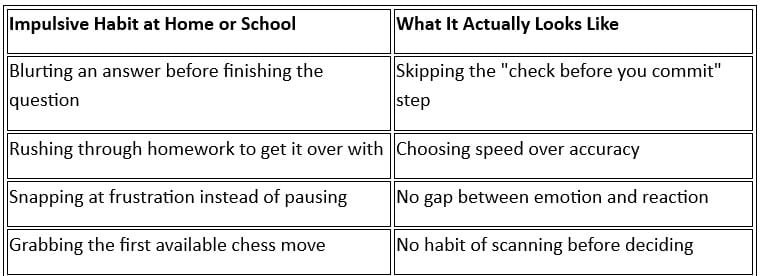
This is precisely the gap that explains why chess teaches children to think before they act more reliably than a lecture about patience ever could: it replaces advice with repetition.

What Does the Decision-Making Process Look Like in a Game of Chess?

Every legal chess move hides four smaller decisions, and skipping any one gets punished almost immediately on the board.
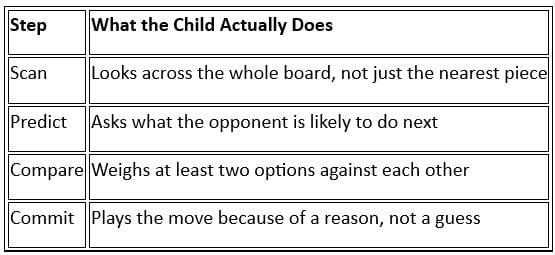
A hung piece or a missed threat shows up within seconds of skipping a step, a blunter consequence than most schoolwork ever delivers. That bluntness is the entire point behind decision-making in chess for kids: the board, not a parent or teacher, delivers the feedback. Kaabil Kids trains this four-step habit into every lesson rather than hoping a child stumbles onto it, building strategic thinking for kids into the curriculum itself, with trainers regularly pausing a game to ask why a move got played.

How Does Chess Build Patience and Self-Control in Kids?

Patience on a chessboard is not sitting quietly and waiting. It is holding back a move that looks tempting in order to find one that actually works, which takes more discipline than waiting ever does. This active, practised version of chess and patience in children is what separates a calm-looking child from one who has genuinely learned to delay a decision.

A 2025 study published in Frontiers in Psychology compared two groups of kindergarten children, one taught chess as part of regular lessons and one that was not, and recorded measurable gains in patience and self-discipline among the chess group, alongside improvements in attention and logical thinking strong enough that the researchers ruled out chance (Frontiers in Psychology, 2025). The mechanism behind chess and patience in children is straightforward: chess punishes impatience on the spot, through a lost piece or a lost game, far faster than most subjects ever give a child that kind of feedback.

Does This Benefit Apply to Every Child, or Only Naturally Patient Ones?

Parents of restless or easily frustrated kids often assume chess and patience in children only works for someone else’s calmer child. Coaches working with hundreds of children see the opposite. A child who struggles most with pausing usually has the most room to improve, and a chessboard gives that exact skill somewhere safe to be practised, with a result clear within minutes rather than weeks.

None of this happens overnight, and chess should never be framed as a substitute for professional support when a child has a diagnosed condition. Think of it the way a music teacher thinks of scales: progress is gradual, built through repetition.

Where Do These Think-Before-You-Act Skills Show Up in Real Life?

Decision making in chess for kids rarely stays confined to a board. Strategic thinking for kids built through one activity tends to leak into three places parents notice almost immediately.

What Does This Look Like in the Classroom?

A child who has practised scanning a board before moving, the basis of strategic thinking for kids, is more likely to reread a tricky question before answering it, instead of writing down whatever thought arrives first.

What Does This Look Like in Friendships and Sibling Conflict? 

The same gap between impulse and action shows up off the board too. A child who has learned to weigh two responses before committing to one move is more likely to do the same before firing back at a sibling.

What Does This Look Like in Exams and Anything Timed?

Most chess games and puzzles run against a clock, which mirrors the pressure of a timed test far more closely than untimed homework ever could, training a child to decide well under a ticking deadline rather than freeze or rush.

How Does Structured Chess Coaching Reinforce Better Thinking Habits?

Playing chess alone teaches a child to make moves. A coach who asks “why did you play that” after every game is the one who turns the habit into something permanent, since noticing your own impulsive choices without outside feedback is slow and unreliable.

Kaabil Kids builds that feedback loop directly into its online chess classes, treating strategic thinking for kids as a skill to be coached, not assumed. FIDE-rated trainers review a child’s games to flag the moves made without scanning or comparing, turning each into a concrete, repeatable lesson rather than a vague comment. An in-house psychologist supports the emotional side of this, staying composed after a loss instead of reacting to it. Families researching online chess coaching or an online chess tutor for this reason are usually looking for exactly that structured, repeated correction loop.

A pattern this specific does not build itself. It needs a curriculum, designed here by International Grandmaster Tejas Bakre, paired with trainers who treat every game as a chance to catch and correct one impulsive habit at a time, because chess teaches children to think before they act only when someone keeps asking them to explain their thinking.

Frequently Asked Questions

What Do Parents Usually Ask About Chess, Decision-Making and Patience in Kids? Frequently Asked Questions

  1. Does chess actually improve decision-making in children? 

Research backs this up specifically for the skills decision making in chess for kids drills directly: scanning options, predicting consequences, and choosing deliberately rather than guessing. This is the clearest evidence that chess teaches children to think before they act, since a 2025 Frontiers in Psychology study found measurable gains in exactly these areas among children given regular chess instruction.

2. Can chess help an impulsive or hyperactive child? 

It can help build the habit of pausing before acting, since every move offers low-stakes practice at exactly that skill. The link between chess and patience in children works best as a complement to other support, not a replacement for professional guidance where a diagnosed condition is involved.

3. At what age should a child start chess for these benefits?

Most children can begin around age five or six, when the brain is especially responsive to structured practice. Kaabil Kids works with children from age 5 through 15, adjusting pace and complexity to match each stage.

4. How long does it take to see a change in a child’s patience? 

Coaches typically notice early shifts within a few months of regular practice, though change tends to be gradual, the same way any new habit takes repetition before it becomes automatic.


Kaabil Kids turns that repeated correction into a weekly habit rather than a one-off experiment, combining a Grandmaster-built curriculum, FIDE-rated trainers, and in-house psychological support so that the pause a child learns on the board shows up off it, too.

Start with Kaabil Kids’ online chess coaching for kids to see it in practice.

Chess, known as the ‘game of kings’, is a very old game that originated a long, long time ago. Hailing from the depths of antiquity to the days of the first chess grandmasters, this scientifically based, strategic pastime has enthralled millions. This blog will explicate the historical background of the game of chess and the heritage of famous players. We shall also expound on why learning chess is essential for beginners, the purpose of chess coaching classes, and why joining a chess academy online is essential.

The Ancient Origins of Chess

Chess originated in 6 AD in northern India, where it was known as chaturanga. This early version of chess was a strategic game that mirrored the four divisions of the Indian army: the foot soldiers, horsemen, elephants, and chariots, which in modern chess are equivalent to pawn, knight, bishop, and rook, respectively. Chaturanga gained popularity in Persia and evolved into a new game called Shatranj. In Persia, the game assumed its present development, its rules and tactics resembling today’s chess.

The game then moved to the Islamic regions before reaching Europe in the Middle Ages, during which it evolved dramatically. In the early 15th century, it developed to its modern form, which included the queen piece and the modern positions of the bishop and the pawn.

The Birth of Modern Chess and Its Grandmasters

The use of the term “grandmaster” (GM) is relatively recent, while the idea of a chess champion has a much longer history. Chess tournaments started being recognized in 1851 when the first chess tournament was organized in London, and Adolf Anderssen won the competition. However, and this is the interesting part, Wilhelm Steinitz was crowned the first official World Chess Champion in 1886. Steinitz began the modern systematic competitive chess and founded the World Chess Championship, which is still the ultimate achievement for a player to be awarded.

The Golden Age of Chess

The period between the two world wars is thought to be the classical or golden age of chess. This period could be considered as the time when such famous players were formed who would forever become a part of football history. In 1921, José Raúl Capablanca, who has been recognized for his prowess in the endgame and possession of classical mastery, succeeded in occupying the title of World Champion. The Cuban’s successor, Alexander Alekhine, was an aggressor who played the game creatively, and this shaped the future generation of players.

The 1950’s and the 1960’s can be referred to as the ‘Soviet era’ of chess as Soviet players, who were trained and financed by the state, reigned supreme. Soviet chess players, who were World Championship holders, included Mikhail Botvinnik, Tigran Petrosian, and Anatoly Karpov. Their triumph not only reinforced soviet chess supremacy but also helped the game gain worldwide recognition.

The Era of Bobby Fischer

The period of the 1970s can be considered the start of a new generation due to the appearance of an American genius, Bobby Fischer. Fischer’s gift and passion for chess led him to this moment in the 1972 World Chess Championship in Reykjavik, Iceland, where he defeated Boris Spassky. Specifically, this match that took place during the height of the Cold War amazed the world and focused more attention on it than any previous chess event. Fischer’s work on opening and his endeavour for perfection are still inspiring and motivating players all around the world, even today.

The Reign of Garry Kasparov

The chess world saw the reign of one of the most prominent chess players in the history of the known universe in mid 1980s to early 2000s. His dynamic and aggressive approach, coupled with his profound knowledge of the game, was decisive in winning the World Championship title in 1985 when he was only 22 years old. Kasparov had one of the most famous rivalries of all time, with Anatoly Karpov for title matches. He has written many books and has been an active champion of the use of technology in training for chess games, a role which has been seen most famously in the case of Garry Kasparov.

The Rise of Magnus Carlsen

The modern chess is considered to be headed by the Norwegian chess player, a grandmaster – Magnus Carlsen. The young player, famous for his great endgame and sharp tactical sense, versatile in his choice of openings, Carlsen became a World Champion in 2013. His performance in traditional and blitz chess has enabled him to be ranked as one of the most versatile players in history. The use of computer analysis, the approach to training, and the general conduct of the match have clearly demonstrated that Carlsen has set the bar high for the contemporary approach to the preparation of chess matches.

The Rise of Indian Chess Grandmasters

In recent decades, Indian chess players have come onto the world map of chess, scoring high with several grandmasters. Chess has been a favoured sport of India right from the pre-independent era and Viswanathan Anand, currently the world’s no. 7, became the first Indian to get the Grandmaster title in 1988. Anand has to his credit five world chess championships, which makes him one of the most successful chess players in the world. He possessed a unique ability to play the game in any style that was required to be successful and has imparted the skills to a new generation of chess players in India and other parts of the world.

Anand set the path for other Indian grandmasters, including Pentala Harikrishna, Krishnan Sasikiran, and new-generation players like Gukesh Das, Vidit Gujrathi and Praggnanandhaa Rameshbabu. These players have further enhanced India’s ranking in international chess and have performed very well in various international tournaments and championships.

The Importance of Learning Chess for Beginners

Looking at the great masters, we can see that the game is extremely deep and sophisticated. For beginners, chess is more than just memorizing specific moves but also exercising operational thinking, technical foresight, and problem-solving skills. Chess is extremely useful for developing mental skills, sharpening memory and for the creative

Key Benefits of Learning Chess for Beginners:

Cognitive Development

Chess benefits both the right and left sides of the brain, improving individuals’ problem-solving skills.

Improved Concentration

The game entails a lot of concentration which is very healthy in school and at the workplace.

Strategic Thinking

Chess also includes aspects of anticipating and planning, which are beneficial in most activities in daily life.

Patience and Discipline

Chess instils the spirit of patience and systematic planning in a game, which encourages discipline and self-control.

Boosts Memory

In essence, the ability to remember and anticipate moves better enhances memory and cognitive abilities.

Sportsmanship

Playing chess helps teach children how to compete fairly and how to act properly when they win or lose the game.

The Role of Chess Coaching Classes

To fully understand and enjoy the game of chess or even improve, the beginner should enrol in chess coaching classes. These classes offer tutored teachings to students, which assist them in grasping basic knowledge and principles or higher levels of thinking.

Advantages of Chess Coaching Classes:

Expert Guidance

Professional trainers bring in things that one can not be able to learn on their own.

Structured Learning

In classes, there is more structure in the way knowledge is conveyed, which means that students develop a proper groundwork.

Interactive Learning

Interacting with the coaches and fellow students in a class helps to appreciate and assimilate content.

Regular Practice

Having a consistent practice in a supervised environment helps a lot in the improvement process.

Performance Analysis

Coaches can study the games and inform the students on the mistakes they have made so that they can be corrected.

Motivation and Support

Learning communities help in motivating learners as well as offering them the necessary emotional support.

The Benefits of Joining a Chess Academy Online

There are times when people are too busy to learn chess and this is where online chess academies come in handy in teaching beginners. These platforms offer a wide range of products, such as video tutorials, computer lessons and game plays.

Benefits of an Online Chess Academy:

Accessibility

It is flexible to learn from any place, at any time, making it easier to incorporate into busy schedules.

Diverse Resources

Depending on the level of the learner, there will be a variety of learning resources to choose from.

Interactive Tools

Almost any Internet resource for games contains tools for studying and monitoring results.

Global Community

Play with different players and even different coaches, thus expanding the learning base.

Cost-Effective

Online classes can be cheaper than face-to-face training and coaching.

Self-Paced Learning

Work at your own pace to ensure everyone is allowed to learn at their own rate.

Conclusion

Analyzing the history of the chess grandmasters and their background, one must conclude that this game has influenced the culture and thinking for centuries. Chess is also a great starting point for a lot of different benefits, including overall mental improvement and thinking abilities. Chess coaching classes and chess academies online are required for the people as they supply the correct framework and suggestions which are needed to understand the game properly. By engaging in these resources, budding players can emulate the grandmasters and feel the heritage of chess.

Currency
INR Indian rupee