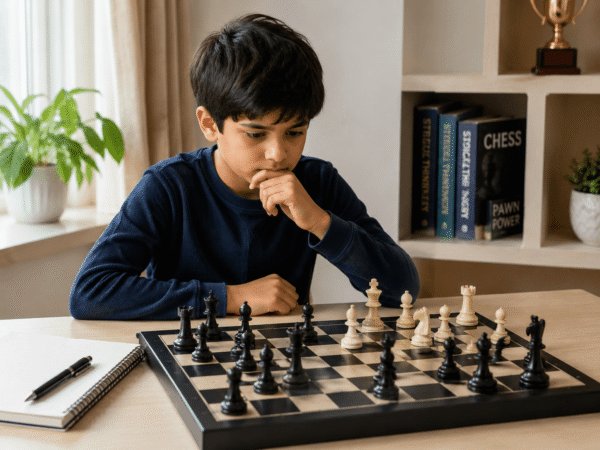
The maths problem gets solved. The homework gets done. Then comes the project that needs planning across a week, and things slow down. Not because the child lacks ability, but because holding a goal across multiple steps is a different skill from solving what sits directly in front of you.
Chess trains the first. Every position is a planning problem that cannot be answered by the next move alone. This is how chess teaches long-term thinking skills to kids through play.
What Is Long-Term Thinking, and Why Does It Matter for Children?
Long-term thinking skills are basically one’s ability to hold a goal in mind, identify the steps to reach it, sequence those steps, and adjust when something changes. This capacity, which researchers call prospective thinking, is the foundation of chess long-term thinking for kids and of strategic thinking for kids across every domain that eventually matters.
This capacity is one of the last executive functions to mature, typically not completing development until the late teens. Children who practise it deliberately build it earlier. A 2025 meta-analysis in SAGE Open confirmed that working memory, the system that holds and updates plans, reliably predicted academic achievement across both early and late developmental stages (Birtwistle et al., SAGE Open, 2025).
Thinking skills are developed following exactly this system, training kids’ long-term thinking in chess by forcing repeated re-sequencing whenever a plan is disrupted mid-game.
| Short-Term Thinking | Long-Term Thinking |
| Reacting to the immediate situation | Anticipating what the board looks like in three moves |
| Choosing the move that looks good right now | Choosing the move that sets up a better position later |
| Responding to a problem once it appears | Recognising a problem while it is still forming |
| Solving the task directly in front of them | Sequencing tasks so the hardest is addressed first |
How Does Chess Encourage Planning Ahead?
Every chess position requires backward induction: starting from the end state you want and working back to the first move that starts building it. Decision making in chess is prospective, not reactive. A child must picture where all their pieces should be in eight moves, identify the obstacles, and find the step that clears the path first.
These are not metaphors for chess-induced planning skills. They are the same cognitive operations applied to a different board.
| Chess Concept | What It Trains | Where It Shows Up |
| Pawn structure decisions | Setting up a position several moves away | Organising a project before the first task starts |
| Piece coordination | Making multiple elements work toward one goal | Contributing to a group without losing the team’s aim |
| Endgame planning | Identifying the win condition and working backward | Scheduling from an exam date backward |
| Prophylaxis | Anticipating the opponent’s plan and preventing it | Spotting what could go wrong before committing |
What Does Learning to Anticipate Consequences Actually Look Like in Chess?
When a trained child considers a move, they run a conditional chain: if I play here, they can go there, which means I need to do this. That is decision making in chess as forward planning, practised under time pressure with a result that arrives within minutes.
A June 2025 study in Revista de Psicología compared children aged 8 to 12 in a structured chess workshop against a matched control group attending a different educational workshop for the same hours. Teacher evaluations recorded measurable improvements in executive functions in the chess group, absent in the control group (Revista de Psicología, 2025), and the gains required structured coaching, not casual play.
A child who has spent a year in this kind of training is more likely to ask what the final answer needs to look like before writing the first line. This critical thinking habit developed through chess in – working toward an end state before moving, carries directly into how a child approaches any multi-step task.
How Do These Thinking Skills Show Up Beyond the Chessboard?
Chess planning skills practised on the board surface in three domains of children’s lives that parents recognise almost immediately.
What Does Long-Term Thinking Look Like in Academic Work?
The critical thinking skills that kids develop in chess builds a habit of planning toward an end state, and this shows up in schoolwork as structuring essays by conclusion first, identifying which part of an assignment takes longest before pressure arrives, and reviewing before submitting. Teachers notice this shift before parents do.
What Does It Look Like in Group Projects and Social Situations?
Piece coordination trains a child to make several elements work simultaneously toward one goal. Strategic thinking for kids is built this way shows up in group work as awareness of how contributions fit together, rather than focus on their own section alone.
What Does It Look Like in Competitive Situations?
Chess trains a child to model what an opponent is building before it arrives, an aspect of decision making in chess that transfers to sport, debates and timed exams as the ability to anticipate a challenge rather than simply absorb it.
How Does Regular Chess Practice Build Strategic Thinking Over Time?
Strategic thinking for kids does not develop from reading about it. Backward induction, conditional reasoning, and consequence mapping are built through repeated planning under real consequences. A child playing unreviewed games online builds pattern recognition but not systematic long-term thinking skills, because those require a coach to name, correct, and reinforce the planning habit each time it is abandoned.
Approximately 46% of users on online chess platforms engage with at least one instructional or learning module rather than treating the platform solely as a game portal, reflecting growing awareness that structured learning and casual play are not interchangeable (Online Chess Instruction and Play Market Report, 2025).
Kaabil Kids’ curriculum, designed by International Grandmaster Tejas Bakre, builds chess planning skills as an explicit teaching goal. FIDE-rated trainers review each child’s games to flag positions where a long-term plan was missing or abandoned, and the in-house psychologist helps children process the frustration of a failed plan. Families looking for online chess classes, online chess coaching, or an online chess tutor that builds this thinking habit will find Kaabil Kids programs structured around exactly this outcome.
Long-term thinking is a trainable skill. In chess, long-term thinking skills are developed through structured coaching, and that coaching ensures the habit transfers rather than staying on the board.
Kaabil Kids gives children aged 5 to 15 a Grandmaster-designed curriculum, FIDE-rated coaching and in-house psychological support, built around strategic thinking for kids that shows up in exams, projects and decisions long after the pieces are put away.
Explore online chess coaching for kids | Book a free trial class
What Do Parents Most Often Ask About Chess and Long-Term Thinking?
Does chess actually improve long-term thinking skills in children?
Research supports this for the cognitive mechanisms chess directly trains: backward induction, conditional reasoning, and consequence mapping. A 2025 study found that children aged 8 to 12 in a structured chess workshop showed teacher-evaluated gains in executive functions absent in a matched control group. In chess, long-term thinking for kids builds through coached play, not unreviewed games.
At what age does a child begin to develop long-term thinking through chess?
Planning is trainable from early childhood. Kaabil Kids works with children aged 5 to 15. Those who begin structured training between ages 7 and 11 typically show the clearest gains in chess planning skills, as that window is especially responsive to executive function development.
How is chess different from other activities for building planning skills?
Most activities build planning indirectly. Chess builds backward induction directly: working from a desired outcome back to the present move. That structure is identical to what project-based schoolwork and competitive exams require. Through chess, critical thinking skills honed by children operate over a longer horizon than most childhood activities can reach.
How long does it take to see strategic thinking improve through chess?
Coaches and teachers typically notice shifts in how a child approaches multi-step tasks within six to twelve months of consistent structured practice. The change shows in how a child begins a project, which is exactly where decision making in chess trains the eye to look first.