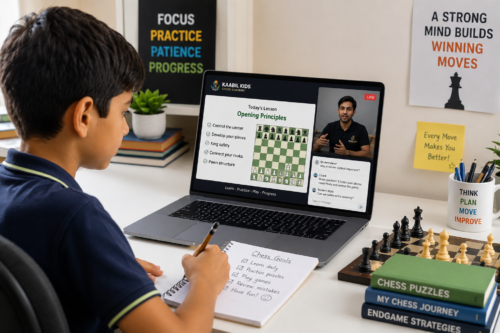
Every online chess platform claims to be effective. Parents researching online chess classes for kids hear the same promises: better focus, sharper thinking, more confidence from almost every website they visit. The claims sound identical because the outcomes are real. What differs, often invisibly, is whether the curriculum behind those classes is actually built to produce them.
An effective online chess curriculum for kids is not a playlist of chess topics taught in a convenient order. It is a sequence, deliberately staged so that each lesson depends on the one before it, taught by someone who adjusts to how a specific child is progressing. That distinction is exactly why Kaabil Kids’ curriculum works for children where a loose collection of lessons does not. This article breaks down what makes a chess curriculum genuinely effective, and how Kaabil Kids applies each of those principles.
Why a Structured Curriculum Matters More Than Random Lessons
A child can attend twenty chess sessions and still plateau if those sessions were not sequenced. Random lessons an opening one week, an endgame puzzle the next, a tactics worksheet after that expose a child to ideas without ever building on them. A structured curriculum does the opposite: fundamentals lead into tactics, tactics lead into opening principles, and opening principles lead into endgame technique, each stage reinforcing the last.
This is not just a teaching preference; the research backs it. A meta-analysis covering 24 separate studies found that chess instruction produced measurable gains in mathematics and general cognitive ability in schoolchildren, but the benefit only became reliable after roughly twenty-five to thirty hours of instruction about a school year of consistent, weekly lessons (Frontiers in Psychology, Sala & Gobet). A one-off webinar or an unstructured trial session simply cannot reach that threshold. Consistency and sequence, not exposure alone, are what convert chess coaching for kids into real cognitive gains.
This is also why a genuine chess academy for kids is judged less by how many topics it covers and more by whether those topics are taught in an order the child’s brain can actually absorb.
Key Elements Every Effective Chess Class for Kids Should Include
Before evaluating any chess class for kids, it helps to know what separates a well-designed one from a generic video call. Look for these five elements:
- A sequenced curriculum fundamentals, tactics, opening principles and endgames taught in that order, not mixed at random.
- Live instruction, not recording a coach who sees how a specific child thinks and adjusts pace and difficulty in real time.
- Small batch sizes enough individual attention that a coach notices a recurring mistake instead of moving on regardless.
- Regular assessment clear checkpoints that confirm a stage is genuinely solid before the next one begins.
- Visible progress reporting parents should be able to see what their child has learned, not just that a class happened.
A curriculum missing even one of these tends to produce children who can recite rules but freeze in an actual game. All five working together is what makes chess coaching for kids genuinely effective rather than merely entertaining.
How Age-Appropriate Content Keeps Kids Engaged
A five-year-old and a twelve-year-old cannot learn chess the same way, even if they are both complete beginners. Younger children hold attention through stories, colours and short, game-like activities. A knight is easier to remember as a character that jumps than as a piece that moves in an L-shape. Older children respond better to logic, cause-and-effect reasoning and the satisfaction of solving a genuinely difficult puzzle.
Developmentally appropriate teaching is a well-established principle in early education: content that matches a child’s cognitive stage holds engagement, while content pitched above or below that stage causes boredom or frustration within minutes. A curriculum built for one age group and stretched across all of them will eventually lose either the youngest or the oldest learners in the room which is precisely why age-banded teaching matters as much for kids online classes as it does in a physical classroom.
The Balance Between Theory, Practice, and Play
Three ingredients build chess skill, and a curriculum that overweights any one of them stalls a child’s progress:
- Theory teaches the why behind a move, the principle behind an opening, the logic of an endgame technique.
- Practice builds recognition solving tactics puzzles until a pattern like a fork or a pin is spotted instantly.
- Play tests transfer applying theory and practice under the pressure of a real, unscripted game.
Too much theory produces a child who can explain chess but hesitates to play it. Too much unsupervised play produces a child who repeats the same mistakes indefinitely, because nobody reviewed the game afterwards to show where it went wrong. The strongest online chess classes for kids rotate deliberately between all three, with a coach reviewing actual games so puzzle-solving skill genuinely transfers to the board.
How Progress Is Measured in a Well-Designed Curriculum
“Is my child actually improving?” is the question every parent eventually asks, and a well-designed curriculum should be able to answer it with specifics rather than reassurance. Meaningful measurement includes:
- Stage completion confirming fundamentals, tactics, openings and endgames are each genuinely solid before moving on.
- Tactics accuracy how consistently a child spots patterns like forks, pins and skewers under time pressure.
- Game review notes specific, recurring errors identified across a child’s actual games, not generic feedback.
- Formal ratings, where relevant competitive players can track measurable improvement through the rating system maintained by FIDE, chess’s global governing body.
A curriculum that cannot show a parent concrete evidence of progress beyond attendance is not actually measuring learning. It is simply logging hours.
How Kaabil Kids Builds a Curriculum That Grows With Your Child
Kaabil Kids applies every principle above by design rather than by accident. The curriculum is sequenced by International Grandmaster Tejas Bakre and delivered live by FIDE-rated trainers, so children move through fundamentals, tactics, opening principles and endgames in the order that actually builds skill, not the order that fits a syllabus.
Classes are taught in small batches so each child gets individual correction rather than generic instruction, and content is age-banded across children aged 5 to 15, so a five-year-old and a thirteen-year-old are never taught the same way. An in-house psychologist works alongside the coaching team to support motivation and focus, which matters as much to long-term progress as the chess content itself. Parents receive visibility into how their child is actually progressing, stage by stage, rather than a generic attendance update.
Families exploring online learning for kids that combines cognitive development with a genuinely structured subject will find this is precisely what Kaabil Kids was built around a curriculum designed to grow with a child rather than one a child eventually outgrows.
Conclusion
An effective online chess curriculum for kids is not defined by how many topics it covers, but by how deliberately those topics are sequenced, how well they are matched to a child’s age, how consistently theory, practice and play are balanced, and how clearly progress is measured along the way. Kaabil Kids builds every one of those elements into a single programme, sequenced by a Grandmaster, delivered by FIDE-rated trainers, and supported by an in-house psychologist for children aged 5 to 15.
If you are comparing chess classes for kids and want to see what a genuinely structured curriculum looks like in practice, book a free trial class with Kaabil Kids.
Frequently Asked Questions
Q1. What makes an online chess curriculum effective for kids?
An effective curriculum sequences fundamentals, tactics, opening principles and endgames in that exact order, taught live by a coach who adjusts to the child and reviews actual games. Structure and consistency, not just the number of topics covered are what make a curriculum work.
Q2. How is Kaabil Kids’ curriculum different from other online chess classes for kids?
Kaabil Kids combines a Grandmaster-designed sequence, FIDE-rated live trainers, small batch sizes, age-banded content for children 5 to 15, and in-house psychologist support for motivation. Most platforms offer one or two of these; Kaabil Kids is built around all of them together.
Q3. Is online chess coaching as effective as in-person classes?
Yes, when the online format is live and structured rather than pre-recorded. Research on chess instruction shows the benefit comes from consistent, sequenced practice with feedback, a condition that live online classes meet just as well as in-person ones, with the added convenience of not needing to travel.
Q4. Can beginners join chess classes for beginners at Kaabil Kids?
Yes. The curriculum starts at the fundamentals stage for children with zero prior experience and progresses through tactics, openings and endgames as each stage becomes solid, so a complete beginner and a returning player are never placed on the same starting point.
Q5. When will parents see progress in their child’s chess skills?
Most families notice early signs of better focus and faster piece recognition within the first few weeks, while measurable tactical and strategic improvement typically builds over several months of consistent, weekly classes. Progress reports and stage completions give parents visible checkpoints along the way rather than a guess.