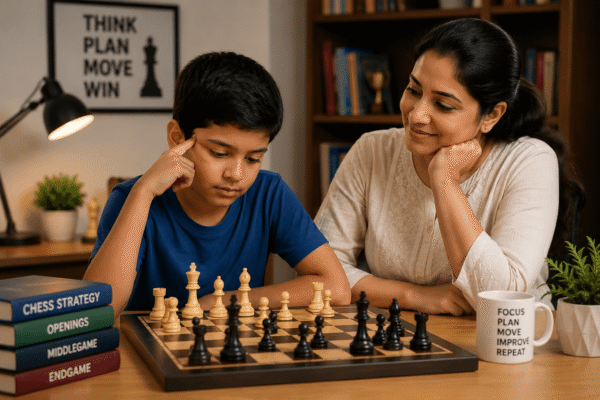
Two children start chess lessons on the same day, with the same coach, using the same beginner curriculum. Three months later, one is confidently spotting forks and setting up simple checkmates. The other is still double-checking how a knight moves. A parent watching this happen naturally starts to worry.
That worry is common, and it is almost always unnecessary. Every child learns chess at a different pace, and that difference says very little about how good they will eventually become. Chess brings together memory, visual pattern recognition, planning, patience and emotional control, and children develop each of these skills on its own timeline. This guide explains what actually shapes a child’s learning speed, why comparing children to their peers can quietly do more harm than good, and how the right online chess tutor works with a child’s natural pace instead of against it.
Understanding Learning Pace vs Learning Ability
Learning pace and learning ability are not the same thing, though parents often treat them as one. Pace is how quickly a child moves through a concept. Ability is how deeply they understand it and how well they can use it once it clicks. A child who takes longer to grasp how pieces coordinate is not necessarily less capable; they may simply need more repetition before a concept becomes automatic.
Developmental research backs this up. A study published by researchers at Stanford University found that children who learn certain skills faster are also better at transferring that knowledge to new situations, but the study also found wide, normal variation in how quickly individual children reached the same level of mastery (Qin et al., PMC, 2020). In other words, speed and depth of understanding are related but separate, and a slower start does not predict a lower ceiling.
In chess specifically, this shows up constantly. A child who is slow to memorise piece movement may turn out to be unusually good at spotting patterns once the fundamentals settle in. Judging a child’s chess future by their first few weeks is a bit like judging a swimmer by how long they took to learn to float.
What Influences How Quickly a Child Grasps Chess Concepts
Several factors combine to shape how fast any individual child moves through the early stages of chess, and almost none of them are within a parent’s control on day one.
- Age and developmental stage: younger children are often still developing the working memory needed to hold several moves in mind at once, so a 6-year-old and a 10-year-old will naturally progress differently even with identical instruction.
- Attention span and temperament: some children dive into a new board position immediately, while more cautious children prefer to watch and absorb before attempting a move themselves. Neither approach is wrong.
- Prior exposure to logic and pattern-based activities: children who have played puzzles, strategy games or building activities often recognise chess patterns faster simply because the underlying skill is not brand new.
- Learning style: some children absorb concepts by watching a coach demonstrate, others need to physically move the pieces themselves several times before a rule sticks.
- Emotional readiness: a child who is anxious about making mistakes will often move cautiously through new material, not because they cannot grasp it, but because they are protecting themselves from getting it wrong.
- Quality and consistency of instruction: a structured sequence delivered through consistent kids chess coaching tends to produce steadier progress than sporadic, unstructured practice, regardless of how quickly a child would otherwise learn.
None of these factors are fixed. A child who starts cautiously at age 6 often becomes one of the more confident players in the group by age 9, once working memory and attention span catch up.
Why Comparing Your Child’s Progress to Others Can Backfire
It is tempting to measure progress against a sibling, a classmate, or another child in the same online chess classes for kids. Resist it. Comparison rarely motivates a child who is moving more slowly; it usually does the opposite.
A 2024 study published in the Journal of Applied Developmental Psychology found that children who perceived their parents comparing them to peers showed measurably lower mastery motivation, the drive to improve a skill for its own sake, regardless of how the children were actually performing. The comparison itself, not the child’s real ability, was what dampened their motivation.
This matters in chess more than in most activities, because chess punishes hesitation. A child who is already anxious about being “behind” tends to play more cautiously, avoid difficult positions, and give up faster after a loss. That is the opposite of what a chess improvement plan needs. The more useful comparison is a child’s own board from a month ago, not another child’s board today.
How a Dedicated Online Chess Tutor Adapts to Each Child’s Speed
This is exactly where a dedicated online chess tutor earns their value over a generic app or a pre-recorded course. Software can adjust puzzle difficulty, but it cannot notice that a child understands a fork in theory yet freezes when one appears in a live game. A trainer can.
Live chess coaching lets a tutor slow down the moment a concept has not landed, revisit a rule from a different angle, or move faster through material a child has clearly mastered instead of holding the whole group to one fixed schedule. Over a series of sessions, an experienced online chess coach starts to recognise a child’s specific pattern: whether they need extra repetition on rules but grasp tactics quickly, or the reverse.
This kind of real-time adjustment is difficult to replicate through self-paced videos alone, which is one reason structured chess coaching online, built around small groups or individual attention, tends to produce steadier, more confidence-building progress than solo app-based practice.
Signs of Real Progress That Have Nothing to Do With Speed
Parents watching for progress often look for the wrong signal: how fast a child is moving through levels. These signs matter more, and every one of them can appear in a child who is progressing slowly by the calendar.
- Staying calm and thinking clearly after losing a piece, instead of giving up on the game
- Asking better questions during a session, such as why a move is strong rather than only what move to make
- Pausing before moving, a sign that planning is starting to happen internally
- Remembering and applying a correction from a previous session without being reminded
- Wanting to play another game after a loss instead of walking away from the board
These behaviours reflect exactly the skills that research links to chess training: concentration, planning and problem-solving. A controlled study on chess instruction and mathematical problem-solving published on PMC found that structured chess instruction improved children’s problem-solving performance more than an active control activity, with the benefit tied to sustained, guided practice rather than raw speed of progress. A child building these habits is developing exactly what the chess improvement roadmap is meant to produce, even if their rating or level badge is climbing slowly.
How Kaabil Kids Personalizes Learning for Every Pace
Kaabil Kids builds its programme around the reality that no two children learn chess at the same speed. Every curriculum is designed by International Grandmaster Tejas Bakre and delivered by FIDE-rated trainers through live online chess classes, which means a trainer can see, in real time, exactly where a child needs more time and where they are ready to move ahead.
Small class sizes and close trainer attention allow lessons to bend around a child’s pace instead of forcing every child through an identical timeline. An in-house psychologist also works alongside the coaching team, supporting children who feel discouraged by comparison or slow starts, so that motivation stays intact while skills are still developing.
Families looking for an online chess academy that treats a child’s individual pace as normal, rather than as a problem to fix, will find that Kaabil Kids’ online chess tutor-led format is built around exactly that approach.
Conclusion
Every child learns chess at a different pace, and that pace is shaped by age, temperament, prior experience and the quality of instruction, not by how naturally talented a child is. Comparing children to their peers tends to lower motivation rather than raise performance, while the real markers of progress, like calmer decision-making and genuine curiosity about the game, often show up long before a child’s speed does.
Kaabil Kids’ chess academy online is built for exactly this kind of individual progress, combining a Grandmaster-designed curriculum, FIDE-rated trainers and in-house psychological support for children aged 5 to 15. Explore Kaabil Kids’ online chess coaching or book a free trial class to see how your child’s own pace can become their strength.
Frequently Asked Questions
Q1. Why do children learn chess at different speeds?
Children learn chess at different speeds because chess draws on several skills at once, including memory, visual pattern recognition, planning and emotional control, and each of these develops on its own timeline. Age, temperament, prior exposure to logic-based games, and the consistency of coaching all shape how quickly a specific child moves through the early stages.
Q2. Is it normal for a child to progress slowly in chess?
Yes, slow early progress is normal and does not predict how strong a child will eventually become. Many children who take longer to grasp the fundamentals go on to develop excellent tactical vision once those basics settle in, because a slower start often reflects careful processing rather than a lack of ability.
Q3. How long does it take a child to get good at chess?
There is no fixed timeline, since it depends on the child’s age, attention span and how consistently they practise. With regular, structured beginner chess lessons, most children move through the fundamentals, basic tactics, opening principles and simple endgames within several months to a year, though the exact pace varies widely from child to child.
Q4. Can a slow starter still become a strong chess player?
Yes. A slow start in chess says very little about a child’s eventual ceiling. Children who need more repetition early on often build a more solid foundation, which tends to support faster, more confident progress once the fundamentals are fully absorbed.
Q5. What should parents do if their child is learning chess slower than classmates?
Avoid comparing your child’s pace to their classmates’, since comparison tends to lower motivation rather than raise performance. Instead, track your child’s own progress over time, praise effort and thinking rather than speed, and consider a trainer or online chess coach who can adjust pacing to your child’s specific needs.