How Does Chess Help Kids Develop Long-Term Thinking Skills?

The maths problem gets solved. The homework gets done. Then comes the project that needs planning across a week, and things slow down. Not because the child lacks ability, but because holding a goal across multiple steps is a different skill from solving what sits directly in front of you.

Chess trains the first. Every position is a planning problem that cannot be answered by the next move alone. This is how chess teaches long-term thinking skills to kids through play.

What Is Long-Term Thinking, and Why Does It Matter for Children?

Long-term thinking skills are basically one’s ability to hold a goal in mind, identify the steps to reach it, sequence those steps, and adjust when something changes. This capacity, which researchers call prospective thinking, is the foundation of chess long-term thinking for kids and of strategic thinking for kids across every domain that eventually matters.

This capacity is one of the last executive functions to mature, typically not completing development until the late teens. Children who practise it deliberately build it earlier. A 2025 meta-analysis in SAGE Open confirmed that working memory, the system that holds and updates plans, reliably predicted academic achievement across both early and late developmental stages (Birtwistle et al., SAGE Open, 2025).

Thinking skills are developed following exactly this system, training kids’ long-term thinking in chess by forcing repeated re-sequencing whenever a plan is disrupted mid-game.

Short-Term ThinkingLong-Term Thinking
Reacting to the immediate situationAnticipating what the board looks like in three moves
Choosing the move that looks good right nowChoosing the move that sets up a better position later
Responding to a problem once it appearsRecognising a problem while it is still forming
Solving the task directly in front of themSequencing tasks so the hardest is addressed first

How Does Chess Encourage Planning Ahead?

Every chess position requires backward induction: starting from the end state you want and working back to the first move that starts building it. Decision making in chess is prospective, not reactive. A child must picture where all their pieces should be in eight moves, identify the obstacles, and find the step that clears the path first.

These are not metaphors for chess-induced planning skills. They are the same cognitive operations applied to a different board.

Chess ConceptWhat It TrainsWhere It Shows Up
Pawn structure decisionsSetting up a position several moves awayOrganising a project before the first task starts
Piece coordinationMaking multiple elements work toward one goalContributing to a group without losing the team’s aim
Endgame planningIdentifying the win condition and working backwardScheduling from an exam date backward
ProphylaxisAnticipating the opponent’s plan and preventing itSpotting what could go wrong before committing

What Does Learning to Anticipate Consequences Actually Look Like in Chess?

When a trained child considers a move, they run a conditional chain: if I play here, they can go there, which means I need to do this. That is decision making in chess as forward planning, practised under time pressure with a result that arrives within minutes.

A June 2025 study in Revista de Psicología compared children aged 8 to 12 in a structured chess workshop against a matched control group attending a different educational workshop for the same hours. Teacher evaluations recorded measurable improvements in executive functions in the chess group, absent in the control group (Revista de Psicología, 2025), and the gains required structured coaching, not casual play.

A child who has spent a year in this kind of training is more likely to ask what the final answer needs to look like before writing the first line. This critical thinking habit developed through chess in – working toward an end state before moving, carries directly into how a child approaches any multi-step task.

How Do These Thinking Skills Show Up Beyond the Chessboard?

Chess planning skills practised on the board surface in three domains of children’s lives that parents recognise almost immediately.

What Does Long-Term Thinking Look Like in Academic Work?

The critical thinking skills that kids develop in chess builds a habit of planning toward an end state, and this shows up in schoolwork as structuring essays by conclusion first, identifying which part of an assignment takes longest before pressure arrives, and reviewing before submitting. Teachers notice this shift before parents do.

What Does It Look Like in Group Projects and Social Situations?

Piece coordination trains a child to make several elements work simultaneously toward one goal. Strategic thinking for kids is built this way shows up in group work as awareness of how contributions fit together, rather than focus on their own section alone.

What Does It Look Like in Competitive Situations? 

Chess trains a child to model what an opponent is building before it arrives, an aspect of decision making in chess that transfers to sport, debates and timed exams as the ability to anticipate a challenge rather than simply absorb it.

How Does Regular Chess Practice Build Strategic Thinking Over Time?

Strategic thinking for kids does not develop from reading about it. Backward induction, conditional reasoning, and consequence mapping are built through repeated planning under real consequences. A child playing unreviewed games online builds pattern recognition but not systematic long-term thinking skills, because those require a coach to name, correct, and reinforce the planning habit each time it is abandoned.

Approximately 46% of users on online chess platforms engage with at least one instructional or learning module rather than treating the platform solely as a game portal, reflecting growing awareness that structured learning and casual play are not interchangeable (Online Chess Instruction and Play Market Report, 2025).

Kaabil Kids’ curriculum, designed by International Grandmaster Tejas Bakre, builds chess planning skills as an explicit teaching goal. FIDE-rated trainers review each child’s games to flag positions where a long-term plan was missing or abandoned, and the in-house psychologist helps children process the frustration of a failed plan. Families looking for online chess classes, online chess coaching, or an online chess tutor that builds this thinking habit will find Kaabil Kids programs structured around exactly this outcome.

Long-term thinking is a trainable skill. In chess, long-term thinking skills are developed through structured coaching, and that coaching ensures the habit transfers rather than staying on the board.

Kaabil Kids gives children aged 5 to 15 a Grandmaster-designed curriculum, FIDE-rated coaching and in-house psychological support, built around strategic thinking for kids that shows up in exams, projects and decisions long after the pieces are put away.

Explore online chess coaching for kids | Book a free trial class

What Do Parents Most Often Ask About Chess and Long-Term Thinking?

Does chess actually improve long-term thinking skills in children? 

Research supports this for the cognitive mechanisms chess directly trains: backward induction, conditional reasoning, and consequence mapping. A 2025 study found that children aged 8 to 12 in a structured chess workshop showed teacher-evaluated gains in executive functions absent in a matched control group. In chess, long-term thinking for kids builds through coached play, not unreviewed games.

At what age does a child begin to develop long-term thinking through chess?

Planning is trainable from early childhood. Kaabil Kids works with children aged 5 to 15. Those who begin structured training between ages 7 and 11 typically show the clearest gains in chess planning skills, as that window is especially responsive to executive function development.

How is chess different from other activities for building planning skills?

Most activities build planning indirectly. Chess builds backward induction directly: working from a desired outcome back to the present move. That structure is identical to what project-based schoolwork and competitive exams require. Through chess, critical thinking skills honed by children operate over a longer horizon than most childhood activities can reach.

How long does it take to see strategic thinking improve through chess?

Coaches and teachers typically notice shifts in how a child approaches multi-step tasks within six to twelve months of consistent structured practice. The change shows in how a child begins a project, which is exactly where decision making in chess trains the eye to look first.

What Happens in an Online Chess Class for Beginners?

The video call connects. The chess board appears on screen. Your child sits there, half-curious, half-suspicious, and you realize you have no idea what the next 45 minutes are supposed to look like.

That uncertainty is the most common reason parents delay booking a class for weeks after deciding chess is worth pursuing. Nobody wants to pay for something they cannot picture. And for chess especially, the imagination tends to jump straight to grandmaster theory and memorized openings, neither of which describes what a beginner actually does.

Online chess classes for beginners look nothing like a lecture and nothing like a self-paced app. This covers what happens in the first session, what a child can do by week four, and what to check before choosing any programme.

The timing matters too. As of December 2024, India has 85 chess grandmasters with 13 ranked among the world’s top 100 players, and following Gukesh Dommaraju’s World Championship victory, chess academies across major cities and tier-two towns are now running at full capacity (Chess in India, Wikipedia, 2024; WION Year-Ender, 2025). The question for parents is not whether chess is worth pursuing. It is how to make sure the class their child joins is actually worth the screen time.

What Do Kids Actually Learn in Their First Online Chess Classes?

Most parents expect openings. Most beginners get something far more useful: the names and movements of all six pieces, how a game starts and ends, and what it means when a king is under threat. That is enough for a first chess lesson for beginners, and a good coach knows it.

By the end of a typical beginner sequence, a child can set up a board independently, spot checkmate in one move, and play a complete legal game without needing prompts from an adult. These are concrete, testable milestones, not vague improvements that are hard to see from the sofa.

Week| What Gets Covered
Week 1| Names and movement of all six pieces; how a game starts and ends
Week 2| Basic captures; understanding checks and how to escape check
Week 3| Simple tactics: forks, pins and basic checkmate patterns
Week 4| Playing a supervised full game with review and one specific goal

Pace matters as much as content in chess lessons for beginners. A child who feels capable at the end of week one is far more likely to return for week two than one who has been rushed into complicated material.

How Do Online Chess Classes Work for Complete Beginners?

A beginner session runs on a video call paired with a shared interactive chess board. The coach demonstrates a position by moving pieces on the shared board, and the child practises on the same board in real time. Nobody is pointing at a physical board and hoping the camera angle is right.

A well-run session has four clear parts:

Time Block| What Happens
0–10 min| Recap of the last lesson; warm-up puzzle or piece-movement drill
10–25 min| New concept introduced with a live demonstration on the shared board
25–40 min| Child practises: guided play, mini game or tactical exercise while the coach observes
40–45 min| Session review; one specific takeaway the child is asked to remember

Kaabil Kids’ online chess classes for beginners follow this live, interactive structure, with FIDE-rated trainers guiding each child through a curriculum designed by International Grandmaster Tejas Bakre. No beginner is left to navigate a lesson sequence alone.

What Skills Are Taught to Beginners in Online Chess Classes?

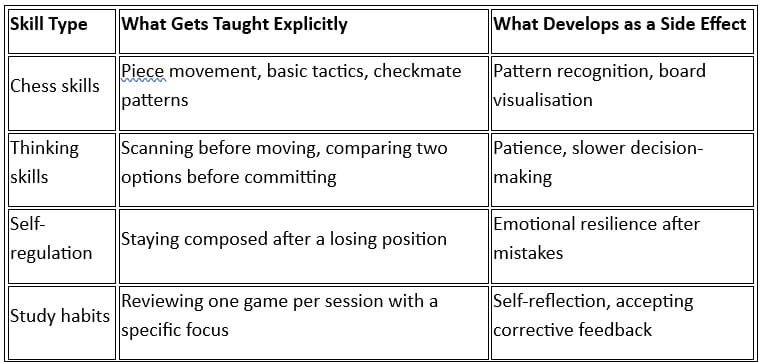
Chess lessons for beginners cover more than chess. The skills that show up in classrooms and friendships often develop as a side effect of chess-specific training, but a well-designed programme plans for both columns deliberately.

online chess classes for beginners

Most beginner chess coaching handles the chess column well. Kaabil Kids’ in-house psychologist works on the self-regulation row specifically, supporting children through the emotional side of losing a position, which most online programmes leave entirely to chance.

Why Is Learning Chess With a Coach Better Than Learning Alone?

The realistic alternative a parent compares online chess classes for beginners against is apps and YouTube. Both have value. Neither can replicate a coach watching how a child thinks rather than just which square they click.

A child working through puzzles alone can develop the habit of trying the first move that looks appealing, getting it wrong, and trying the next one, without ever building the discipline of checking before committing. That habit, repeated across hundreds of puzzles, is harder to undo later than it is to prevent early with guided instruction.

Youth registrations on online chess platforms have grown 27% since 2023, driven largely by parental interest in cognitive development and structured learning rather than casual play (Online Chess Instruction and Play Market Report, 2025). Parents researching how to learn chess online for kids are not looking for more screen time. They are looking for a coach who watches, corrects and explains, the one thing an app genuinely cannot provide.

Beginner chess coaching fills exactly that gap. A trainer who asks “why did you play that piece?” after every game builds the habit of reasoning out loud, not just moving. That separates useful chess lessons for beginners from simply moving pieces around without thinking. For families evaluating chess classes for kids online, this distinction is the most useful one to carry into a buying decision.

How Do You Choose the Right Online Chess Programme for Your Child?

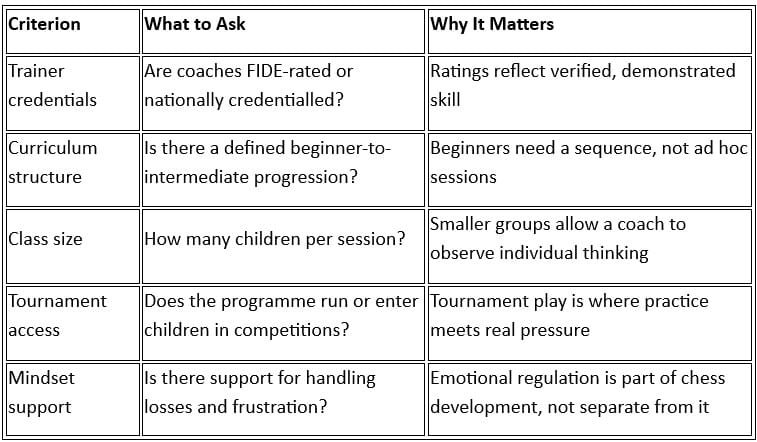
Online chess classes for beginners vary enormously in quality, structure and what they actually deliver. A useful framework covers five criteria:

Online chess classes for beginners

Kaabil Kids meets every criterion above: FIDE-rated trainers, a Grandmaster-designed curriculum spanning beginner, intermediate and advanced tracks, small-group live sessions, regular tournaments and an in-house psychologist for mindset support. As a beginner chess coaching platform for children aged 5 to 15, it treats all five areas as part of the same programme rather than optional extras.

A child’s first experience of beginner chess coaching is not complicated when the programme is well-designed. They show up, learn the pieces, and leave having done something concrete. That is how chess classes for kids online are supposed to work: each session building on the one before it.

Explore Kaabil Kids’ online chess coaching for beginners | Book a free trial class

What Do Parents Most Often Ask About Online Chess Classes for Beginners? 

What happens in the first online chess class for a beginner?

A well-run first session covers the names and movements of all six pieces, how a game starts and ends, and usually one simple concept such as how the king gets into check. The child practises on a shared interactive board while the coach watches and corrects in real time. No prior knowledge is needed to join online chess classes for beginners, whether you choose to learn chess online for kids or through a local club.

What age can children start online chess classes?

The best age to learn chess online for kids is generally five or six, when pattern recognition develops quickly. Kaabil Kids covers ages 5 to 15, adjusting pace and complexity for each group. Younger children have fewer ingrained habits to unlearn, which makes earlier starts more efficient than later ones.

How long are online chess lessons for beginners?

Most chess classes for kids online run between 45 and 60 minutes for beginners, split across instruction, supervised practice and review. Children aged five to seven do better with sessions at the shorter end; focus tends to hold well up to about 30 to 40 minutes.

What does a child need to join an online chess class?

A device with a camera and a stable internet connection is enough to get started with beginner chess coaching online. No physical chess board is required, since the shared digital board handles everything during a live session. Some programmes suggest a physical board for practice between lessons, but it is not a requirement for the first class.

Chess is often viewed as a game of strategy and tactics, but its psychological elements are vital to achieving success. The ability to maintain focus, manage emotions, and develop mental resilience can significantly influence your performance on the chessboard. This blog post will explore the psychology of chess and offer practical tips on how to develop mental toughness, helping you stay calm under pressure. 

If you want to enhance your kid’s skills, enroll in online chess classes at Kaabil Kids. 

Understanding the Psychology of Chess 

Chess is a complex game that demands intense mental effort. To succeed, players must grasp several psychological aspects, such as patience, focus, and emotional control. Understanding these factors will help you develop the mental toughness required for chess. 

The Importance of Patience 

Patience is crucial in chess. It’s easy to become frustrated when the game doesn’t go as planned or when faced with a tough opponent. Staying patient allows you to think clearly, make better decisions, and avoid hasty moves that could lead to mistakes. When you practice online chess classes, you’ll learn that taking your time to analyze each position is essential for improvement. 

Maintaining Focus 

Chess games can last for hours, requiring players to concentrate for extended periods. Distractions can lead to blunders, so it’s important to develop your ability to stay focused. By recognizing when your mind starts to wander, you can practice redirecting your attention back to the board. 

Developing Mental Resilience 

Setbacks and mistakes are part of chess, even for experienced players. Developing mental resilience enables you to bounce back from these challenges and continue to perform at a high level. Here are a few strategies to help build resilience: 

Learn from Mistakes 

Every loss is an opportunity to learn. Instead of dwelling on your errors, analyze what went wrong and how you can improve. This proactive approach helps you maintain a positive mindset and prepares you for future games. 

Maintain a Positive Attitude 

A positive attitude can significantly affect your performance. Embrace the idea that every game is a chance to grow and improve, regardless of the outcome. Online chess classes for kids often emphasize this aspect, encouraging them to view challenges as opportunities rather than obstacles. 

Practicing Mindfulness 

Mindfulness entails remaining present and focused on the current moment. Practicing mindfulness can enhance your performance by reducing anxiety and increasing concentration. Here are a few mindfulness techniques you can incorporate into your chess routine: 

Focus on Your Breathing 

When you feel anxious or overwhelmed during a game, take a moment to focus on your breathing. Deep, slow breaths can help calm your nerves and bring your attention back to the board. This practice is especially useful when you feel the pressure building. 

Pay Attention to Sensations 

Being aware of the physical sensations in your body can help ground you in the present moment. Notice how your fingers feel on the pieces or the chair beneath you. This focus can help you stay engaged in the game and reduce distractions. 

Visualizing Success 

Visualization is a powerful tool that can enhance your confidence and mental toughness. Here’s how to effectively use visualization to prepare for your chess games: 

Picture Yourself Succeeding 

Before a game, take a moment to visualize yourself playing well. Imagine making strategic moves, staying focused, and ultimately winning the match. This positive mental imagery can boost your confidence and set a successful mindset for your game. 

Practice Positive Self-Talk 

Along with visualization, positive self-talk is a great way to reinforce your confidence. Remind yourself of your skills and abilities and affirm your commitment to doing your best. This practice can help you remain calm and collected during high-pressure moments. 

Managing Your Emotions 

Chess can evoke strong emotions, from excitement to frustration. It is essential to learn how to control these emotions in order to stay focused. The following techniques will assist you in controlling your emotions:  

Stay Calm Under Pressure 

When you feel anxious or frustrated, try to take a step back. If possible, pause and take a few deep breaths before making your next move. This moment of reflection can help you regain composure and think more clearly. 

Recognize Emotional Triggers 

Understanding what drives your emotions can help you regulate them more effectively. If you notice certain situations making you anxious, such as facing a stronger opponent or being in a losing position, develop strategies to cope with these feelings before they impact your game. 

Setting Realistic Goals 

Setting achievable goals can keep you motivated and focused during your chess journey. Here are some suggestions for effective goal setting:  

Instead of fixating on winning or losing, set smaller, manageable goals for each game. For example, you might aim to make fewer mistakes or to improve your opening strategies. These smaller goals can provide a sense of accomplishment and motivate you to keep learning. 

Celebrate Progress 

Acknowledge and honor your accomplishments, no matter how minor. Whether you’ve improved your focus or learned a new tactic, acknowledging your progress will help keep you motivated on your chess journey. 

Conclusion 

Developing mental toughness is essential for succeeding in chess. By understanding the psychological aspects of the game, cultivating mental resilience, practicing mindfulness, visualizing success, managing your emotions, and setting realistic goals, you can enhance your psychological skills. These tools will help you stay focused and perform your best, regardless of the challenges you face during a game. 

If you’re looking to improve your chess skills and develop mental toughness, learn chess online at Kaabil Kids. Our classes are designed to help players build their strategic abilities and the psychological skills necessary for success in chess and beyond. Consider online chess classes for kids and unlock their full potential! 

Chess, the game of kings, has enthralled people for millennia. Whether you’re a novice trying to learn the fundamentals or an experienced player looking to improve your abilities, a professional chess school may make a significant difference in your chess journey. This blog article investigates how enrolling in a chess school may significantly enhance your game, including information on the advantages, techniques, and long-term effects of a professional chess academy.

The Foundations of Chess Mastery

A professional chess school offers a regulated atmosphere in which players of all skill levels may develop a firm foundation in chess. Unlike self-study or casual play, an academy provides a structured way to study the game. Even experienced players might benefit from reviewing the basics. A chess school guarantees that you have a thorough knowledge of fundamental principles, including piece movement, board management, and basic tactics. This foundation is essential for gaining more sophisticated talents later on.

Ways of professional chess academies helps in improving the game. 

Strategic Thinking Development

Chess schools concentrate on teaching strategic thinking rather than merely memorizing moves. You’ll learn how to assess situations, plan many actions, and grasp the long-term consequences of your board choices. This strategic approach distinguishes casual gamers from serious opponents.

Tactical Awareness

Tactics are the building elements of chess strategy. A decent school will teach you common tactical concepts like forks, pins, skewers, and discovered assaults. Regular tactical training improves your ability to identify these possibilities in actual games, providing you with a massive advantage over opponents who lack this concentrated experience.

Expert instruction and personalized feedback

One of the most important benefits of attending a chess school is the opportunity to get expert instruction. Professional academies use experienced trainers, who often include named players like International Masters (IMs) and Grandmasters (GMs). Learning from high-level players may bring essential insights and motivation.

Unlike online courses or books, a chess school provides individualized comments on your games. Coaches can identify your skills and shortcomings, allowing you to concentrate your training on the areas that need the most significant progress. This personalized strategy guarantees that you’re constantly focusing on the most critical areas of your gameplay.

Structured Curriculum and Progressive Learning

A professional chess school usually provides a well-structured program that gradually builds abilities. Starting with simple principles and progressing to more complex methods, this systematic approach guarantees that you are continually pushing yourself without feeling overwhelmed. An excellent school covers all areas of the game, from opening theory to middlegame strategy, endgame approaches, and even the psychological aspects of competitive play.

Exposure to various playing styles

One of the primary advantages of a chess school is exposure to a range of playing styles. Academies often conduct regular sparring sessions in which you may compete against opponents of different skill levels. This experience prepares you to adapt to diverse playing styles and increases your flexibility as a player. Furthermore, analyzing games played by chess masters is an essential component of chess instruction. Academies often feature sessions where historical and recent master games are dissected, allowing you to grasp high-level strategic and tactical principles.

Tournament Preparation and Competition Experience

Academies provide crucial training for individuals who want to play competitive chess. You’ll learn how to prepare for tournaments, manage your time during games, and deal with the psychological stress of competitive play. Many schools hold internal competitions, which provide a secure atmosphere for gaining competitive experience without the burden of official ratings. After competitions, academy instructors may help you assess your games, suggest areas for growth, and celebrate your accomplishments.

Access to Advanced Tools and Resources

Professional chess academies often give access to materials that would be difficult or costly to gain independently. Many schools employ professional-level chess software for analysis and teaching. These tools may give in-depth insights about positions and help you uncover tiny improvements in your game, especially online chess for beginners. Access to substantial chess libraries, which include both ancient materials and recent publications, may help you expand your chess knowledge.

Creating a Chess Community

Aside from the technical components, a chess school provides something equally valuable: a community of like-minded people. Interacting with other chess enthusiasts may speed up your learning. Discussing games, solving riddles, and exchanging experiences all help to create a rich learning environment. Being part of a community helps you stay motivated and responsible. Regular lessons and the presence of peers may promote constant practice and growth.

Long-Term Advantages of Academy Training

The advantages of professional chess school instruction go beyond immediate game enhancement. Chess training develops analytical skills that may be used in a variety of situations, improving general critical thinking ability. Chess practice promotes attention and focus, which are helpful in both academic and professional situations. In a chess school, students learn to manage victories and losses graciously and to keep calm under pressure, both of which are crucial life skills.

Enhance Your Problem-Solving Skills 

Chess training at a professional chess academy sharpens problem-solving abilities beyond the board. Engaging with complex positions and strategic challenges stimulates creative thinking while developing multifaceted problem-solving abilities. Chess can become invaluable in many spheres of life, from academic pursuits to professional careers; its systematic approach of breaking down chess positions into manageable pieces with optimal solutions translates well to real-life situations, making you an efficient decision-maker in any arena.

Memory and Pattern Recognition

Chess academy training significantly strengthens memory and pattern recognition skills. By repeatedly being exposed to different chess positions and game scenarios, you gain an intuitive understanding of board patterns and piece configurations – something which carries over into other aspects of your life, helping you identify trends more efficiently or make connections between disparate situations. Furthermore, practising memorizing opening lines, tactical motifs, and endgame techniques strengthens overall memory capacity – providing additional cognitive functions beyond chess!

Decision-Making Under Pressure

Professional chess academies provide valuable lessons in time management and decision-making under pressure. Timed games and clock management exercises teach players to manage their thinking time efficiently while making critical decisions with limited information—skills directly transferrable into academic, professional, and personal environments where pressure builds quickly. Remaining calm, quickly analyzing options, and making sound choices is an invaluable skills that any fast-paced environment must rely on for success.

Choosing the Right Chess Academy

When choosing an online chess Classes, evaluate its reputation and track record, teacher quality, curriculum structure, facilities and resources, and scheduling compatibility. Look for academies with a solid reputation and a history of producing successful athletes. Ensure that the academy’s teachers are certified and experienced and that the program is appropriate for your objectives and learning style.

Conclusion

A professional chess school may provide a transforming experience for chess players of all skill levels. From laying a firm foundation and getting excellent training to acquiring competitive experience and joining a supportive group, the advantages are vast and far-reaching. Whether you want to be a titled player or wish to appreciate the game at a higher level, systematic instruction in a professional chess academy online like Kaabil Kids will help you advance and expand your passion for the beautiful game of chess. We have come a long way in helping businesses prepare for chess effectively. Connect us for more details.

Currency
INR Indian rupee