A child plays four games a week, finishes every puzzle set and shows up to class on time. Yet the same rook blunder from January shows up again in March. The parent is not imagining it. Effort is high and improvement is flat.

The gap sits in one missing habit: playing a game teaches a child to play chess, but reviewing it teaches them to play better. Most young players do the first and skip the second. Chess game analysis, the practice of returning to a finished game to understand what happened, is the missing step behind most stalled chess improvement techniques. This blog covers what it involves, why it beats extra games alone, and how post-game review becomes a regular habit.

What Is Chess Game Analysis, and Why Don’t Most Kids Do It?

Chess game analysis means going back through a completed game, move by move, to find decisions that were wrong, nearly right or better than expected. It is not a punishment for losing, not a session cataloguing every suboptimal move, and not about replaying the game to feel bad. The goal is one usable lesson extracted before the game is forgotten.

Most children skip it unprompted because starting the next game feels better than sitting with the last one. A child never shown what to look for has no starting point, so the chess learning process stays at “playing” rather than advancing to “learning from play.” That gap is what post-game review is designed to close.

Why Does Reviewing Chess Mistakes Matter More Than Playing More Games?

Skills are built through corrected repetition, a specific error named and fixed, not repetition alone. A 2025 systematic review published in Frontiers in Education found that tailored, specific feedback consistently improved student achievement, while vague feedback left performance flat (Frontiers in Education, 2025). A separate 2025 study presented at the Educational Data Mining conference found that correct-or-incorrect feedback significantly sped up learning, while general feedback slowed it (Educational Data Mining, 2025). Neither study looked at chess directly, but the mechanism matches the board exactly.

A child who plays ten games and reviews none reinforces good habits and chess mistakes in equal measure. A child who plays five games and reviews three specifically targets the weak habits for correction. The chess learning process compounds once errors are named rather than repeated, which is what good chess coaching benefits are built around.

Without post-game review, the same chess mistakes reappear across different opponents, wins feel random and losses feel like bad luck, and intuition builds alongside blind spots in equal measure until progress stalls. With post-game review, specific errors get named and gradually eliminated, both results become data points rather than verdicts, and each session adds a concrete lesson that carries forward.

What Are the Best Post-Game Questions to Ask a Child After a Chess Game?

Good post-game review does not begin with a computer engine. It begins with a question that puts the child in control before any external tool opens. Three questions work across ages and levels: was there a moment the game felt like it shifted? Was there a move made quickly that felt wrong the second it left your hand? Was there a point where you did not know what to do and simply guessed?

These questions point a child straight to the moments where post-game review delivers the most value, and they do not require a coach to ask them.


Age GroupBest Starting Post-Game Review Question
5 to 8 yearsWhich of your pieces felt most useful? Which felt stuck the whole game?
9 to 11 yearsWas there a move you made quickly that you wish you’d thought about longer?
12 to 15 yearsWhat was the plan you were carrying out, and where did it stop working?

The Compounding Secret: Why Reviewed Games Beat Ten Forgotten Ones

Each reviewed game produces one or two specific lessons, tested in the next game and reviewed again to check whether the lesson stuck. Improvement built this way tends to outpace improvement built on volume alone.

A Nature-published study on retrieval practice and feedback timing found that students given corrective feedback scored close to double what a no-feedback group scored one month later, a gap that widened over time (Humanities and Social Sciences Communications, 2024/2025). This is a learning-sciences finding applied to chess by analogy, not a chess-specific study. But the pattern maps directly: specific chess mistakes, specific correction, tested next game.

Chess improvement techniques tied to a game a child actually remembers land better than abstract puzzles because the emotional context of the game is still live. One of the quieter chess coaching benefits parents notice after several months is that their child is no longer surprised by the same position type twice. That is the chess learning process working as it should.

Conclusion :

Kaabil Kids gives every child aged 5 to 15 a trained coach who reviews their games, names the chess mistakes that matter most at their level, and builds the post-game review habit into every session, so improvement compounds rather than stalls. Explore Kaabil Kids’ online chess coaching | Book a free trial class

Why a Coach Catches What a Parent Can’t

A parent asking the three questions above provides a strong start. A trained coach adds what a parent usually cannot: knowledge of which chess mistakes are fixable at a given level, which point to a specific recurring weakness, and which patterns surface across multiple games.

A coach identifies the one most impactful error to address first. These chess coaching benefits accumulate over months, since mistakes named in one session disappear from the next, freeing attention for the next layer of chess improvement techniques.

Kaabil Kids builds post-game review into every coaching session as a core part of the chess learning process, not an optional extra. Each child’s games are reviewed by a FIDE-rated trainer who flags the two or three chess mistakes with the highest impact and sets targeted chess improvement techniques for the following week. Kaabil Kids’ in-house psychologist supports the emotional side, helping children treat game review as productive information rather than a verdict on their ability. Families comparing online chess classes, a chess tutor online or a chess academy that treats game review as central to the curriculum will find that focus built into every Kaabil Kids session.

Playing chess without reviewing it builds experience, not skill. Chess game analysis, even with two or three simple questions after a game, turns every result into a lesson. The improvement compounds and the chess mistakes shrink. A child who reviews three games a week will eventually outpace one who plays ten and never looks back.

Frequently Asked Questions

Q1. What is chess game analysis and how does it help children improve?

Chess game analysis is the process of reviewing a completed game to spot decisions that were wrong, nearly right or stronger than expected, and understanding why. It turns each result into a usable lesson. Without it, good and bad habits get reinforced in equal measure. With it, mistakes are isolated and corrected on purpose.

Q2. How do you review a chess game with a child without discouraging them?

Start with a question rather than a correction. Asking what felt like the turning point gives a child control over their own post-game review instead of putting them on the defensive. Keep the focus on one or two chess mistakes per session, not every suboptimal move. Treat wins and losses as equally useful data.

Q3. How often should a child analyze their chess games?

Reviewing two to three games a week works better than reviewing every game played. The chess learning process benefits more from fewer games reviewed carefully than from a high volume glanced at briefly. Weekly consistency matters more than completeness.

Q4. What is the difference between self-analysis and coach-led chess game analysis?

Self-analysis, a parent or child reviewing a game with simple questions, is a strong habit that costs nothing but attention. Coach-led review adds a trained eye that separates a one-off slip from a recurring weakness, prioritizes which chess mistakes to fix first, and applies chess improvement techniques suited to that child’s specific level. The chess coaching benefits of a trained coach show up fastest once a child has plateaued on self-directed play.


Type “how to start learning chess” into any search engine and you will find a dozen opinions that contradict each other. Study openings on day one. Ignore openings until you hit a certain rating. Play a thousand casual games first. Solve puzzles before you touch a real game.

Online chess learning has a logical sequence, and following it is the single biggest difference between a beginner who improves steadily and one who stalls for months. This beginner chess guide covers the four stages in the exact order each one builds on the previous. No prior knowledge needed.

Chess.com reached 250 million registered members by February 2026 (Chess.com, 2026), yet FIDE’s database lists only 1.64 million formally rated players against an estimated 605 million casual players worldwide (icon-era.com, citing FIDE, 2025). The gap between those numbers is every beginner who has not yet found a structured path. This roadmap is that path.

Chess Fundamentals Every Beginner Needs Before Anything Else

Chess fundamentals are not a formality to rush past. They are the only layer that every subsequent stage depends on. A child with a shaky understanding of how a bishop moves carries that gap into every tactic and every game for years.

Stage 1 of any online chess learning programme covers exactly five things: piece names and movements, how check works and the three ways to escape it, the special rules (castling, en passant, pawn promotion), the win condition, and the most common draw types. Beginner chess lessons start here, not with openings.

How do you know Stage 1 is solid? Look for these signs before moving on:

The milestone for leaving Stage 1 is simple: the child sets up the board from memory and plays a complete legal game without a single rules reminder.

Tactics: Where the Board Finally Starts Making Sense

Tactics are short sequences of moves that win material or force a result through a specific pattern. They are the most satisfying stage of any beginner chess guide because results are immediate and visible. Spot a fork, win a piece, feel the board click into focus for the first time.

Four tactics belong in every beginner chess training program, learned in this order:

TacticWhat It DoesWhy Beginners Learn It First
Checkmate in oneForces the game to end on the next moveConfirms piece movement and board vision are solid
ForkOne piece attacks two opponent pieces simultaneouslyTeaches seeing multiple threats at once
PinRestricts a piece without exposing a valuable one behind itShows how position limits the opponent’s options
SkewerForces a valuable piece to move, revealing a weaker oneReverses pin logic; deepens pattern recognition


One catch in self-directed practice: a child who solves puzzles alone often cannot apply them in real games. A chess training program that reviews actual games and shows exactly where a tactic was missed closes that gap faster than solo puzzle-solving ever will.

Openings: Three Principles Beat a Hundred Memorised Lines

This is where most beginners waste the most study time. A child who memorises eight moves of a named opening will panic the moment an opponent deviates. A child who understands three principles adapts to almost any position.

The three chess fundamentals of the opening are these: control the centre by aiming pawns and pieces toward the d4, d5, e4 and e5 squares; develop pieces quickly by bringing knights and bishops out before moving any piece twice; castle early to get the king to safety before attacking.

A chess training program built on principles produces adaptable players. One built on memorised repertoires produces players who are lost the moment the game goes off-script. At the beginner stage, principles are the only opening study worth doing.

Why Do Endgame Skills Matter More Than Most Beginners Expect?

Most self-directed online chess learning plans skip endgames entirely. That is why most beginners routinely draw or lose positions they have technically already won.

Endgame knowledge is not advanced content saved for later. Three concepts belong in a beginner’s plan from early on: king activity (the king becomes a powerful fighting piece and must move to the centre of the board), pawn endings (most simplified positions come down to whether a pawn can be promoted), and rook endings (the most common type at beginner level, where keeping the rook active wins positions that look equal).

Every effective beginner chess guide treats this as stage four, not an optional add-on. The chess improvement roadmap without endgames is a map with a section deliberately torn out.

When Is the Right Time to Start Professional Chess Coaching?

A solid beginner chess guide carries most children through all four stages using free resources, puzzles and self-play. There is a ceiling, and it arrives earlier than most parents expect.

The clearest signs it has arrived:

The global chess learning platforms market was valued at $2.8 billion in 2025 and is projected to grow at 11.7% annually through 2034, driven primarily by demand for structured coaching rather than casual play (Dataintelo, 2025). When those signs appear, a coach does not replace the four stages. They personalise the sequence, correct the specific recurring errors and provide the external accountability that keeps the chess improvement roadmap moving forward.

Kaabil Kids’ beginner chess lessons sequence all four stages in exactly this order, with a curriculum designed by International Grandmaster Tejas Bakre and delivered by FIDE-rated trainers in live online chess classes. An in-house psychologist supports motivation throughout the online chess learning journey. Families looking for online chess coaching or an online chess tutor who builds this complete roadmap from day one will find Kaabil Kids structured around exactly that outcome.

Conclusion :

The online chess learning sequence is clear: chess fundamentals first, tactics second, opening principles third, endgame basics fourth, and coaching when self-direction reaches its ceiling. Kaabil Kids puts this full chess improvement roadmap into a single structured programme for children aged 5 to 15, sequenced by a Grandmaster, delivered by FIDE-rated trainers and supported by an in-house psychologist. Explore online chess coaching for beginners or book a free trial class to get started.

Frequently Asked Questions

Q1. What is the best way to begin online chess learning as a complete beginner?

Follow the four-stage sequence: chess fundamentals first, then simple tactics, then opening principles, then endgame basics. A structured beginner chess guide makes this order explicit so no beginner wastes months on stage three before stage one is solid.

Q2. How long does it take to go from beginner to intermediate in chess?

A child following structured beginner chess lessons with weekly coaching typically develops solid tactics and basic endgame technique within twelve to eighteen months. Progress is consistently faster with reviewed games than unreviewed ones, which is exactly what a good chess training program delivers.

Q3. Should a beginner focus more on tactics or openings?

Tactics, by a significant margin. A child who reliably spots forks, pins and basic mates will win more games than one who has memorised openings but misses a free piece every session. Opening principles come after chess fundamentals and tactics are genuinely solid.

Q4. When should a child start taking formal beginner chess lessons?

As soon as the chess fundamentals are solid enough to play a complete legal game. Starting online chess coaching at the tactics stage, rather than waiting for a plateau before seeking beginner chess lessons, means a coach shapes the learning habits that make every subsequent stage faster. Waiting until motivation drops is the most avoidable delay on any chess improvement roadmap.

What Happens in an Online Chess Class for Beginners?

The video call connects. The chess board appears on screen. Your child sits there, half-curious, half-suspicious, and you realize you have no idea what the next 45 minutes are supposed to look like.

That uncertainty is the most common reason parents delay booking a class for weeks after deciding chess is worth pursuing. Nobody wants to pay for something they cannot picture. And for chess especially, the imagination tends to jump straight to grandmaster theory and memorized openings, neither of which describes what a beginner actually does.

Online chess classes for beginners look nothing like a lecture and nothing like a self-paced app. This covers what happens in the first session, what a child can do by week four, and what to check before choosing any programme.

The timing matters too. As of December 2024, India has 85 chess grandmasters with 13 ranked among the world’s top 100 players, and following Gukesh Dommaraju’s World Championship victory, chess academies across major cities and tier-two towns are now running at full capacity (Chess in India, Wikipedia, 2024; WION Year-Ender, 2025). The question for parents is not whether chess is worth pursuing. It is how to make sure the class their child joins is actually worth the screen time.

What Do Kids Actually Learn in Their First Online Chess Classes?

Most parents expect openings. Most beginners get something far more useful: the names and movements of all six pieces, how a game starts and ends, and what it means when a king is under threat. That is enough for a first chess lesson for beginners, and a good coach knows it.

By the end of a typical beginner sequence, a child can set up a board independently, spot checkmate in one move, and play a complete legal game without needing prompts from an adult. These are concrete, testable milestones, not vague improvements that are hard to see from the sofa.

Week| What Gets Covered
Week 1| Names and movement of all six pieces; how a game starts and ends
Week 2| Basic captures; understanding checks and how to escape check
Week 3| Simple tactics: forks, pins and basic checkmate patterns
Week 4| Playing a supervised full game with review and one specific goal

Pace matters as much as content in chess lessons for beginners. A child who feels capable at the end of week one is far more likely to return for week two than one who has been rushed into complicated material.

How Do Online Chess Classes Work for Complete Beginners?

A beginner session runs on a video call paired with a shared interactive chess board. The coach demonstrates a position by moving pieces on the shared board, and the child practises on the same board in real time. Nobody is pointing at a physical board and hoping the camera angle is right.

A well-run session has four clear parts:

Time Block| What Happens
0–10 min| Recap of the last lesson; warm-up puzzle or piece-movement drill
10–25 min| New concept introduced with a live demonstration on the shared board
25–40 min| Child practises: guided play, mini game or tactical exercise while the coach observes
40–45 min| Session review; one specific takeaway the child is asked to remember

Kaabil Kids’ online chess classes for beginners follow this live, interactive structure, with FIDE-rated trainers guiding each child through a curriculum designed by International Grandmaster Tejas Bakre. No beginner is left to navigate a lesson sequence alone.

What Skills Are Taught to Beginners in Online Chess Classes?

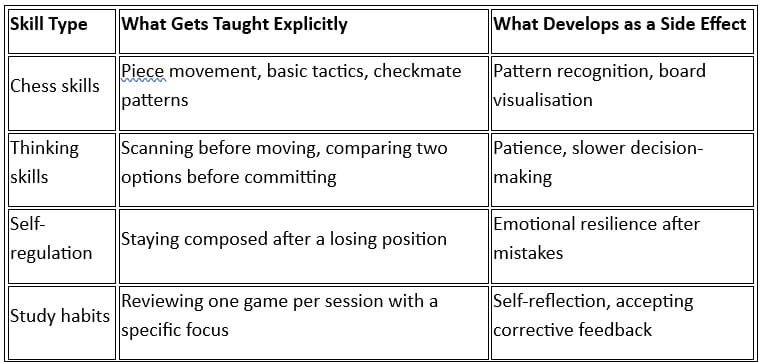
Chess lessons for beginners cover more than chess. The skills that show up in classrooms and friendships often develop as a side effect of chess-specific training, but a well-designed programme plans for both columns deliberately.

online chess classes for beginners

Most beginner chess coaching handles the chess column well. Kaabil Kids’ in-house psychologist works on the self-regulation row specifically, supporting children through the emotional side of losing a position, which most online programmes leave entirely to chance.

Why Is Learning Chess With a Coach Better Than Learning Alone?

The realistic alternative a parent compares online chess classes for beginners against is apps and YouTube. Both have value. Neither can replicate a coach watching how a child thinks rather than just which square they click.

A child working through puzzles alone can develop the habit of trying the first move that looks appealing, getting it wrong, and trying the next one, without ever building the discipline of checking before committing. That habit, repeated across hundreds of puzzles, is harder to undo later than it is to prevent early with guided instruction.

Youth registrations on online chess platforms have grown 27% since 2023, driven largely by parental interest in cognitive development and structured learning rather than casual play (Online Chess Instruction and Play Market Report, 2025). Parents researching how to learn chess online for kids are not looking for more screen time. They are looking for a coach who watches, corrects and explains, the one thing an app genuinely cannot provide.

Beginner chess coaching fills exactly that gap. A trainer who asks “why did you play that piece?” after every game builds the habit of reasoning out loud, not just moving. That separates useful chess lessons for beginners from simply moving pieces around without thinking. For families evaluating chess classes for kids online, this distinction is the most useful one to carry into a buying decision.

How Do You Choose the Right Online Chess Programme for Your Child?

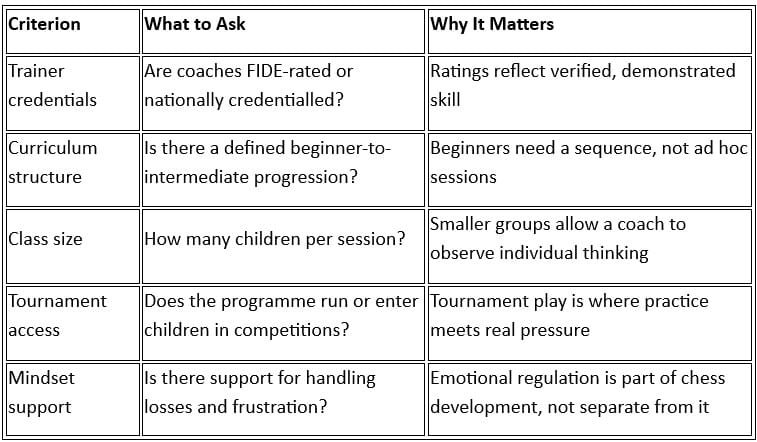
Online chess classes for beginners vary enormously in quality, structure and what they actually deliver. A useful framework covers five criteria:

Online chess classes for beginners

Kaabil Kids meets every criterion above: FIDE-rated trainers, a Grandmaster-designed curriculum spanning beginner, intermediate and advanced tracks, small-group live sessions, regular tournaments and an in-house psychologist for mindset support. As a beginner chess coaching platform for children aged 5 to 15, it treats all five areas as part of the same programme rather than optional extras.

A child’s first experience of beginner chess coaching is not complicated when the programme is well-designed. They show up, learn the pieces, and leave having done something concrete. That is how chess classes for kids online are supposed to work: each session building on the one before it.

Explore Kaabil Kids’ online chess coaching for beginners | Book a free trial class

What Do Parents Most Often Ask About Online Chess Classes for Beginners? 

What happens in the first online chess class for a beginner?

A well-run first session covers the names and movements of all six pieces, how a game starts and ends, and usually one simple concept such as how the king gets into check. The child practises on a shared interactive board while the coach watches and corrects in real time. No prior knowledge is needed to join online chess classes for beginners, whether you choose to learn chess online for kids or through a local club.

What age can children start online chess classes?

The best age to learn chess online for kids is generally five or six, when pattern recognition develops quickly. Kaabil Kids covers ages 5 to 15, adjusting pace and complexity for each group. Younger children have fewer ingrained habits to unlearn, which makes earlier starts more efficient than later ones.

How long are online chess lessons for beginners?

Most chess classes for kids online run between 45 and 60 minutes for beginners, split across instruction, supervised practice and review. Children aged five to seven do better with sessions at the shorter end; focus tends to hold well up to about 30 to 40 minutes.

What does a child need to join an online chess class?

A device with a camera and a stable internet connection is enough to get started with beginner chess coaching online. No physical chess board is required, since the shared digital board handles everything during a live session. Some programmes suggest a physical board for practice between lessons, but it is not a requirement for the first class.

Chess is more than just a board game; it’s a journey of strategic thinking and mental growth. For young minds, learning chess provides a strong foundation in logic, problem-solving, and patience. 

With the right guidance and practice, every child has the potential to master this timeless game. Through online chess classes for kids, we make learning chess easy, fun, and accessible to children of all skill levels. 

In this blog, we will explore the essential chess moves and strategies every beginner should know. If your child is ready to step into the world of chess, this guide is the perfect starting point. 

The Chessboard and Its Basics 

Before diving into moves, understanding the chessboard is crucial. A standard chessboard has 64 squares, alternating between light and dark colors. Each player starts with 16 pieces: 

  1. Pawns – Frontline soldiers, vital for advancing strategies. 
  2. Rooks – Corner pieces, experts in straight-line movement. 
  3. Knights – Masters of the L-shape move. 
  4. Bishops – Swift diagonals for targeted attacks. 
  5. Queen – The most powerful piece, combining rook and bishop moves. 
  6. King – The game’s heart, always to be protected. 

Essential Moves for Beginners 

In chess online classes, we break down essential moves to ensure that young learners can grasp the basics with ease. Let’s explore these moves every beginner should know: 

1. Pawn Moves 

Pawns move forward one square but capture diagonally. Their first move allows them to advance two squares. Teaching kids the value of pawns helps them understand strategic planning, as pawns can transform into any piece upon reaching the opponent’s back rank. 

2. The King’s Safety: Castling 

Castling is a special move where the king moves two squares toward a rook, and the rook jumps to the other side. This is a beginner’s first lesson in protecting the king while activating the rook. 

3. The Knight’s Leap 

Knights are unique because they jump over other pieces in an “L” shape. This move teaches children the importance of positioning and foresight. 

4. The Diagonal Advantage: Bishop Moves 

Bishops control long diagonals, making them excellent for setting up defenses and delivering surprise attacks. 

5. The Queen’s Dominance 

While powerful, beginners should be cautious not to over-rely on the queen. Learning to use the queen strategically without exposing it to early attacks is vital. 

6. Check and Checkmate 

Teaching the concepts of check (attacking the king) and checkmate (the king cannot escape) is foundational. Simple patterns like the “back rank mate” are great for early lessons. 

Beginner Strategies 

When learning chess, having the right strategies in place is crucial for building a strong foundation. In our chess classes online, we emphasize these key strategies that every beginner should know. 

1. Control the Center 

Encourage children to place their pawns and pieces in the central squares. This provides a solid base for attacks and defenses. 

2. Develop Pieces Early 

Focus on bringing out knights and bishops early in the game instead of moving the same piece repeatedly. 

3. King Safety is Key 

Prioritize castling within the first 10 moves to secure the king and connect the rooks. 

4. Avoid Losing Pieces Needlessly 

Teaching beginners the value of each piece helps them make better decisions. For example, losing a queen to capture a pawn is a poor trade. 

5. Plan Your Moves 

Encourage children to think a few moves ahead rather than reacting impulsively. This helps them anticipate their opponent’s strategy and make better-informed decisions to control the flow of the game.  

Advanced Tips for Young Learners 

Once children grasp the basics, they can explore advanced tactics: 

1. The Fork 

Using one piece to attack two opponent pieces simultaneously. Knights are especially effective for this tactic. 

2. The Pin 

A pin occurs when an opponent’s piece must stay still because moving it would reveal a more valuable piece behind. 

3. The Skewer 

A reverse pin where a more valuable piece is attacked first, forcing it to move and exposing a less valuable piece behind it. 

4. The Discovered Attack 

A powerful tactic where moving one piece uncovers an attack by another piece. This can lead to unexpected threats, as the opponent must address two issues simultaneously. 

The Role of Practice in Mastery 

Practice is the cornerstone of improvement in chess. Regular games against peers or AI opponents strengthen decision-making skills. Platforms offering chess classes online often include analysis tools, allowing kids to review games and learn from their mistakes. 

Encourage children to set aside time each day for puzzles and practice matches. This habit fosters discipline, analytical thinking, and patience. 

Conclusion 

Chess is more than just a game; it’s a powerful tool for developing critical thinking, patience, and strategic skills. By mastering essential moves and tactics, young learners can gain confidence both on and off the chessboard. Our online chess classes for kids provide a comprehensive and engaging platform where children can explore the fascinating world of chess at their own pace. 

Whether your child is a beginner or ready to take their skills to the next level, our expertly designed chess classes focus on nurturing their potential while making learning fun. Enroll today at Kaabil Kids and watch your child embark on a lifelong journey of learning, growth, and strategic mastery! 

When you think of chess, you automatically think of it as a grand game of strategy, intellect, and concentration. So, if you want to step into this world of chess, then turn your head and take a look at online chess for beginners. Want to know why they are your best bet when you want to start off? Let’s find out! 

Why Go for Chess for Beginners: Online Edition! 

1. Flexibility and Convenience 

If there is one big advantage of online chess coaching classes, it’s the flexible nature of the programs. So, today is inconvenient? No worries! You can schedule your lessons tomorrow or whenever it’s convenient. The best part? You don’t have to take a step out of your home (or room)! 

This flexibility makes chess for beginners (online) easier for those who are just finding their way into the game. 

2. Personalized Attention 

Another key benefit of online chess lessons is the individualized support you receive. 

What Are the Key Features of Online Chess for Beginners 

1. Interactive Lessons with Expert Trainers 

Online chess coaching classes offer access to expert trainers who help beginners at every stage of their journey. 

2. A Structured Curriculum 

One of the biggest challenges for beginners is knowing where to start and what to focus on. Enter online chess for beginners. They solve this problem with clear, structured curriculums. 

So, You Want to Know the Advantages of Online Chess for Beginners 

1. Building a Strong Foundation 

For beginners, starting with the basics is essential to building a solid understanding of the game. 

2. Cognitive and Problem-Solving Development 

Playing chess improves various cognitive skills, which is one reason it’s an excellent game for beginners. 

3. Continuous Support and Motivation 

With online chess coaching, you receive constant support to keep you motivated and on track. 

How Kaabil Kids’ Online Chess Coaching Classes are Helping Beginners 

Kaabil Kids offers online chess coaching classes that are specifically designed for beginners, making it an excellent choice for new players: 

Conclusion 

If you’re a beginner looking to dive into chess, online chess coaching classes are the best choice for you. It combines flexibility, expert guidance, and cost-effective learning, making it the perfect way to start. With structured lessons, personalized attention, and continuous support, you’ll develop the skills needed to master chess at your own pace. 

Want to start your journey of mastering chess as a beginner? Book a demo class at Kaabil Kids to experience how fun and rewarding chess can be! 

Currency
USD United States (US) dollar