How Many Online Chess Classes Should Kids Attend Each Week to See Consistent Improvement?
A child attends one 45-minute chess class a week, does no practice in between, and wonders why the same tactical pattern taught in October still gets missed in December. Nothing about the class was wrong. The frequency was.
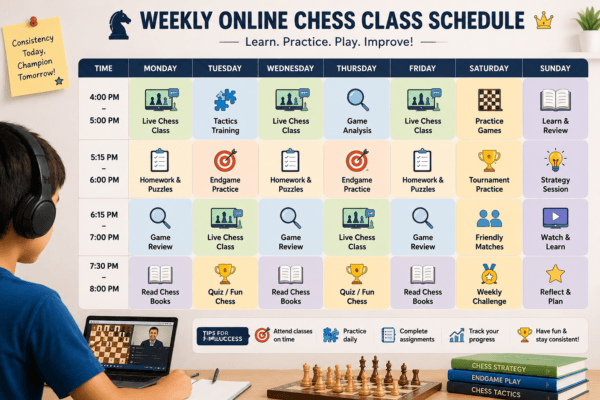
Parents researching kids chess coaching almost always ask about curriculum, coaches and cost. Far fewer ask the question that actually determines whether a child improves: how often should the classes happen? Too few sessions and skills fade between lessons before they solidify. Too many, without enough practice time in between, and a child burns out before the benefit shows up. This guide sets out exactly how many classes a week make sense at each stage of online chess learning, and how to tell when it’s time to change the pace.
Why the Right Number of Weekly Classes Matters More Than You Think
Does playing more chess games actually help more than taking more classes? The research says both matter, but not in equal measure at every stage. A landmark study of tournament-rated chess players found that a combination of serious study, competition and formal instruction accounted for roughly 40% of the variance in chess skill ratings, with serious study alone the strongest single predictor (Charness et al., 2005, Applied Cognitive Psychology). The same research found that grandmasters had logged close to 5,000 hours of serious solo study within their first decade of serious play, nearly five times what intermediate-level players had put in.
A separate finding adds nuance for younger, developing players: the total number of games played correlated more strongly with chess rating than total study hours did (Howard, 2012). In practice, this means a weekly class schedule that includes only instruction, with no games in between, leaves real improvement on the table. Frequency matters because chess skill is built through repeated exposure and correction, not through occasional exposure to a lot of information at once.
How Many Classes Beginners Need to Build a Strong Foundation
For a true beginner, more classes are not automatically better. What matters is consistency without overload.One weekly class is usually enough at the very start, since a beginner is
| Stage | Recommended Live Classes/Week | What Fills the Rest of the Week |
| Absolute beginner (learning rules, piece movement) | 1 class | 15–20 minutes of casual practice, 2–3 times a week |
| Beginner building basic tactics | 1–2 classes | Puzzle practice and one supervised game a week |
still absorbing fundamentals: piece movement, check, the special rules, and basic checkmates. Pushing to two or three classes before this stage is solid tends to overwhelm a child rather than accelerate them. Once fundamentals are steady and a child moves into simple tactics, forks, pins, skewers, two classes a week alongside regular puzzle practice becomes the more effective rhythm. This is the same sequencing that underpins any solid programme for online chess classes for kids: fundamentals first, frequency increasing only once the previous stage is genuinely secure.
What Changes as Kids Move to Intermediate and Advanced Levels
As a child’s game deepens, so does the value of additional structured time, but the increase should track ability, not simply enthusiasm.
| Stage | Recommended Live Classes/Week | What Fills the Rest of the Week |
| Intermediate (openings, combinations, basic endgames) | 2–3 classes | Reviewed practice games, timed puzzles |
| Advanced or tournament-track | 3+ classes, plus individual sessions | Tournament play, game analysis with a coach |
At the intermediate stage, a child is coordinating more moving pieces at once: opening principles, tactical combinations, early endgame technique. Two to three classes a week gives a coach enough contact time to catch recurring errors before they harden into habits. At the advanced or tournament-track stage, the priority shifts from adding more classes to adding more reviewed games, since game-time and post-game analysis are what convert theory into tournament performance. A child playing competitively benefits more from three focused sessions plus regular tournament practice than from five generic classes with no game review attached.
Why Parents Still Search for a “Chess Coaching Centre Near Me” and What They Should Know
Despite the shift to online learning, a large number of parents are still searching for a chess coaching centre near me, a chess training near me, or a chess teacher near me. The instinct makes sense: a physical location has always signalled structure, accountability and a real person a parent can meet.
What most parents discover once they look closely is that a well-run online programme delivers the same structure without the geographic limit. A live weekly schedule, a dedicated coach, progress reports and tournaments accomplish what a local academy promises, without restricting the search to whichever coaches happen to operate nearby. Families who start out searching for chess classes near me frequently end up choosing an online format instead, once they realise consistency and coach quality matter more than physical proximity to a class.
Signs Your Child Needs More Practice Time or a Different Pace
How do you know if a child needs more chess practice time, rather than a different class altogether? A few signs are consistent across age groups:
- The same mistake keeps returning across different games and different opponents, suggesting the current frequency isn’t enough for a correction to stick.
- Puzzles feel disconnected from real games, meaning practice time between classes isn’t reinforcing what’s taught in them.
- Motivation is dropping, often a sign the pace is either too slow to feel like progress or too intense to feel enjoyable.
- A child wants to enter tournaments but has had no exposure to timed, competitive games between classes.
- Improvement has visibly plateaued despite consistent attendance, which usually points to a need for more game-time or more targeted review, not simply more classes.
Any one of these is a signal to adjust frequency or structure, not necessarily to add more sessions blindly.
How Kaabil Kids Structures a Weekly Routine for Steady Improvement
Kaabil Kids builds its schedule around the same principle the research supports: consistent, level-appropriate frequency beats an occasional heavy session. Every child follows a curriculum designed by International Grandmaster Tejas Bakre, delivered through live weekly classes with FIDE-rated trainers who adjust frequency as the child progresses through each stage.
Between live sessions, students get structured assignments, puzzle sets and monthly in-house tournaments, so the week includes both instruction and the game-time research shows is essential. An in-house psychologist monitors motivation and pace, stepping in when a child shows signs of plateauing or burnout. Families exploring online chess coaching for the first time can start with a lower weekly commitment and scale up as the child’s stage and goals evolve.
Conclusion
There’s no single correct number of weekly chess classes that applies to every child. A beginner needs one steady class and light practice. An intermediate player needs two to three classes plus reviewed games. A tournament-track player needs frequent, focused sessions built around competitive play. What matters most across every stage is consistency that matches the child’s current level, not an arbitrary number chosen in advance.
If you’re not sure where your child currently fits, explore online chess coaching for kids or Book a free trial class to receive a personalised recommendation for your child’s ideal weekly learning plan based on their age, experience, and goals.
FAQs
Q1. How many chess classes should a beginner attend per week? One class a week is usually enough for a true beginner, paired with short, casual practice sessions between classes to reinforce the fundamentals.
Q2. Is it better to take fewer, longer classes or more, shorter ones? Shorter, more frequent sessions generally work better for children, since chess concepts are absorbed and applied more effectively through repeated, spaced exposure than through occasional long sessions.
Q3. Can too many chess classes actually slow a child’s progress? Yes. Without enough time to practise and apply what’s taught, additional classes add information faster than a child can absorb it, which can lead to burnout rather than faster improvement.
Q4. Does playing more chess games help more than taking more classes? Both matter, but research suggests the total number of games played correlates strongly with skill improvement, so classes without any practice games in between limit progress.
Q5. How do I know if my child needs more chess practice time? Watch for repeated mistakes across different games, puzzles that don’t translate to real play, or a visible plateau despite consistent class attendance, all signs that practice frequency needs adjusting.
Q6. Should tournament-track kids attend more classes than casual learners? Yes. Children preparing for competitive play typically benefit from three or more sessions a week plus dedicated game analysis, since tournament performance depends heavily on reviewed, competitive game-time.