Why Live Online Chess Classes Are More Effective Than Recorded Chess Courses

A child watches a recorded lesson on knight forks for the second time. The explanation makes sense on screen. Ten minutes later, in an actual game, a fork opportunity appears and the child hesitates, unsure whether this position even matches the video. Nobody is there to say: yes, this is it, play the move. The moment passes. The chance is gone.

That gap, between watching a concept and applying it under real pressure, is the single biggest difference between recorded chess courses and live chess coaching. Chess.com had reached 250 million registered members by February 2026 (Chess.com, 2026), while FIDE’s own database lists only 1.64 million formally rated players worldwide against an estimated 605 million casual players (icon-era.com, citing FIDE, 2025). Millions of children are learning chess online. Very few are being coached through it live. This blog breaks down exactly what that gap costs a beginner, and why structured kids chess coaching closes it faster than any video library can.

Understanding the Difference Between Live and Recorded Chess Courses

The two formats are not variations of the same thing. They are built on opposite assumptions about how a child learns.

Recorded chess courses are pre-shot video lessons. A coach explains a concept once, it gets filmed, and every student who watches it afterward, regardless of skill level, pace, or specific doubt, sees the exact same explanation. There is no way to pause and ask why a move works in one position but not another.

Live online chess classes connect a child directly with a real coach in real time. The coach watches how the child actually thinks, catches the exact moment a wrong idea forms, and adjusts the lesson before that idea becomes a habit. This is the core of any credible online chess academy: instruction that responds to the learner in the moment, not a fixed script that plays the same way for everyone.

Why Live Online Chess Classes Deliver Better Results

Is live coaching actually better, or does it just feel that way? The research lines up with what coaches see every week. A 2025 meta-analysis of 31 randomized controlled trials covering more than 3,800 learners found that synchronous, real-time online instruction produced stronger knowledge outcomes and higher engagement than both asynchronous, recorded formats and traditional face-to-face teaching (ScienceDirect, 2025). Neither that study nor the feedback research behind it looked at chess specifically, but the mechanism maps directly onto the board: a coach who sees a mistake as it happens can name it and correct it before it repeats.

That single difference, feedback delivered at the moment of the mistake rather than after it, is what makes live chess coaching measurably more effective:

Benefits of Live Chess Coaching for Kids

Beyond faster technical improvement, live classes build habits and confidence that recorded content has no mechanism for delivering.

Live Online Chess Classes vs Recorded Chess Courses

FactorLive Online Chess ClassesRecorded Chess Courses
FeedbackInstant, personalisedNone or delayed
EngagementHigh, interactiveLow, passive viewing
PacingAdapts to the learnerFixed for everyone
Doubt SolvingImmediateNot possible
AccountabilityScheduled, structuredSelf-paced, easy to skip
Social InteractionYes, with coach and peersNone
InvestmentHigher, with personalized coachingGenerally cheaper
Best ForConsistent, measurable growthCasual, supplementary revision

Recorded content has a place as a revision tool, but it rarely works as a child’s primary learning method. This is exactly why platforms offering structured Online Chess Coaching see far better retention and results than those relying purely on video libraries.

Which Option Is Best for Beginners?

For a child just starting out, live classes are almost always the better choice, and the reason is specific: beginners don’t yet know what they don’t know. A child working through the fundamentals stage, piece movement, check, the special rules, needs someone to catch the exact moment a wrong habit forms, not a general explanation that assumes the learner can already self-correct. That assumption rarely holds for a 6 to 10-year-old picking up chess for the first time.

Recorded lessons can still play a role, as revision material between live sessions once a concept has already been taught properly. But as a standalone learning method for a true beginner, video alone leaves the exact gaps that structured online chess coaching is built to close.

Why Parents Prefer Live Online Chess Classes for Their Children

Parents today want more than entertainment value from a chess subscription. They want measurable growth, safety, and a coach they can actually trust. Live classes deliver on all three:

This combination of trust, structure, and visible progress is why more families are moving away from generic video libraries toward dedicated live coaching platforms.

Conclusion

Recorded chess courses have a place, as a low-cost introduction or a supplementary resource between lessons. But for genuine skill development, confidence, and consistent progress, live chess coaching is simply the more effective format. The real-time feedback and human connection it offers cannot be replicated by any pre-recorded video, however well produced.

Kaabil Kids builds its programme around exactly this principle: a curriculum designed by International Grandmaster Tejas Bakre, delivered live by FIDE-rated trainers, with an in-house psychologist supporting motivation and confidence along the way. If you’re looking for a trusted online chess academy where every session is live, tracked, and built around your child rather than a fixed script, explore Kaabil Kids’ online chess coaching or book a free trial class to see the difference for yourself.

FAQs

Q1. Are live online chess classes better than recorded courses for beginners? Yes. Beginners benefit most from real-time correction and guidance, which only live classes can provide before a wrong habit sets in.

Q2. What age should a child start live chess classes?
Most coaches recommend starting between ages 5 and 7, though children of any age can benefit from structured kids chess coaching.

Q3. Can recorded chess courses be useful at all?
Yes, as supplementary revision material between live sessions, reinforcing a concept the coach has already taught, but not as a primary learning method.

Q4. How do live chess classes track a child’s progress?
Through regular assessments, assignments, puzzles, and tournament performance, monitored by the coach over weeks and months rather than left to chance.

Q5. Is online chess learning as effective as in-person coaching?
When delivered live and interactively, online chess learning can match in-person coaching, with the added benefit of convenience and access to specialized coaches regardless of location.
A child plays four games a week, finishes every puzzle set and shows up to class on time. Yet the same rook blunder from January shows up again in March. The parent is not imagining it. Effort is high and improvement is flat.

The gap sits in one missing habit: playing a game teaches a child to play chess, but reviewing it teaches them to play better. Most young players do the first and skip the second. Chess game analysis, the practice of returning to a finished game to understand what happened, is the missing step behind most stalled chess improvement techniques. This blog covers what it involves, why it beats extra games alone, and how post-game review becomes a regular habit.

What Is Chess Game Analysis, and Why Don’t Most Kids Do It?

Chess game analysis means going back through a completed game, move by move, to find decisions that were wrong, nearly right or better than expected. It is not a punishment for losing, not a session cataloguing every suboptimal move, and not about replaying the game to feel bad. The goal is one usable lesson extracted before the game is forgotten.

Most children skip it unprompted because starting the next game feels better than sitting with the last one. A child never shown what to look for has no starting point, so the chess learning process stays at “playing” rather than advancing to “learning from play.” That gap is what post-game review is designed to close.

Why Does Reviewing Chess Mistakes Matter More Than Playing More Games?

Skills are built through corrected repetition, a specific error named and fixed, not repetition alone. A 2025 systematic review published in Frontiers in Education found that tailored, specific feedback consistently improved student achievement, while vague feedback left performance flat (Frontiers in Education, 2025). A separate 2025 study presented at the Educational Data Mining conference found that correct-or-incorrect feedback significantly sped up learning, while general feedback slowed it (Educational Data Mining, 2025). Neither study looked at chess directly, but the mechanism matches the board exactly.

A child who plays ten games and reviews none reinforces good habits and chess mistakes in equal measure. A child who plays five games and reviews three specifically targets the weak habits for correction. The chess learning process compounds once errors are named rather than repeated, which is what good chess coaching benefits are built around.

Without post-game review, the same chess mistakes reappear across different opponents, wins feel random and losses feel like bad luck, and intuition builds alongside blind spots in equal measure until progress stalls. With post-game review, specific errors get named and gradually eliminated, both results become data points rather than verdicts, and each session adds a concrete lesson that carries forward.

What Are the Best Post-Game Questions to Ask a Child After a Chess Game?

Good post-game review does not begin with a computer engine. It begins with a question that puts the child in control before any external tool opens. Three questions work across ages and levels: was there a moment the game felt like it shifted? Was there a move made quickly that felt wrong the second it left your hand? Was there a point where you did not know what to do and simply guessed?

These questions point a child straight to the moments where post-game review delivers the most value, and they do not require a coach to ask them.


Age GroupBest Starting Post-Game Review Question
5 to 8 yearsWhich of your pieces felt most useful? Which felt stuck the whole game?
9 to 11 yearsWas there a move you made quickly that you wish you’d thought about longer?
12 to 15 yearsWhat was the plan you were carrying out, and where did it stop working?

The Compounding Secret: Why Reviewed Games Beat Ten Forgotten Ones

Each reviewed game produces one or two specific lessons, tested in the next game and reviewed again to check whether the lesson stuck. Improvement built this way tends to outpace improvement built on volume alone.

A Nature-published study on retrieval practice and feedback timing found that students given corrective feedback scored close to double what a no-feedback group scored one month later, a gap that widened over time (Humanities and Social Sciences Communications, 2024/2025). This is a learning-sciences finding applied to chess by analogy, not a chess-specific study. But the pattern maps directly: specific chess mistakes, specific correction, tested next game.

Chess improvement techniques tied to a game a child actually remembers land better than abstract puzzles because the emotional context of the game is still live. One of the quieter chess coaching benefits parents notice after several months is that their child is no longer surprised by the same position type twice. That is the chess learning process working as it should.

Conclusion :

Kaabil Kids gives every child aged 5 to 15 a trained coach who reviews their games, names the chess mistakes that matter most at their level, and builds the post-game review habit into every session, so improvement compounds rather than stalls. Explore Kaabil Kids’ online chess coaching | Book a free trial class

Why a Coach Catches What a Parent Can’t

A parent asking the three questions above provides a strong start. A trained coach adds what a parent usually cannot: knowledge of which chess mistakes are fixable at a given level, which point to a specific recurring weakness, and which patterns surface across multiple games.

A coach identifies the one most impactful error to address first. These chess coaching benefits accumulate over months, since mistakes named in one session disappear from the next, freeing attention for the next layer of chess improvement techniques.

Kaabil Kids builds post-game review into every coaching session as a core part of the chess learning process, not an optional extra. Each child’s games are reviewed by a FIDE-rated trainer who flags the two or three chess mistakes with the highest impact and sets targeted chess improvement techniques for the following week. Kaabil Kids’ in-house psychologist supports the emotional side, helping children treat game review as productive information rather than a verdict on their ability. Families comparing online chess classes, a chess tutor online or a chess academy that treats game review as central to the curriculum will find that focus built into every Kaabil Kids session.

Playing chess without reviewing it builds experience, not skill. Chess game analysis, even with two or three simple questions after a game, turns every result into a lesson. The improvement compounds and the chess mistakes shrink. A child who reviews three games a week will eventually outpace one who plays ten and never looks back.

Frequently Asked Questions

Q1. What is chess game analysis and how does it help children improve?

Chess game analysis is the process of reviewing a completed game to spot decisions that were wrong, nearly right or stronger than expected, and understanding why. It turns each result into a usable lesson. Without it, good and bad habits get reinforced in equal measure. With it, mistakes are isolated and corrected on purpose.

Q2. How do you review a chess game with a child without discouraging them?

Start with a question rather than a correction. Asking what felt like the turning point gives a child control over their own post-game review instead of putting them on the defensive. Keep the focus on one or two chess mistakes per session, not every suboptimal move. Treat wins and losses as equally useful data.

Q3. How often should a child analyze their chess games?

Reviewing two to three games a week works better than reviewing every game played. The chess learning process benefits more from fewer games reviewed carefully than from a high volume glanced at briefly. Weekly consistency matters more than completeness.

Q4. What is the difference between self-analysis and coach-led chess game analysis?

Self-analysis, a parent or child reviewing a game with simple questions, is a strong habit that costs nothing but attention. Coach-led review adds a trained eye that separates a one-off slip from a recurring weakness, prioritizes which chess mistakes to fix first, and applies chess improvement techniques suited to that child’s specific level. The chess coaching benefits of a trained coach show up fastest once a child has plateaued on self-directed play.


What Happens in an Online Chess Class for Beginners?

The video call connects. The chess board appears on screen. Your child sits there, half-curious, half-suspicious, and you realize you have no idea what the next 45 minutes are supposed to look like.

That uncertainty is the most common reason parents delay booking a class for weeks after deciding chess is worth pursuing. Nobody wants to pay for something they cannot picture. And for chess especially, the imagination tends to jump straight to grandmaster theory and memorized openings, neither of which describes what a beginner actually does.

Online chess classes for beginners look nothing like a lecture and nothing like a self-paced app. This covers what happens in the first session, what a child can do by week four, and what to check before choosing any programme.

The timing matters too. As of December 2024, India has 85 chess grandmasters with 13 ranked among the world’s top 100 players, and following Gukesh Dommaraju’s World Championship victory, chess academies across major cities and tier-two towns are now running at full capacity (Chess in India, Wikipedia, 2024; WION Year-Ender, 2025). The question for parents is not whether chess is worth pursuing. It is how to make sure the class their child joins is actually worth the screen time.

What Do Kids Actually Learn in Their First Online Chess Classes?

Most parents expect openings. Most beginners get something far more useful: the names and movements of all six pieces, how a game starts and ends, and what it means when a king is under threat. That is enough for a first chess lesson for beginners, and a good coach knows it.

By the end of a typical beginner sequence, a child can set up a board independently, spot checkmate in one move, and play a complete legal game without needing prompts from an adult. These are concrete, testable milestones, not vague improvements that are hard to see from the sofa.

Week| What Gets Covered
Week 1| Names and movement of all six pieces; how a game starts and ends
Week 2| Basic captures; understanding checks and how to escape check
Week 3| Simple tactics: forks, pins and basic checkmate patterns
Week 4| Playing a supervised full game with review and one specific goal

Pace matters as much as content in chess lessons for beginners. A child who feels capable at the end of week one is far more likely to return for week two than one who has been rushed into complicated material.

How Do Online Chess Classes Work for Complete Beginners?

A beginner session runs on a video call paired with a shared interactive chess board. The coach demonstrates a position by moving pieces on the shared board, and the child practises on the same board in real time. Nobody is pointing at a physical board and hoping the camera angle is right.

A well-run session has four clear parts:

Time Block| What Happens
0–10 min| Recap of the last lesson; warm-up puzzle or piece-movement drill
10–25 min| New concept introduced with a live demonstration on the shared board
25–40 min| Child practises: guided play, mini game or tactical exercise while the coach observes
40–45 min| Session review; one specific takeaway the child is asked to remember

Kaabil Kids’ online chess classes for beginners follow this live, interactive structure, with FIDE-rated trainers guiding each child through a curriculum designed by International Grandmaster Tejas Bakre. No beginner is left to navigate a lesson sequence alone.

What Skills Are Taught to Beginners in Online Chess Classes?

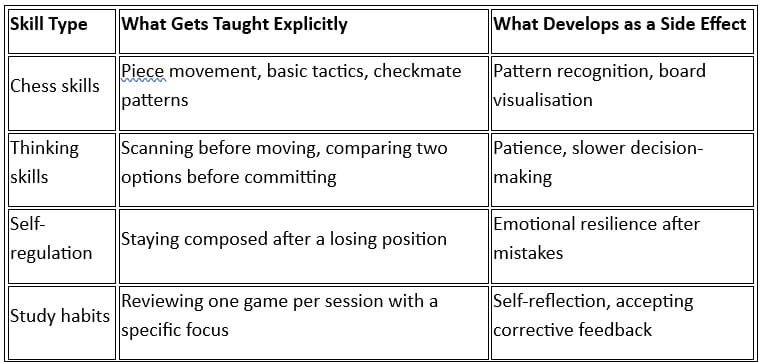
Chess lessons for beginners cover more than chess. The skills that show up in classrooms and friendships often develop as a side effect of chess-specific training, but a well-designed programme plans for both columns deliberately.

online chess classes for beginners

Most beginner chess coaching handles the chess column well. Kaabil Kids’ in-house psychologist works on the self-regulation row specifically, supporting children through the emotional side of losing a position, which most online programmes leave entirely to chance.

Why Is Learning Chess With a Coach Better Than Learning Alone?

The realistic alternative a parent compares online chess classes for beginners against is apps and YouTube. Both have value. Neither can replicate a coach watching how a child thinks rather than just which square they click.

A child working through puzzles alone can develop the habit of trying the first move that looks appealing, getting it wrong, and trying the next one, without ever building the discipline of checking before committing. That habit, repeated across hundreds of puzzles, is harder to undo later than it is to prevent early with guided instruction.

Youth registrations on online chess platforms have grown 27% since 2023, driven largely by parental interest in cognitive development and structured learning rather than casual play (Online Chess Instruction and Play Market Report, 2025). Parents researching how to learn chess online for kids are not looking for more screen time. They are looking for a coach who watches, corrects and explains, the one thing an app genuinely cannot provide.

Beginner chess coaching fills exactly that gap. A trainer who asks “why did you play that piece?” after every game builds the habit of reasoning out loud, not just moving. That separates useful chess lessons for beginners from simply moving pieces around without thinking. For families evaluating chess classes for kids online, this distinction is the most useful one to carry into a buying decision.

How Do You Choose the Right Online Chess Programme for Your Child?

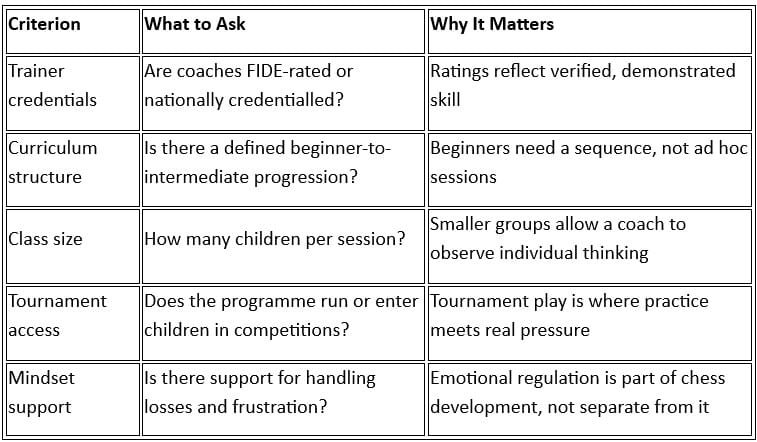
Online chess classes for beginners vary enormously in quality, structure and what they actually deliver. A useful framework covers five criteria:

Online chess classes for beginners

Kaabil Kids meets every criterion above: FIDE-rated trainers, a Grandmaster-designed curriculum spanning beginner, intermediate and advanced tracks, small-group live sessions, regular tournaments and an in-house psychologist for mindset support. As a beginner chess coaching platform for children aged 5 to 15, it treats all five areas as part of the same programme rather than optional extras.

A child’s first experience of beginner chess coaching is not complicated when the programme is well-designed. They show up, learn the pieces, and leave having done something concrete. That is how chess classes for kids online are supposed to work: each session building on the one before it.

Explore Kaabil Kids’ online chess coaching for beginners | Book a free trial class

What Do Parents Most Often Ask About Online Chess Classes for Beginners? 

What happens in the first online chess class for a beginner?

A well-run first session covers the names and movements of all six pieces, how a game starts and ends, and usually one simple concept such as how the king gets into check. The child practises on a shared interactive board while the coach watches and corrects in real time. No prior knowledge is needed to join online chess classes for beginners, whether you choose to learn chess online for kids or through a local club.

What age can children start online chess classes?

The best age to learn chess online for kids is generally five or six, when pattern recognition develops quickly. Kaabil Kids covers ages 5 to 15, adjusting pace and complexity for each group. Younger children have fewer ingrained habits to unlearn, which makes earlier starts more efficient than later ones.

How long are online chess lessons for beginners?

Most chess classes for kids online run between 45 and 60 minutes for beginners, split across instruction, supervised practice and review. Children aged five to seven do better with sessions at the shorter end; focus tends to hold well up to about 30 to 40 minutes.

What does a child need to join an online chess class?

A device with a camera and a stable internet connection is enough to get started with beginner chess coaching online. No physical chess board is required, since the shared digital board handles everything during a live session. Some programmes suggest a physical board for practice between lessons, but it is not a requirement for the first class.

Chess is one of the world’s oldest and most intellectually engaging games, having a millennia-long history. Despite its basic principles, chess may be fairly difficult, particularly for new or casual players. Many chess players, even experienced ones, sometimes face misinterpreted rules, which cause annoyance or bewilderment throughout a game. In this article, we’ll look at the top five most misunderstood chess rules and provide advice on how to avoid them so you may play comfortably and properly.

Misunderstood Chess Rules And Ways to Avoid Them

1. En Passant is a tricky pawn move

According to the professionals offering online chess classes, one of the most often misunderstood chess rules is en passant (French for “in passing”), a particular move involving pawns. It’s an unusual but important rule that permits a pawn to capture an opponent’s pawn in extremely precise situations.

How It Works

The en passant move happens when your opponent advances a pawn two squares ahead of its starting position and lands alongside your piece. On the very next move, capture the opponent’s pawn as if it had simply progressed one square ahead. The capture must occur immediately after the opponent’s pawn has moved two squares; otherwise, the chance is gone.

How to Avoid Misunderstandings

Understanding the patient’s timing is critical for preventing misunderstanding. You can only execute en passant after your opponent has moved their pawn two squares ahead. If you wait one more move, the choice will be unavailable. Pay close attention to your opponent’s pawn movements and be aware of the potential to execute en passant.

2. The 50-Move Rule is Not an Endless Game

Another widely misinterpreted rule is the 50-move rule, which is intended to prevent a game from going on indefinitely without advancement. According to the rule, if no pawn has been moved and either side has captured no piece in 50 consecutive moves, any player may claim a draw.

Why it exists

The 50-move restriction prevents players from shuffling pieces across the board endlessly in a drawn-out position, bringing closure to games that are essentially equal.

How to Avoid Misunderstandings

It’s easy to lose count of how many moves have elapsed without a pawn move or capture, particularly in extended endgames. Keep track of moves using chess clocks or notations. Remember that the rule only applies if no captures or pawn movements have occurred in the previous 50 moves. Understanding when and how to claim a draw under the 50-move rule will help you avoid unwanted games and stress.

3. Insufficient Mating Material: Determine When It’s a Draw

Insufficient mating material is one of the less well-known criteria. This rule applies when neither player has enough pieces to complete the checkmate, resulting in an inevitable draw. However, many players, particularly novices, are unsure what constitutes inadequate mating material.

What is insufficient mating material?

King versus. King: Neither player can checkmate the other with just their king.

King and Bishop versus. King: A single bishop cannot cause a checkmate.

King and Knight versus. King: A knight alone cannot achieve checkmate.

King and Two Knights versus. King: Even with two knights, forcing a checkmate requires help from the opposing side.

How to Avoid Misunderstandings

To minimize misunderstanding, constantly review the content on the board. If your opponent only has one king remaining, you should still examine if you have enough material to checkmate. For example, a king and a queen can readily give checkmate, but a king and a lone knight cannot. When in doubt, examine the endgame carefully to see if a draw is unavoidable.

4. Casting: Special Safety Conditions

Castling is a key defensive move in chess, allowing a player to protect their king while developing a rook. However, it has special requirements that, if not understood, might lead to unlawful movements.

The Conditions for Casting

Neither the king nor the rook engaged in castling can have moved earlier in the game.

The king cannot be checked.

The squares between the king and rook must be unoccupied.

The king is unable to cross through an under-attack square.

The king and rook cannot land in a square, which would put them under check or threat.

How to Avoid Misunderstandings

A typical misconception occurs when players attempt to castle while their king is under check or while crossing through an assaulted square. Remember that castling is a delicate technique requiring exact circumstances. Before trying to castle, be sure that all of the prerequisites have been satisfied. Whether you’re unclear about whether castling is legal, check the board to see whether the king has moved or if there are any threats along the way.

5. Touch-Move Rule: Respecting Your Move

The touch-move rule is basic but sometimes misinterpreted, particularly in casual gaming. It specifies that if you touch a piece, you must move it if it can be moved legally. This rule guarantees that participants thoroughly consider their movements before acting.

How It Works

When you touch a piece, you commit to moving it. If you contact an opponent’s piece, you must capture it, if feasible. If you touch a piece and realize there is no legal move for it, you will be warned and then free to pick another move.

How to Avoid Misunderstandings

In casual games, players may loosen the touch-move restriction, but in formal competitions, it is rigidly enforced. To prevent making inadvertent or hasty movements, don’t touch your pieces until you’re certain of your choice. If you’re adjusting a piece on the board, say “adjust” (or “j’adoube” in French) to indicate that you don’t plan to make a move. This helps to avoid misunderstandings and ensures easier gaming.

Tips for Preventing Chess Rule Confusion

Study the rules regularly: Even experienced players might benefit from a quick review of the official chess rules. Understanding the complexities of regulations like en passant and castling might help you avoid improper movements during games.

Practice with Friends or Online Platforms: Many chess for beginners online platforms carefully follow the rules, making them ideal practice grounds for learning how to prevent blunders. Playing in a controlled atmosphere can help you improve your knowledge of complicated rules.

Use Chess Notation: Recording your movements in traditional chess notation is a great way to ensure you’re following the rules properly, particularly the 50-move rule.

Watch Tutorial Videos: Websites like Kaabil Kids provide great online chess for beginners that explain difficult rules. Watching specialists explain these guidelines might dispel any remaining uncertainties.

Request Clarification in Tournaments: If you’re playing in a formal situation, don’t hesitate to ask the judge or referee for clarification on a rule. It is usually preferable to verify than to make an unlawful action.

Final Thoughts 

Chess is a game of strategy and accuracy, and even little misunderstandings of the rules may have serious effects. En passant, the 50-move rule, inadequate mating material, castling, and the touch-move rule are the top five misunderstood chess rules. By learning them from professionals at Kaabil Kids, provider of the best Online chess classes, you may play confidently and avoid frequent problems. Whether you’re playing informally with friends or in a formal tournament, a thorough grasp of these rules can enhance your game and let you concentrate on your strategy rather than the technical aspects of the game. Happy playing!

Currency
INR Indian rupee