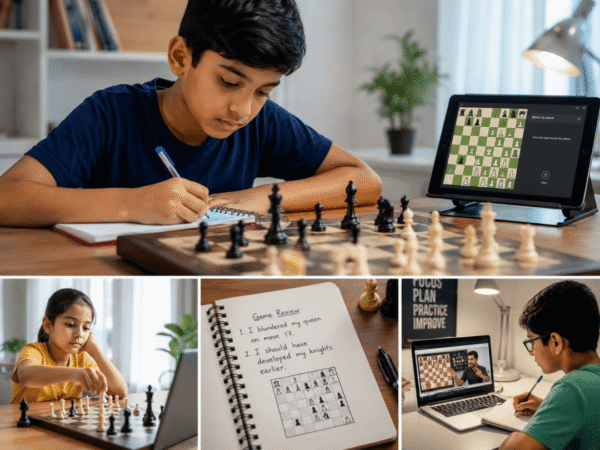
A daily chess practice routine for kids doesn’t need hours. Learn how to split 20–30 minutes across puzzles, games and review so your child actually improves.
Most chess parents know this routine: lessons on Tuesday, a flurry of games before Saturday’s tournament, then silence until next Tuesday. The board collects dust, the puzzle app sits unopened, and everyone wonders why progress feels slow despite a child who clearly loves the game.
Online chess has exploded well past hobby status. Chess.com alone crossed 200 million members in April 2025, with more than 20 million games played on the platform every single day as per reports. Your child isn’t just playing a board game anymore. They’re stepping into one of the fastest-growing online communities on the planet.
Here’s the reassuring part. A real chess practice routine for kids doesn’t need hours. It needs a rhythm that survives school nights, siblings, and the occasional Tuesday meltdown, the same rhythm that good online chess coaching is designed to reinforce.
Why Does Consistency Matter More Than Natural Talent in Chess?
Parents often assume some kids are simply “chess kids,” wired for the game in a way others aren’t. Coaches who have watched thousands of students disagree. Chess improvement behaves like a skill, not a gift, so it responds to repetition far more than to raw aptitude.
A 2025 study published in Frontiers in Psychology found that young children who received regular, structured chess instruction showed statistically significant gains in attention, memory, logical thinking, and even math scores compared with children who didn’t, with results strong enough that the researchers ruled out chance entirely (Frontiers in Psychology, 2025).
Translate that for a Tuesday-to-Saturday household: a child who plays 15 to 20 focused minutes daily for a year will usually out-improve a child who plays for two hours once a week. The brain treats chess the way it treats a language or an instrument, which is exactly why a proper chess practice routine for kids beats sporadic marathon sessions. Small, frequent reps beat occasional long ones.
What Does an Ideal Daily Chess Practice Routine Look Like for a Beginner?
Forget elaborate study plans. A beginner’s daily chess practice routine for kids fits into three short blocks totaling roughly 30 minutes.
| Time | | Activity | | Why It Works |
| 5-10 min | | Tactics puzzles | | Sharpens pattern recognition before the real game begins |
| 10-15 min | | One full game | | Forces real decision-making instead of theory |
| 5-10 min | | Reviewing that game | | Turns a loss into a lesson instead of a forgotten memory |
The order matters more than the exact minutes. Puzzles warm up the brain, the game applies it, and the review locks in whatever almost worked. Skip the review step, and a child can play hundreds of games while repeating the same three mistakes.
This is the exact rhythm Kaabil Kids builds into its beginner track, with weekly assignments and live sessions following the same warm-up, play, review structure, so a child isn’t left guessing what to do with their 30 minutes.
How Should Kids Split Practice Time Between Tactics, Games and Analysis?
Once the basics are solid, the split deserves more thought.
| Practice Activity | | What It Builds |
| | Pattern recognition and faster calculation |
| | Decision-making under real-time pressure |
| | Spotting the mistake that keeps repeating |
Most kids default to puzzles because solving one feels like an instant win. Analysis gets skipped because it feels like homework. That is a problem, since reviewing games is the activity most directly tied to actual rating improvement. Good daily chess practice for kids gives roughly equal time to all three, with a tilt toward analysis once a child starts taking tournaments seriously.
How Long Should a Daily Chess Session Be at Different Ages?
A five-year-old and a fourteen-year-old should not be handed the same practice schedule. Most child development guidelines suggest kids can hold focused attention for roughly two to three minutes per year of their age, so a daily chess practice routine for kids works best when it respects that ceiling instead of fighting it.
| Age Group | | Suggested Daily Practice Time |
| 5-7 years | | 10-15 minutes |
| 8-10 years | | 15-25 minutes |
| 11-13 years | | 25-40 minutes |
| 14-15 years | | 40-60 minutes |
These are starting points, not contracts. A consistent 10 minutes beats an ambitious 40 that quietly stops happening by week two.
What Mistakes Do Kids Most Often Make When Practising Chess on Their Own?
Five mistakes show up again and again in independent practice:
- Playing game after game without reviewing a single one
- Jumping into fancy openings before basic tactics and endgames are solid
- Blaming a loss on bad luck instead of finding the exact moment it went wrong
- Practising in long, irregular bursts instead of short daily sessions
- Solving app puzzles endlessly while avoiding a slower, properly thought-out game
None of these means a child lacks talent. They usually just mean nobody has shown them what a useful chess practice routine for kids, built on daily chess practice for kids rather than occasional bursts, actually looks like.
How Can Parents Help Kids Stick to a Daily Chess Routine?
Parents cannot force consistency, but they can remove the friction that kills it, the same friction that pushes many families toward chess classes for kids once home routines start slipping.
Pick a fixed slot tied to something that already happens daily; right after breakfast works far better than “sometime today.” Save corrections for the review step instead of pausing mid-game, since constant interruptions teach a child to wait for answers rather than find them. Praise the habit itself, not just the wins; a losing streak followed by quitting is worse than a losing streak followed by Tuesday’s session happening anyway. A simple sticker chart works wonders for younger kids, who chase a visible streak rather than an abstract rating number.
When Does a Child Need Structured Coaching Instead of Just Independent Practice?
A home routine carries most kids a long way, until it doesn’t. The common stalling point looks like this: a child keeps playing, keeps solving puzzles, and somehow keeps making the same three mistakes without realising it, because nobody is flagging the pattern. This is usually when families first start researching online chess coaching.
That is the gap that structured chess classes for kids are built to close. Kaabil Kids runs an online chess coaching programme for children aged 5 to 15, with a curriculum designed by International Grandmaster Tejas Bakre and delivered by FIDE-rated trainers across beginner, intermediate and advanced levels. Weekly assignments slot into that same daily rhythm, tournaments give the practice somewhere to go, and an in-house psychologist supports focus and mindset alongside the chess itself.
It helps to remember the scale of what these kids are stepping into. The reigning World Chess Champion, Gukesh Dommaraju, is Indian. The next name on that list is probably finishing homework somewhere right now.
Frequently Asked Questions
What Do Parents Most Often Ask About Daily Chess Practice for Kids?
How much should a kid practice chess every day?
Most beginners do well with 10 to 30 minutes a day, depending on age, split between a tactics warm-up, one game, and a short review. A workable chess practice routine for kids depends more on showing up most days of the week than on hitting an exact number of minutes.
What is the best daily chess practice routine for a beginner?
A simple three-part routine works best: 5-10 minutes of tactics puzzles, one full game of 10-15 minutes, and 5-10 minutes reviewing that game afterward. This keeps daily chess practice for kids short enough to repeat every single day without burnout.
How can parents help kids stay consistent with chess practice?
Attach practice to an existing daily habit, save feedback for after the game instead of during it, and praise showing up rather than only winning. A visible streak tracker often does more for motivation than talk of ratings.
Is daily practice better than just taking a weekly chess class?
A weekly class introduces new ideas, but without daily practice between classes those ideas rarely stick. The two work best together, with short home sessions reinforcing what a coach teaches each week, whether that coach comes from a school programme, chess classes for kids, or dedicated online chess coaching.
A chess practice routine for kids does not need to be long, dramatic, or supervised down to the minute. It needs to be short, daily, and occasionally reviewed, which is a far easier habit to maintain than a two-hour Sunday session that quietly falls off by spring.
Kaabil Kids gives kids aged 5 to 15 that exact structure through chess classes built around a Grandmaster-designed curriculum, FIDE-rated trainers, and a weekly rhythm that turns daily practice into measurable progress instead of one more thing to nag about.
Explore Kaabil Kids’ online chess coaching for kids to get started