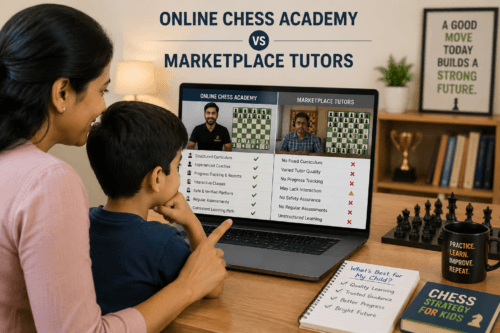
Search a marketplace app for “chess tutor” and forty profiles appear in under a minute. Search “online chess academy” instead, and a handful of structured programmes show up, each with a curriculum, a trial class and named coaches. Parents increasingly choose the second option, and the reason isn’t marketing. It’s what actually happens to a child’s progress over months, not a single hour.
This blog looks at why most parents now prefer an online chess academy over a marketplace tutor, and what to check before enrolling a child anywhere.
What Are Marketplace Tutors and How Do They Operate?
Marketplace tutors are independent individuals listed on freelance or tutoring platforms, where anyone can create a profile and start teaching. There is rarely a shared curriculum across tutors on the same platform, so each session depends entirely on that one person’s plan for the day.
This works fine for a one-off homework help session. It struggles as a long-term learning path, because a child moving from fundamentals to tactics to openings needs continuity that a single freelancer cannot always guarantee if they get busy, switch platforms, or simply teach inconsistently from week to week.
What Makes an Online Chess Academy Different From a Marketplace Listing
An online chess academy is an organisation, not an individual. It hires and verifies coaches, builds one curriculum every coach follows, and stays responsible for the child’s progress even if a coach becomes unavailable.
The difference shows up in three places: who is teaching, what they are teaching, and who is checking that it’s working. A marketplace listing only answers the first question. This is why parents researching online chess classes for kids increasingly look past single listings toward academies with a visible, structured process behind them.
Why a Structured Curriculum Beats Freelance, Unverified Teaching
A structured curriculum sequences learning in a fixed order: fundamentals, then tactics, then opening principles, then endgame technique. Skipping this order is the most common reason beginners plateau, no matter how talented the individual tutor is.
Freelance tutors, even well-meaning ones, often teach whatever a child finds fun that week, which keeps sessions pleasant but doesn’t guarantee progress. Organisations like FIDE and Chess.com structure their own training resources around this same staged approach, because chess improvement consistently depends more on sequence than on raw hours played. An academy’s curriculum exists to protect that sequence, session after session, coach after coach.
The Importance of a Chess Trial Class Before Committing
A chess trial class is the best way to judge a programme before paying for a term. It shows how a coach actually teaches a live child, not just what a listing promises.
Parents should use a free chess trial class to check three things: does the coach explain clearly at the child’s level, does the child stay engaged for the full session, and is there a visible plan beyond today’s class. A marketplace tutor can also offer a trial, but it only evaluates that one person. A trial with an academy also reveals whether the surrounding structure, materials and reporting are worth the commitment.
What to Expect From a Chess Demo Class at a Genuine Academy
A chess demo class at a real academy shouldn’t feel like a sales pitch disguised as teaching. It should look almost identical to a real class: a quick assessment of where the child stands, a short concept taught live, and a clear next step regardless of whether the parent enrols.
A good chess demo class for kids also gives parents a summary afterward explaining the child’s current level and which stage of the roadmap they’d start from. That kind of feedback is rare from an individual marketplace tutor, simply because there’s no system behind them generating it.
Accountability and Consistency: Academy vs Individual Tutors
If a marketplace tutor cancels, falls ill, or moves on, the parent is left finding a replacement and often restarting from scratch. An academy assigns a coach but keeps a backup system and progress notes that outlast any single person’s availability.
Consistency compounds. A child with ten structured sessions in a row, each building on the last, ends up meaningfully ahead of one with ten disconnected sessions, even if both had “an hour of chess” weekly. This is where an online chess academy proves its value over a full term, not just one class.
How Kaabil Kids Combines the Best of Structure and Personal Attention
Kaabil Kids runs its programme on a curriculum designed by International Grandmaster Tejas Bakre and delivers it through live online chess classes taught by FIDE-rated trainers, so every child follows the same fundamentals-to-endgame sequence regardless of which coach they’re paired with.
Coaches still personalise pace and attention to each child, and an in-house psychologist supports focus, confidence and motivation alongside the chess content. For parents comparing options, this is the practical middle ground: the reliability of an academy paired with the attentiveness families expect from best online chess coaching.
Beyond the game itself, structured chess coaching for kids builds concentration, pattern-based problem-solving, patience with losing positions, and the discipline of following a plan across weeks rather than one session at a time.
Conclusion
Marketplace tutors can be a reasonable stopgap for a single session, but children who need sustained progress are consistently better served by a structured academy with a verified curriculum, consistent coaches and a real feedback loop. Kaabil Kids brings all of this together with Grandmaster-designed learning and FIDE-rated trainers for children aged 5 to 15. Book a chess trial class or a chess demo class and see the difference in a single session.
FAQs
Q1. What is the difference between a marketplace tutor and an online chess academy?
A marketplace tutor is an independent individual with no shared curriculum or oversight, while an online chess academy is an organisation with a sequenced curriculum, verified coaches and progress tracking that continues even if one coach changes.
Q2. Is a chess trial class really necessary before enrolling?
Yes. A chess trial class shows exactly how a coach teaches a live child and whether the child stays engaged, which a listing or price page cannot show on its own.
Q3. Can a marketplace tutor be a good option for chess coaching?
It can work for occasional, casual sessions, but for steady long-term improvement, a structured academy with a sequenced curriculum consistently produces faster, more reliable progress.
Q4. How does a chess demo class differ from a regular session?
It includes a quick assessment of the child’s current level, a short live-taught concept, and a clear recommendation for what stage to start from next, alongside normal teaching.
Q5. Why do parents choose online chess academies over freelance tutors?
Mainly for consistency and accountability: curriculum continuity, coach backup, and structured feedback that a single freelance tutor working alone cannot reliably offer over months of lessons.