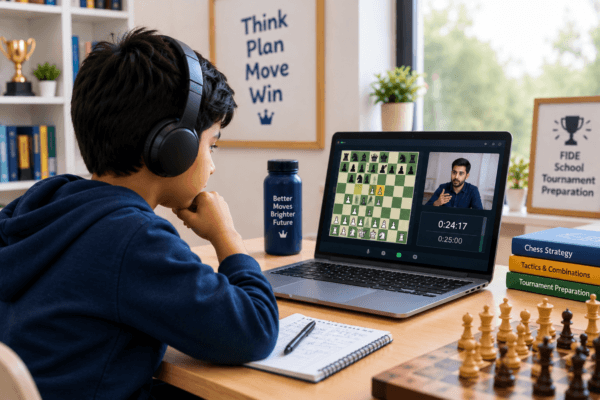
How Online Chess Classes Help Children Prepare for FIDE and School Tournaments
Every parent who watches their child fall in love with chess eventually hears the same question: “Can I play in a real tournament?” It’s an exciting moment, and also a slightly daunting one. School chess tournaments and FIDE tournaments run very differently from a casual game at home, and a child who has only ever played relaxed weekend games can find the clock, the notation sheet, and the silence of a tournament hall genuinely overwhelming.
This is where structured online chess classes make the real difference. This guide looks at what tournament preparation actually involves, how online chess classes for kids build those specific skills, and how a program like Kaabil Kids gets children ready for the pressure of real competition, not just the rules of the game.
Why Tournament Preparation Needs More Than Just Casual Practice
Is casual practice enough to prepare a child for a tournament? Not usually. Casual games teach a child how pieces move and how to enjoy the game, but tournaments demand something different: managing a ticking clock, recording every move in notation, sitting through a loss without a rematch, and staying focused for forty minutes or more without a parent nearby to help.
A child who has never played with a clock will often panic the first time one is placed in front of them, regardless of how strong their chess actually is. Tournament readiness is a separate skill from chess knowledge, and it has to be practized deliberately, the same way a child rehearses for a school play rather than simply memorizing the lines.
How Online Chess Classes Build the Skills Needed for FIDE and School-Level Play
Structured online chess classes prepare children for competitive chess by building four specific habits: playing with a clock, recording moves in standard notation, reviewing games afterward, and handling losses constructively. These are rarely picked up from casual play alone.
Time management is usually the biggest hurdle. A coach who introduces timed games gradually, first with generous time controls and then progressively shorter ones, helps a child learn to think quickly without panicking. Notation, the standard way of recording each move, is a requirement at every FIDE tournament, and children who practise it early find it second nature rather than a distraction during their first real event.
How do kids get a FIDE rating? A child earns an official FIDE rating by playing in FIDE-rated tournaments, where results are reported to the International Chess Federation and used to calculate a numerical rating that reflects playing strength. Children don’t need a rating to start; most begin with unrated school or club tournaments and work toward their first FIDE-rated event once they’re comfortable with the format. You can learn more about how the rating system works directly from FIDE, chess’s global governing body.
School chess tournaments, meanwhile, are usually less formal but still follow standard time controls and etiquette, making them a natural stepping stone before a child enters FIDE-rated competitive chess.
What a Structured Practice Routine Looks Like for Young Tournament Players
A child preparing for competition needs a different balance than casual practice, one that mirrors what actually happens at a tournament table. A typical weekly routine includes:
- Timed tactics practice: solving puzzles under a countdown to build calculation speed under pressure
- Opening review: learning two or three reliable openings deeply rather than many superficially
- Full-length timed games: played at tournament time controls to build stamina and focus
- Post-game analysis: reviewing every game afterward to catch recurring mistakes before they become habits
- Mock tournaments or simulated matches: so the format itself feels familiar before the real event
This kind of routine takes weeks to build properly, which is why tournament preparation works best as an ongoing part of a child’s regular chess classes for kids rather than a rushed effort in the final days before an event.
How Kaabil Kids Prepares Children for Real Competitive Pressure
Kaabil Kids builds tournament readiness directly into its coaching rather than treating it as a separate, last-minute add-on. Children train under FIDE-rated trainers within a curriculum designed by International Grandmaster Tejas Bakre, so tournament skills like time management and notation are introduced gradually as part of normal lessons, not crammed in before a competition.
Monthly tournaments give students regular, low-pressure opportunities to practise the format itself, building genuine tournament experience well before a high-stakes school or FIDE event. An in-house psychologist works alongside the coaching team to help children manage the nerves and disappointment that come with competitive play, because handling a loss well is as much a part of tournament readiness as any opening or tactic. Families exploring a chess academy for kids that treats competitive readiness as a core part of the curriculum, not an afterthought, will find this is central to how Kaabil Kids designs its programs.
Conclusion
Preparing a child for FIDE and school chess tournaments takes more than knowing the rules well. It requires deliberate practice with the clock, comfort with notation, the ability to review and learn from losses, and real exposure to the tournament format itself. Structured online chess classes build these skills gradually, turning a talented casual player into a confident competitor.
If you’re looking for a program that treats tournament preparation as part of everyday coaching rather than a rushed afterthought, explore what Kaabil Kids’ online chess classes offer and book a free trial class to see how your child’s readiness develops over time.
Frequently Asked Questions
Q1. What age can kids start playing in FIDE-rated tournaments?
There’s no minimum age set by FIDE itself, but most children begin around age 7 to 9, after they’ve built solid fundamentals and played several unrated school or club events first.
Q2. Are school chess tournaments different from FIDE tournaments?
Yes. School tournaments are usually informal and unrated, while FIDE tournaments follow official time controls and rules, and results affect a child’s official rating. School events are a good stepping stone toward FIDE-rated play.
Q3. How long does it take to prepare a child for their first tournament?
There’s no fixed timeline, as every child learns at a different pace. Many children benefit from several weeks of structured preparation, including practice games, timed play, chess notation, and mock matches, to help them feel more confident and comfortable before their first tournament.
Q4. Can beginners join competitive chess classes for kids?
Yes. Tournament preparation is introduced gradually alongside fundamentals, so a beginner isn’t expected to play competitively before they’re ready; coaches build up time management and notation skills as the child progresses.
Q5. Does playing in tournaments actually improve a child’s chess skills?
Yes. Tournament play forces children to apply what they’ve practised under real time pressure and without help, which reinforces learning far more effectively than casual games alone.