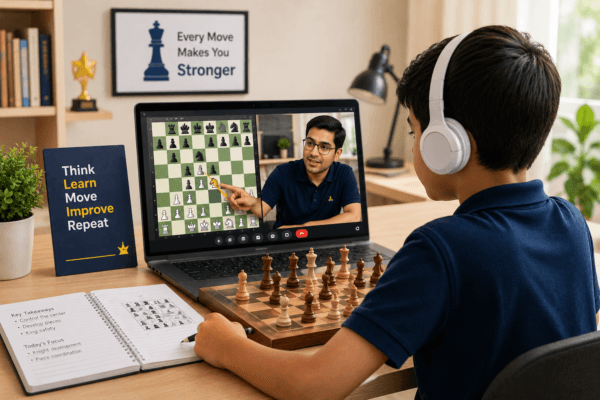
Why Live Online Chess Classes Are More Effective Than Recorded Chess Courses
A child watches a recorded lesson on knight forks for the second time. The explanation makes sense on screen. Ten minutes later, in an actual game, a fork opportunity appears and the child hesitates, unsure whether this position even matches the video. Nobody is there to say: yes, this is it, play the move. The moment passes. The chance is gone.
That gap, between watching a concept and applying it under real pressure, is the single biggest difference between recorded chess courses and live chess coaching. Chess.com had reached 250 million registered members by February 2026 (Chess.com, 2026), while FIDE’s own database lists only 1.64 million formally rated players worldwide against an estimated 605 million casual players (icon-era.com, citing FIDE, 2025). Millions of children are learning chess online. Very few are being coached through it live. This blog breaks down exactly what that gap costs a beginner, and why structured kids chess coaching closes it faster than any video library can.
Understanding the Difference Between Live and Recorded Chess Courses
The two formats are not variations of the same thing. They are built on opposite assumptions about how a child learns.
Recorded chess courses are pre-shot video lessons. A coach explains a concept once, it gets filmed, and every student who watches it afterward, regardless of skill level, pace, or specific doubt, sees the exact same explanation. There is no way to pause and ask why a move works in one position but not another.
Live online chess classes connect a child directly with a real coach in real time. The coach watches how the child actually thinks, catches the exact moment a wrong idea forms, and adjusts the lesson before that idea becomes a habit. This is the core of any credible online chess academy: instruction that responds to the learner in the moment, not a fixed script that plays the same way for everyone.
Why Live Online Chess Classes Deliver Better Results
Is live coaching actually better, or does it just feel that way? The research lines up with what coaches see every week. A 2025 meta-analysis of 31 randomized controlled trials covering more than 3,800 learners found that synchronous, real-time online instruction produced stronger knowledge outcomes and higher engagement than both asynchronous, recorded formats and traditional face-to-face teaching (ScienceDirect, 2025). Neither that study nor the feedback research behind it looked at chess specifically, but the mechanism maps directly onto the board: a coach who sees a mistake as it happens can name it and correct it before it repeats.
That single difference, feedback delivered at the moment of the mistake rather than after it, is what makes live chess coaching measurably more effective:
- Real-time correction: A hung queen or a missed mate-in-two gets caught and fixed on the spot, before it becomes a pattern.
- Personalised pacing: A concept that isn’t landing gets slowed down. A child racing ahead gets pushed further.
- Interactive practice: Kids play live games against the coach and get analysis immediately, not theory in isolation.
- Accountability: A scheduled class with a real person on the other side builds discipline that a “watch whenever” video cannot replicate.
Benefits of Live Chess Coaching for Kids
Beyond faster technical improvement, live classes build habits and confidence that recorded content has no mechanism for delivering.
- Better focus and engagement: A child pays closer attention to a person who is actively watching and responding than to a screen playing on autopilot.
- Confidence building: Being asked questions, answering out loud, and explaining a move to a coach builds communication skills alongside chess skills.
- Social learning: Group live classes let children compare strategies with peers and build friendships around a shared interest, something a solo video can never offer.
- Emotional support: A live coach notices when a loss has frustrated a child and can work through it in the moment. A recording plays on regardless.
- Goal-oriented progress: Coaches track development over weeks and months and adjust the curriculum as the child grows, which is the foundation of serious kids chess coaching.
Live Online Chess Classes vs Recorded Chess Courses
| Factor | Live Online Chess Classes | Recorded Chess Courses |
| Feedback | Instant, personalised | None or delayed |
| Engagement | High, interactive | Low, passive viewing |
| Pacing | Adapts to the learner | Fixed for everyone |
| Doubt Solving | Immediate | Not possible |
| Accountability | Scheduled, structured | Self-paced, easy to skip |
| Social Interaction | Yes, with coach and peers | None |
| Investment | Higher, with personalized coaching | Generally cheaper |
| Best For | Consistent, measurable growth | Casual, supplementary revision |
Recorded content has a place as a revision tool, but it rarely works as a child’s primary learning method. This is exactly why platforms offering structured Online Chess Coaching see far better retention and results than those relying purely on video libraries.
Which Option Is Best for Beginners?
For a child just starting out, live classes are almost always the better choice, and the reason is specific: beginners don’t yet know what they don’t know. A child working through the fundamentals stage, piece movement, check, the special rules, needs someone to catch the exact moment a wrong habit forms, not a general explanation that assumes the learner can already self-correct. That assumption rarely holds for a 6 to 10-year-old picking up chess for the first time.
Recorded lessons can still play a role, as revision material between live sessions once a concept has already been taught properly. But as a standalone learning method for a true beginner, video alone leaves the exact gaps that structured online chess coaching is built to close.
Why Parents Prefer Live Online Chess Classes for Their Children
Parents today want more than entertainment value from a chess subscription. They want measurable growth, safety, and a coach they can actually trust. Live classes deliver on all three:
- Transparency: Parents can sit in on sessions and see exactly how their child is progressing, not just take a platform’s word for it.
- Trained, verifiable coaches: Live coaches are real professionals, often FIDE-rated, building an ongoing relationship with the child rather than appearing once on a screen.
- Progress tracking: Regular assessments, tournaments, and feedback reports give parents a clear, evidence-based picture of improvement.
- Convenience with structure: Parents searching for chess classes near me are increasingly finding that live online classes match the structure and accountability of an in-person academy, minus the commute.
This combination of trust, structure, and visible progress is why more families are moving away from generic video libraries toward dedicated live coaching platforms.
Conclusion
Recorded chess courses have a place, as a low-cost introduction or a supplementary resource between lessons. But for genuine skill development, confidence, and consistent progress, live chess coaching is simply the more effective format. The real-time feedback and human connection it offers cannot be replicated by any pre-recorded video, however well produced.
Kaabil Kids builds its programme around exactly this principle: a curriculum designed by International Grandmaster Tejas Bakre, delivered live by FIDE-rated trainers, with an in-house psychologist supporting motivation and confidence along the way. If you’re looking for a trusted online chess academy where every session is live, tracked, and built around your child rather than a fixed script, explore Kaabil Kids’ online chess coaching or book a free trial class to see the difference for yourself.
FAQs
Q1. Are live online chess classes better than recorded courses for beginners? Yes. Beginners benefit most from real-time correction and guidance, which only live classes can provide before a wrong habit sets in.
Q2. What age should a child start live chess classes?
Most coaches recommend starting between ages 5 and 7, though children of any age can benefit from structured kids chess coaching.
Q3. Can recorded chess courses be useful at all?
Yes, as supplementary revision material between live sessions, reinforcing a concept the coach has already taught, but not as a primary learning method.
Q4. How do live chess classes track a child’s progress?
Through regular assessments, assignments, puzzles, and tournament performance, monitored by the coach over weeks and months rather than left to chance.
Q5. Is online chess learning as effective as in-person coaching?
When delivered live and interactively, online chess learning can match in-person coaching, with the added benefit of convenience and access to specialized coaches regardless of location.