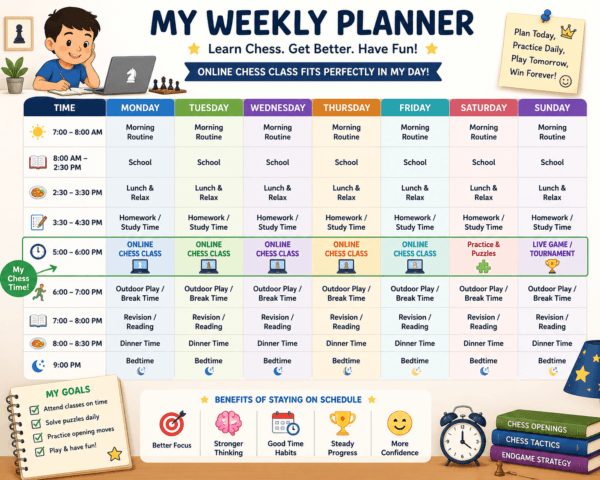
A parent decides their child should learn chess, opens the family calendar to find a slot, and closes it again ten minutes later. School ends at 3:30. Swimming is Tuesday and Thursday. Homework eats another hour most nights. Bedtime cannot move. The idea is good; the calendar disagrees.
Fitting online chess classes into an already full week is a scheduling problem, not a motivation problem, and it has a straightforward answer once homework, screen time, sleep and other activities are laid out side by side. This guide covers how much time a weekly chess class really needs, where it fits around the rest of the day, which time slots work best by age, how many other activities a chess schedule can realistically sit alongside, and what to do when the routine stops working.
How Much Time Does a Weekly Online Chess Class Actually Take?
A single live online chess class typically runs 30 to 60 minutes depending on age, once or twice a week, with optional puzzle practice on the days in between. That is the entire time commitment for most structured programmes, not a daily obligation stacked on top of everything else. The confusion usually comes from comparing chess to sports training, which often does demand daily practice. Chess does not work that way at the beginner and intermediate stages; a short, consistent weekly session with occasional practice beats long, irregular sessions every time.
This is the number worth anchoring the rest of the schedule to: one fixed 30-to-60-minute slot a week, protected the same way a football practice or a music lesson would be protected.
Where Chess Fits Around Homework, Screen Time and Sleep
The right slot for a chess class depends on what the rest of the day already looks like, so it helps to know the general shape of a typical school-age day before placing anything new into it.
On homework: the widely used National Education Association guideline is roughly ten minutes of homework per grade level per night, which puts a first grader at about ten minutes and a typical elementary-age child under 30 minutes on most days. That leaves real room in the after-school hours for a chess class without displacing schoolwork, as long as the slot is placed deliberately rather than squeezed in after everything else runs long.
On screen time: in a 2021 US parent survey reported by eMarketer via Statista, 51 percent of parents said their child spent more than three hours a day on screens outside of homework. A structured chess class is screen time with a coach, a curriculum and a clear stopping point, which makes it a reasonable swap for a portion of otherwise unstructured screen time rather than an addition to it.
On sleep: the American Academy of Sleep Medicine recommends 9 to 12 hours a night for children aged 6 to 12 and 8 to 10 hours for teenagers aged 13 to 18, endorsed by the American Academy of Pediatrics. Any activity placed late enough to cut into that window, chess included, costs more than it gives back. The class should slot in well before the wind-down routine starts, not compete with it.
A Sample Weekly Schedule by Age Group
There is no single correct time slot, but these starting points work for most families and can be adjusted once the real week is in front of you.
| Age Group | Best Class Window | Session Length | Scheduling Note |
| Ages 5-7 | Right after school snack, before homework fatigue sets in | 30-40 minutes | Keep it earlier in the evening; attention span drops fast after dinner |
| Ages 8-11 | Late afternoon, after a short break but before homework starts | 45-50 minutes | Works well as a homework warm-up; sharpens focus for what follows |
| Ages 12-15 | Early evening or weekend morning, depending on sports and tuition load | 50-60 minutes | Protect a fixed weekday sleep buffer; do not push the slot past 8 pm on school nights |
What Time of Day Works Best for Live Online Chess Classes?
Three windows tend to work better than the rest. Right after school, before homework begins, uses a child’s freshest post-school attention rather than the tired stretch after dinner. Immediately before homework can also work well, since a short focused activity like chess can act as a warm-up that sharpens concentration for the work that follows. Weekend mornings suit families whose weekday evenings are already full with sports or tuition, and they remove the pressure of a school-night slot entirely.
What to avoid is placing the class in the last hour before bedtime. Research on study time from Stanford researchers found that the benefits of homework plateau at around two hours a night, with longer sessions linked to higher stress and less time for everything else in a child’s day, and the same principle applies to any structured activity stacked too close to sleep: it stops helping and starts costing rest instead.
How Many Other Activities Can a Chess Schedule Realistically Sit Alongside?
Chess rarely needs to compete for space with everything else, because it takes up so little of the week on its own. But it does need to be weighed against the rest of the schedule. A 2018 UK study covered by ScienceDaily, based on interviews with almost 50 families, found that 88 percent of children took part in organised activities on four to five days a week, with 58 percent doing more than one activity in a single evening. That pattern is what tends to make a calendar feel impossible, not the act of adding one more well-placed activity to it.
A commonly used rule of thumb among parenting educators is to cap structured activities at three per week and to drop one before adding a new one once that ceiling is reached. The Child Mind Institute frames the real test more simply: does the child still have time for homework, friends, family and enough sleep? If the answer is yes, one more activity, including a weekly chess class, comfortably fits.
Building a Weekly Chess Routine That Actually Sticks
- Anchor the class to the same day and time every week rather than rescheduling around whatever else comes up; consistency matters more than finding the theoretically perfect slot.
- Treat the slot as fixed the way a sports practice or music lesson would be treated, not as the first thing to move when the week gets busy.
- Fold puzzle practice into screen time that already exists, such as swapping fifteen minutes of unstructured tablet use for a puzzle app, instead of adding a new block to the day.
- Review one recurring mistake from the last class rather than grinding through unrelated puzzles; this keeps practice short and still useful on busy weekdays.
- Leave one day a week completely free of structured chess activity, even during an active tournament season, so the class stays something the child looks forward to rather than one more box to check.
Signs the Schedule Needs to Change
A few signals tend to show up before a parent names the problem directly:
- The child is consistently tired or reluctant right before the class, not just occasionally
- Homework quality or bedtime starts slipping on the days chess is scheduled
- The weekly slot keeps getting rescheduled rather than protected
- Practice between classes disappears entirely because there is no time left to fit it in
None of these signs mean chess itself is the problem. Usually they mean the slot is in the wrong window, chess is stacked too close to another demanding activity, or the week has too many commitments in total. Moving the class by an hour, swapping it to a lighter weekday, or dropping one other activity is almost always enough to fix it, and it rarely means giving up the class altogether.
Kaabil Kids runs live online chess classes built around exactly this kind of realistic weekly rhythm, with a curriculum designed by International Grandmaster Tejas Bakre and delivered by FIDE-rated trainers, supported by an in-house psychologist who works with families on pacing and motivation, not just the chessboard. Families exploring online chess coaching or an online chess tutor will find the class structure is designed to sit inside one weekly slot from day one, not to grow into another daily commitment.
Conclusion
A weekly online chess class only needs one protected 30-to-60-minute slot placed away from homework crunch and bedtime, with light optional practice folded into time that already exists. Kaabil Kids builds its live online chess classes around exactly that rhythm, with a Grandmaster-designed curriculum, FIDE-rated trainers, and an in-house psychologist supporting the pacing, for children aged 5 to 15. Explore online chess coaching for beginners or book a free trial class to see how it fits into your week.
Frequently Asked Questions
Q1. How many days a week should a child take online chess classes?
Most beginner and intermediate students only need one live class a week, with light optional practice on two or three other days. Daily classes are unnecessary at this stage and tend to cause burnout faster than they build skill.
Q2. Is it better to schedule chess before or after homework?
Before homework generally works better for younger children, since a short focused chess session can sharpen concentration for the work that follows. For older children with heavier homework loads, a slot right after school, before homework starts, tends to work best instead.
Q3. How much time should a child spend practising chess outside of class?
Fifteen to twenty minutes of puzzle practice two or three times a week is enough for most beginners. This works best when it replaces existing unstructured screen time rather than adding a new block to an already full day.
Q4. What if chess class keeps clashing with other activities?
Rather than dropping chess, try moving it to a lighter weekday or a weekend morning first. If the clash persists, it is usually a sign the overall weekly activity count needs trimming rather than a reason to remove chess specifically.