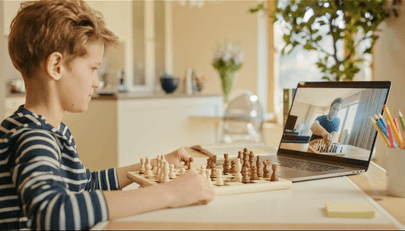
The Complete Beginner Roadmap for Learning Chess Online
Type “how to start learning chess” into any search engine and you will find a dozen opinions that contradict each other. Study openings on day one. Ignore openings until you hit a certain rating. Play a thousand casual games first. Solve puzzles before you touch a real game.
Online chess learning has a logical sequence, and following it is the single biggest difference between a beginner who improves steadily and one who stalls for months. This beginner chess guide covers the four stages in the exact order each one builds on the previous. No prior knowledge needed.
Chess.com reached 250 million registered members by February 2026 (Chess.com, 2026), yet FIDE’s database lists only 1.64 million formally rated players against an estimated 605 million casual players worldwide (icon-era.com, citing FIDE, 2025). The gap between those numbers is every beginner who has not yet found a structured path. This roadmap is that path.
Chess Fundamentals Every Beginner Needs Before Anything Else
Chess fundamentals are not a formality to rush past. They are the only layer that every subsequent stage depends on. A child with a shaky understanding of how a bishop moves carries that gap into every tactic and every game for years.
Stage 1 of any online chess learning programme covers exactly five things: piece names and movements, how check works and the three ways to escape it, the special rules (castling, en passant, pawn promotion), the win condition, and the most common draw types. Beginner chess lessons start here, not with openings.
How do you know Stage 1 is solid? Look for these signs before moving on:
- Moving any piece without hesitation when asked
- Seeing check before it happens, not only after it does
- Executing castling, en passant and pawn promotion without a rules lookup
- Understanding why a position is lost before resigning
The milestone for leaving Stage 1 is simple: the child sets up the board from memory and plays a complete legal game without a single rules reminder.
Tactics: Where the Board Finally Starts Making Sense
Tactics are short sequences of moves that win material or force a result through a specific pattern. They are the most satisfying stage of any beginner chess guide because results are immediate and visible. Spot a fork, win a piece, feel the board click into focus for the first time.
Four tactics belong in every beginner chess training program, learned in this order:
| Tactic | What It Does | Why Beginners Learn It First |
| Checkmate in one | Forces the game to end on the next move | Confirms piece movement and board vision are solid |
| Fork | One piece attacks two opponent pieces simultaneously | Teaches seeing multiple threats at once |
| Pin | Restricts a piece without exposing a valuable one behind it | Shows how position limits the opponent’s options |
| Skewer | Forces a valuable piece to move, revealing a weaker one | Reverses pin logic; deepens pattern recognition |
One catch in self-directed practice: a child who solves puzzles alone often cannot apply them in real games. A chess training program that reviews actual games and shows exactly where a tactic was missed closes that gap faster than solo puzzle-solving ever will.
Openings: Three Principles Beat a Hundred Memorised Lines
This is where most beginners waste the most study time. A child who memorises eight moves of a named opening will panic the moment an opponent deviates. A child who understands three principles adapts to almost any position.
The three chess fundamentals of the opening are these: control the centre by aiming pawns and pieces toward the d4, d5, e4 and e5 squares; develop pieces quickly by bringing knights and bishops out before moving any piece twice; castle early to get the king to safety before attacking.
A chess training program built on principles produces adaptable players. One built on memorised repertoires produces players who are lost the moment the game goes off-script. At the beginner stage, principles are the only opening study worth doing.
Why Do Endgame Skills Matter More Than Most Beginners Expect?
Most self-directed online chess learning plans skip endgames entirely. That is why most beginners routinely draw or lose positions they have technically already won.
Endgame knowledge is not advanced content saved for later. Three concepts belong in a beginner’s plan from early on: king activity (the king becomes a powerful fighting piece and must move to the centre of the board), pawn endings (most simplified positions come down to whether a pawn can be promoted), and rook endings (the most common type at beginner level, where keeping the rook active wins positions that look equal).
Every effective beginner chess guide treats this as stage four, not an optional add-on. The chess improvement roadmap without endgames is a map with a section deliberately torn out.
When Is the Right Time to Start Professional Chess Coaching?
A solid beginner chess guide carries most children through all four stages using free resources, puzzles and self-play. There is a ceiling, and it arrives earlier than most parents expect.
The clearest signs it has arrived:
- The same errors repeat across different opponents, suggesting intuition is reinforcing mistakes rather than correcting them
- Tactics puzzles feel disconnected from actual games, meaning pattern recognition is not yet transferring to real positions
- Motivation drops because progress is no longer visible and the chess improvement roadmap has no obvious next step
- A child wants to enter tournaments but has no idea how to prepare
The global chess learning platforms market was valued at $2.8 billion in 2025 and is projected to grow at 11.7% annually through 2034, driven primarily by demand for structured coaching rather than casual play (Dataintelo, 2025). When those signs appear, a coach does not replace the four stages. They personalise the sequence, correct the specific recurring errors and provide the external accountability that keeps the chess improvement roadmap moving forward.
Kaabil Kids’ beginner chess lessons sequence all four stages in exactly this order, with a curriculum designed by International Grandmaster Tejas Bakre and delivered by FIDE-rated trainers in live online chess classes. An in-house psychologist supports motivation throughout the online chess learning journey. Families looking for online chess coaching or an online chess tutor who builds this complete roadmap from day one will find Kaabil Kids structured around exactly that outcome.
Conclusion :
The online chess learning sequence is clear: chess fundamentals first, tactics second, opening principles third, endgame basics fourth, and coaching when self-direction reaches its ceiling. Kaabil Kids puts this full chess improvement roadmap into a single structured programme for children aged 5 to 15, sequenced by a Grandmaster, delivered by FIDE-rated trainers and supported by an in-house psychologist. Explore online chess coaching for beginners or book a free trial class to get started.
Frequently Asked Questions
Q1. What is the best way to begin online chess learning as a complete beginner?
Follow the four-stage sequence: chess fundamentals first, then simple tactics, then opening principles, then endgame basics. A structured beginner chess guide makes this order explicit so no beginner wastes months on stage three before stage one is solid.
Q2. How long does it take to go from beginner to intermediate in chess?
A child following structured beginner chess lessons with weekly coaching typically develops solid tactics and basic endgame technique within twelve to eighteen months. Progress is consistently faster with reviewed games than unreviewed ones, which is exactly what a good chess training program delivers.
Q3. Should a beginner focus more on tactics or openings?
Tactics, by a significant margin. A child who reliably spots forks, pins and basic mates will win more games than one who has memorised openings but misses a free piece every session. Opening principles come after chess fundamentals and tactics are genuinely solid.
Q4. When should a child start taking formal beginner chess lessons?
As soon as the chess fundamentals are solid enough to play a complete legal game. Starting online chess coaching at the tactics stage, rather than waiting for a plateau before seeking beginner chess lessons, means a coach shapes the learning habits that make every subsequent stage faster. Waiting until motivation drops is the most avoidable delay on any chess improvement roadmap.