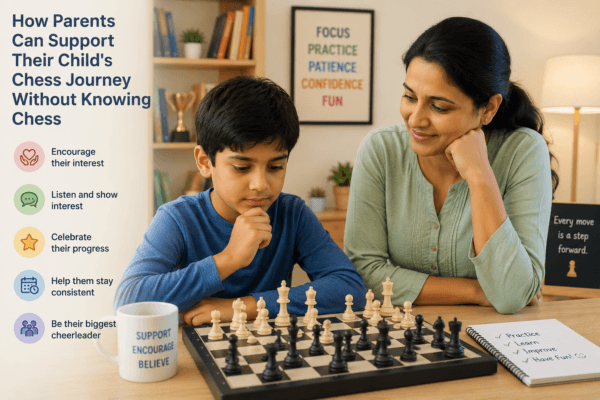
“I don’t even know how the knight moves. How am I supposed to help?
It’s one of the most common worries parents raise once their child starts chess. The pieces look unfamiliar, the notation looks like code, and every video the child watches seems to move faster than a parent can follow.
Here’s the reassurance worth starting with: you do not need to know chess to support your child’s chess journey. Research on family involvement in learning consistently shows that a parent’s presence, encouragement, and consistency matter more than subject expertise. This guide walks through exactly what that support looks like in practice, with no chessboard knowledge required.
Why You Don’t Need to Know Chess to Support Your Child’s Learning
Parents rarely re-derive algebra to help with math homework or out-swim their child’s coach to help with swimming. Support and instruction are different jobs, and chess is no exception. The coach teaches the game. The parent builds the conditions that let the child stick with it.
Research from Harvard Graduate School of Education backs this up directly. Family involvement is linked to stronger academic outcomes across subjects, and the involvement that matters most looks like attendance, encouragement, routine-building, and interest, not the parent’s own mastery of the subject. A parent doesn’t need to solve a checkmate puzzle to make sure practice happens at the same time every week, or to notice when a child seems proud of a game.
A 2025 study published in Frontiers in Psychology on chess teaching in early childhood found significant improvements in attention, memory, logical thinking, patience, and self-discipline among children in structured chess programs, and specifically recommended parental involvement, alongside trained instruction, as a factor that strengthens these outcomes. The instruction came from trained coaches. The involvement came from parents who showed up, asked questions, and paid attention, regardless of whether they could tell a fork from a pin.
Do I need to know how to play chess to support my child’s chess learning?
No. A parent’s role is to provide encouragement, consistency, and structure, not chess expertise. The coaching itself should come from a trained instructor. Research on family involvement shows that active, encouraging parents help children stay motivated and consistent, regardless of whether the parent understands the game.
Simple Ways to Show Interest in Your Child’s Chess Progress
Interest is easy to show and does not require decoding a chessboard. A few habits go a long way:
- Watch a few minutes of a class or a game, without commenting on individual moves. Just being present communicates that this matters.
- Ask to see a game they’re proud of and let them narrate it. Children usually enjoy explaining their own thinking far more than being quizzed on it.
- Track the markers a coach mentions, a puzzle streak, a rating change, a tournament result and follow up on those specifically in the following week. It shows the parent was listening, not just present.
- Celebrate effort after a loss, not only wins. Chess has more losses than wins for most learners, and how a parent responds to a loss shapes whether a child keeps playing.
- Show up to tournaments or online demo days, even without understanding the position on the board. A parent in the room (virtual or physical) still counts as support.
None of this requires the parent to evaluate whether a move was good. It only requires attention.
How can a parent track their child’s chess progress without understanding the game?
By tracking what the coach reports rather than the moves themselves rating changes, puzzle accuracy, tournament results, and specific skills the coach flags as improving or needing work. Asking the child to narrate their own games is also an effective, no-expertise-required way to follow progress.
Why a Reputed Chess Institute Can Guide You Too, Even Without Visiting One “Near Me”
Many parents start their search with “chess institute near me,” “chess teacher near me,” or “chess coaching centre near me,” on the assumption that being nearby makes it easier to stay involved or easier to judge quality. In practice, physical proximity doesn’t guarantee visibility into how a child is actually doing. A nearby center can still leave parents in the dark between report cards.
A well-structured online chess coaching program often does the opposite. Recorded classes, written progress notes, and periodic reports give a parent more insight into their child’s actual learning than sitting in a waiting room ever would. The “coach” a parent doesn’t have to become themselves is exactly what a chess teacher near me search, or its online equivalent, is meant to find: someone who can explain the game at a child’s level and report back to the parent in plain language.
This is also where searching more broadly than “near me” pays off. A chess classes near me search limits a family to whoever happens to be local, while an online chess coaching search opens the door to programs built by titled players and delivered by FIDE-rated trainers, regardless of city. For a parent who isn’t going to evaluate the coaching quality themselves, the credentials behind the program matter more than its address.
Creating a Supportive Environment for Practice at Home
A supportive environment for chess practice has very little to do with chess itself:
- Pick a consistent time and day for practice or homework puzzles. Routine matters more than duration: twenty focused minutes at the same time each day beats an hour squeezed in whenever there’s a gap.
- Set up a quiet, distraction-free spot. This doesn’t need a dedicated chess corner, just a place without a screen playing in the background.
- Let the child sit with a puzzle before stepping in. A parent doesn’t need to solve it. The instinct to jump in and “fix” a stuck moment can actually shortcut the problem-solving chess is meant to build.
- Keep practice pressure-free. Tying chess results to rewards or punishments tends to shift a child’s motivation from enjoying the game to avoiding a consequence, which usually backfires over a long learning journey.
- Stay nearby during online classes without hovering. Being available if something goes wrong technically is enough; the class itself is the coach’s job.
Can a parent help with chess practice at home without knowing the rules?
Yes. A parent’s contribution at home is mostly environmental: a consistent schedule, a quiet space, and low-pressure encouragement. The actual chess content, including puzzles and lesson review, is best left to the coach’s assigned material and explanations rather than a parent attempting to correct moves they aren’t confident about.
How Kaabil Kids Keeps Parents Involved and Informed
Kaabil Kids builds its beginner chess lessons around a curriculum designed by International Grandmaster Tejas Bakre and delivered by FIDE-rated trainers in live online chess coaching classes for children aged 5 to 15. An in-house psychologist supports motivation throughout the journey, which matters directly for parents worried about frustration or confidence dips after a string of losses.
Because classes are live and online, parents don’t need to sit in and evaluate the content to stay informed. Kaabil Kids is structured so a parent can follow a child’s development through the coach’s own updates, rather than needing to become a chess evaluator themselves. That structure is exactly what replaces “the parent needs to know chess” with “the parent needs five minutes to read a report.”
Families searching for a chess coaching centre near me or an online chess tutor often find that the online format actually gives them more consistent visibility into a child’s progress than a local option would. Kaabil Kids is built around exactly that outcome: expert-led coaching for the child, and clear, digestible updates for the parent.
Conclusion
Supporting a child through their chess journey isn’t about learning to play chess yourself. It’s about showing up consistently, asking questions that let the child do the thinking, and building a calm, low-pressure space for practice at home. The coaching, structure, and expertise can come from elsewhere.
Kaabil Kids pairs a Grandmaster-designed curriculum with FIDE-rated trainers, an in-house psychologist, and clear progress updates, so parents can stay genuinely involved without needing to be the expert in the room. Explore online chess coaching for kids or book a free trial class to see how it works for your child.
Frequently Asked Questions
Q1. Do I need to know how to play chess to support my child’s chess learning?
No. A parent’s role is to provide encouragement, consistency, and structure, not chess expertise. The coaching itself should come from a trained instructor, and research on family involvement shows that active, engaged parents help children stay motivated regardless of whether the parent understands the game.
Q2. How can a parent track their child’s chess progress without understanding the game?
Track what the coach reports rather than the moves themselves: rating changes, puzzle accuracy, tournament results, and the specific skills a coach flags as improving. Asking a child to narrate their own games in their own words is also an effective way to follow progress without any chess knowledge required.
Q3. Is online chess coaching effective if the parent doesn’t know chess?
Yes. Online chess coaching is led entirely by trained instructors, so a parent’s role stays the same as it would with any structured class: routine, encouragement, and attention to feedback. Reputed programs also send parents progress updates, which removes the need to assess chess skill directly.
Q4. Can a parent help with chess practice at home without knowing the rules?
Yes. A parent’s contribution at home is mostly environmental: a consistent schedule, a quiet distraction-free space, and low-pressure encouragement after both wins and losses. The chess content itself, including puzzles and lesson review, is best left to the coach’s material.
Q5. When should parents look for a structured chess coaching program instead of teaching casually at home?
Once a child shows real interest but progress plateaus, or once puzzles and casual games start feeling repetitive without improvement, a structured program becomes more useful than self-directed learning. A titled curriculum and trained coach can diagnose specific gaps that a parent, understandably, usually can’t spot on their own.