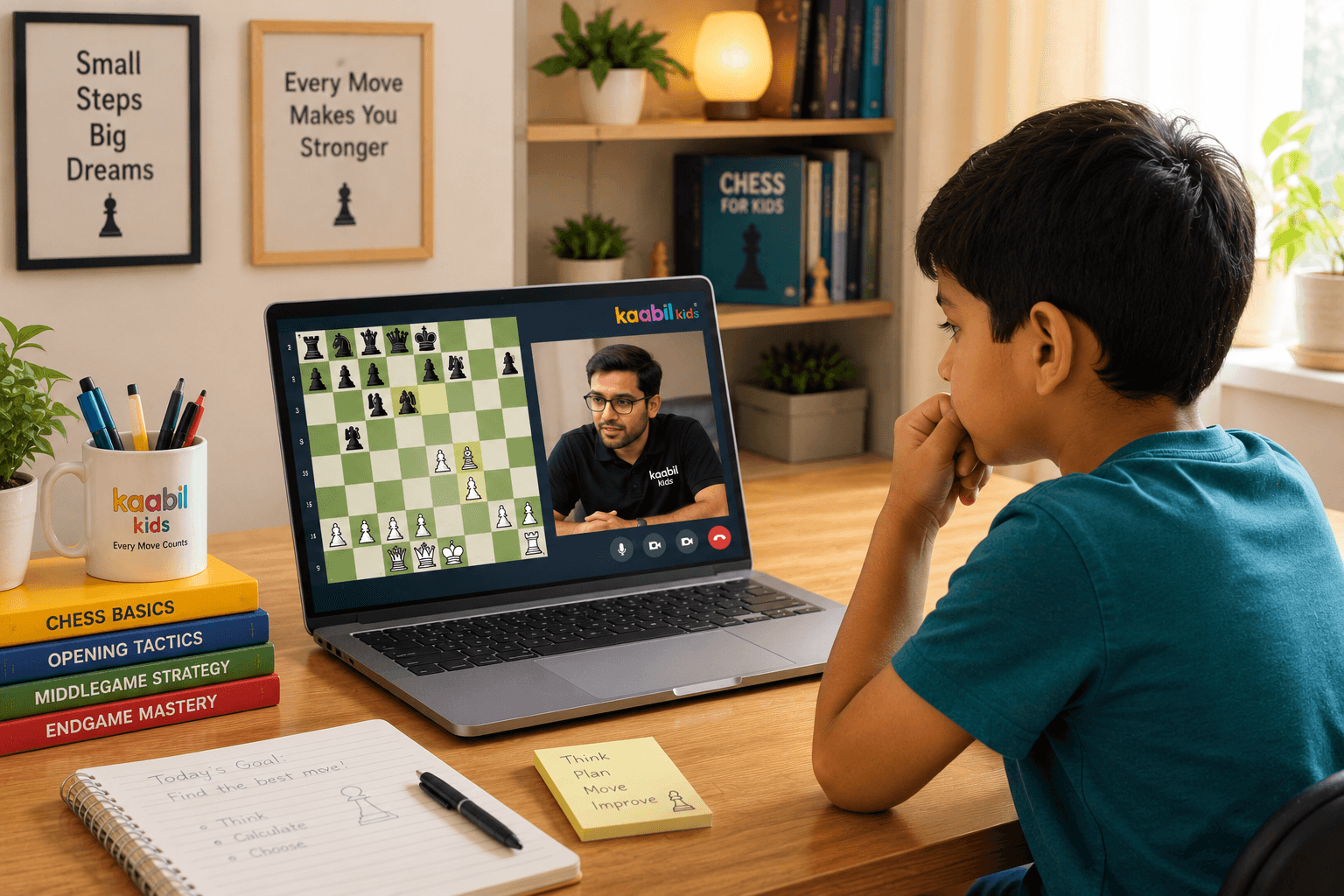
A seven-year-old stares at the board for a full minute before moving. Her first instinct was to grab the free pawn. Instead, she checks what happens next, sees the trap, and picks a safer move. Nobody told her the answer. She worked it out herself.
That pause, the moment a child chooses to think before acting, is what parents are really searching for when they look up online chess classes for kids. A 2025 study published in Frontiers in Psychology followed young children through structured chess instruction and found significant gains in attention, memory, logical thinking, patience and self-discipline compared to children who did not receive chess teaching (Frontiers in Psychology, 2025). At Kaabil Kids, this is the outcome the entire coaching approach is built around: not just a child who knows chess notation, but one who thinks more carefully everywhere else too.
Why Chess Is One of the Best Tools for Building Thinking Skills
Chess is often called a mental workout, and the comparison holds up under research, not just intuition. A 2025 study on chess intervention and executive function measured decision-making and working memory in children before and after structured chess training. Both showed statistically significant improvement, with decision-making scores rising notably after just weeks of coaching (Walden University dissertation research, 2025). Unlike many enrichment activities, chess demands a decision on every single move, which means a child gets constant, repeated practice at exactly the skill parents want strengthened.
Every move on the board requires a child to consider several options and predict what happens next, with no single “correct” answer handed to them. This is what naturally builds critical thinking skills: the child has to reason it out, not recall a memorized fact. Because mistakes are immediate and visible on the board, chess also builds the habit of pausing to think before acting, a skill that extends far beyond the game itself.
How Kaabil Kids’ Teaching Style Encourages Independent Decision-Making
Does live coaching actually build independent thinking, or does it just teach memorized openings faster? At Kaabil Kids, the coaching style is deliberately built to avoid the second outcome.
Instead of telling a child what move to make, coaches ask guiding questions: “What is your opponent threatening?” or “What happens if you move here?” This approach pushes children to work through decision making in chess on their own, with support rather than direct instruction. Over weeks of practice, children start applying this same question-asking habit to their own thinking, both on and off the board.
Small live batches make this possible. In a crowded classroom, individual reasoning gets lost in the noise. Kaabil Kids keeps its online chess coaching sessions focused and interactive, so every child gets the chance to explain their reasoning, receive feedback, and adjust their thinking in real time, the kind of back-and-forth that passive learning formats cannot replicate.
How Regular Practice Builds Genuine Confidence, Not Just Chess Skill
Confidence building rarely comes from being told a child is smart. It comes from doing something difficult, struggling with it, and getting measurably better over time. Chess offers exactly this kind of earned confidence.
When a child loses a game, reviews what went wrong, and comes back to play better the following week, they learn something more valuable than any single tactic: setbacks are part of progress, not proof of failure. This mindset is one of the most consistent predictors of long-term learning success in educational psychology.
Kaabil Kids’ chess classes for kids are structured around steady, visible improvement. Children move through levels, take on new challenges, and see their own progress reflected in how they play, and that visible growth builds more authentic self-belief than praise alone ever could.
What Chess Practice Changes Beyond the Chessboard
| Before Consistent Chess Practice | After a Few Months of Structured Coaching |
| Reacts quickly, often without weighing options | Pauses to consider consequences before deciding |
| Gives up quickly when a problem feels hard | Sticks with a difficult problem longer |
| Struggles to explain reasoning behind a choice | Can walk through why a decision was made |
| Loses focus during longer tasks | Holds attention through multi-step tasks |
| Sees mistakes as failure | Treats mistakes as information to correct |
Parents often notice these shifts first in homework and everyday decisions, not on the chessboard itself. A child who pauses before answering a question, sticks with a hard problem a little longer, or explains their reasoning more clearly is applying smart thinking skills first practiced during a chess class, to situations that have nothing to do with the game.
Conclusion
Chess is more than a game of strategy. Backed by growing research on cognitive development, it becomes a structured way for children to build critical thinking, sharpen decision-making, and develop confidence that holds up outside the classroom. Kaabil Kids’ approach combines small live batches, guided questioning, and steady skill progression, delivered by trained coaches, to help children grow into thoughtful, self-assured learners.
If you’re looking for a structured, expert-led online chess coaching program that focuses on genuine thinking skills rather than memorized openings, explore Kaabil Kids’ programs or book a free trial class to see the difference for yourself.
FAQs
Q1. Is online chess coaching as effective as in-person classes for kids?
Yes, when the format includes live interaction rather than pre-recorded lessons. A coach who can ask questions and give immediate feedback builds skill faster than either format alone; the key factor is live engagement, not the medium itself.
Q2. What age should a child start chess classes?
Most children can begin around age 5 or 6, once they can sit through a short structured activity and follow simple rules. Kaabil Kids designs its chess class for kids programs to suit different age groups, adjusting pace and complexity accordingly.
Q3. How many hours a week should a child practice chess to see real benefits?
One to two structured sessions per week, along with some independent practice, is generally enough for steady improvement. Consistency matters more than long hours.
Q4. Can chess help with a child’s focus and attention span?
Yes. Chess requires sustained attention on a single problem, which trains children to concentrate for longer stretches without getting distracted, a benefit that often becomes noticeable in homework and classroom settings within a few months.
Q5. Does my child need to be good at math to succeed in chess?
No. Chess relies more on pattern recognition, planning, and reasoning than on mathematical calculation. Many children who find math challenging still excel at chess once they understand the underlying patterns.
Q6. How is Kaabil Kids’ coaching different from free apps or videos?
Free apps and videos teach moves and openings but rarely explain the reasoning behind them. Kaabil Kids’ live coaches focus on why a move works, using guided questions so children build independent decision-making skills instead of memorizing patterns.
Q7. Will my child need special equipment for online chess classes?
No special equipment is required beyond a computer or tablet with a stable internet connection. Kaabil Kids’ online chess classes for kids run through a simple, accessible online format so children can join from home.