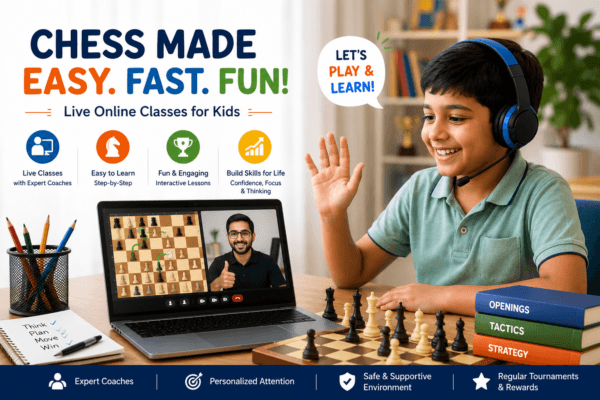
Chess has a reputation problem with beginners. Parents picture long silences, complicated notation, and grandmasters staring at a board for twenty minutes before moving a single pawn. It looks like a subject for later, once a child is “old enough” or “serious enough.” That reputation is exactly what keeps so many curious kids from ever picking up the game.
Kaabil Kids was built around a different idea: chess can be taught in a way that feels easy from the very first class, fast enough to hold a child’s attention, and genuinely fun, without cutting corners on real skill. This is how Kaabil Kids’ online chess classes for kids turn an intimidating board game into something children actually look forward to each week.
Why Chess Feels Intimidating to Many Beginners at First
Why does chess feel hard for beginners? Chess feels hard at first because it looks like sixty-four squares of pure memorization, when in reality only a handful of ideas need to click before the rest starts making sense. New players see sixteen pieces, six different move patterns, and words like “castling” or “en passant,” and assume they need to know all of it before they can even start playing.
That assumption is the real barrier, not the game itself. A five-year-old doesn’t need to understand opening theory to enjoy moving a knight for the first time. The intimidation usually comes from how chess is taught, not from chess itself, which is exactly the gap a good chess class for kids is designed to close.
How Kaabil Kids Breaks Down Chess into Simple, Bite-Sized Lessons
Kaabil Kids solves this by never handing a child the whole game at once. Each online chess class introduces one small, concrete idea, how a bishop moves, what a fork is, how to protect a king, and gives a child enough repetition to genuinely understand it before the next idea is added.
This sequencing follows a clear order: fundamentals first, then tactics, then opening principles, then endgames, so each new idea builds on one the child already knows instead of jumping around at random. Classes also run in small batches, so a trainer can notice exactly when a specific child is stuck on a specific idea and slow down for them, instead of pushing the whole group ahead regardless.
For families comparing an online chess class against browsing free puzzles alone on a platform like Chess.com, this structured, step-by-step approach is usually what turns scattered exposure into real understanding.
What Makes Learning Chess with Kaabil Kids Feel Like Play, Not Work
Is learning chess fun for kids? Yes, when the lessons are built around a child’s age rather than a fixed syllabus. A five-year-old learns a knight as a character that “jumps” over other pieces, while a twelve-year-old is challenged with a genuinely tricky puzzle to solve. Both are learning chess. Neither feels like a lecture.
Kaabil Kids’ trainers lean on stories, puzzles, and small in-class challenges to keep sessions interactive rather than one-directional. A child isn’t watching a coach explain chess: they’re solving it, one small win at a time, with a real person responding to how they think. That interaction is what separates a kid-friendly chess class from a recorded video course, and it’s a large part of why children stay engaged long enough to actually improve.
This kind of engaging chess classes approach also supports broader learning: research from Harvard’s Center on the Developing Child notes that play-based practice is one of the most effective ways to help children build executive function skills like focus and self-control, skills chess naturally exercises move after move.
How Kids Start Seeing Real Progress Within the First Few Classes
When does a child start improving at chess? Most children show visible signs of progress, faster piece recognition, fewer basic blunders, better patience during a game, within their first few weeks of consistent classes. This isn’t the same as becoming a strong player overnight; it’s the early stage where the game stops feeling foreign and starts feeling familiar.
That early momentum matters. A child who notices they’re getting better stays motivated to keep practising, which is exactly the loop a structured online chess class is designed to create. Kaabil Kids’ trainers track this progress stage by stage, so parents see specific, visible checkpoints rather than a vague sense that “class happened again this week.” As children advance, some go on to play in tournaments recognized by FIDE, chess’s global governing body, giving strong learners a real, measurable ladder to climb if they choose to.
Conclusion
Chess doesn’t have to be intimidating, and it doesn’t have to feel like homework. When lessons are broken into small, age-appropriate steps and taught live by a trainer who adjusts to how a child actually learns, chess becomes something kids want to come back to, not something they’re told to sit through.
That is the core idea behind Kaabil Kids: making chess easy to start, fast to grasp, and genuinely fun to keep playing. If you’re looking for a structured, expert-led online chess class for kids that turns curiosity into real skill, exploring a class with Kaabil Kids is a good place to start.
Frequently Asked Questions
Q1. At what age can a child start online chess classes?
Most children can start as young as five, once they can sit through a short, guided activity. Kaabil Kids’ classes are age-banded so five-year-olds and teenagers are never taught the same way.
Q2. How long does it take to learn the basics of chess?
Most beginners learn the rules and basic piece movement within two to three classes, with real tactical understanding building steadily over the following weeks of consistent practice.
Q3. Can a child with zero experience join an online chess class?
Yes. Kaabil Kids’ curriculum starts at the fundamentals stage, so a complete beginner and a returning player are never placed at the same starting point.
Q4. Is online chess coaching as effective as in-person classes for beginners?
Yes, when the class is live and interactive rather than pre-recorded. A live trainer can still correct mistakes and adjust pace in real time, which is what actually drives improvement, in person or online.
Q5. Which skills does a child develop through regular chess classes?
Regular chess practice supports concentration, memory, pattern recognition, patience, and decision-making under pressure, skills that carry over well beyond the chessboard.