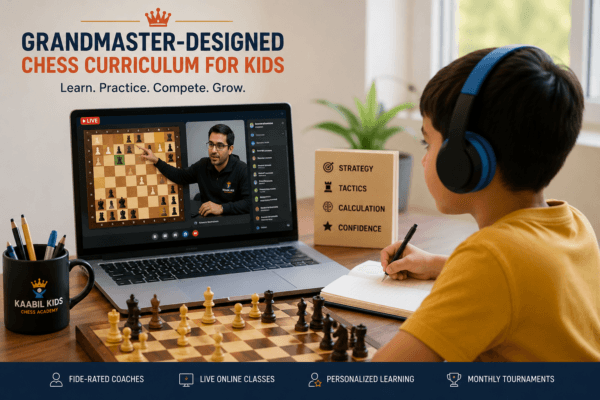
Every parent researching a chess academy for kids eventually runs into the same marketing language: expert coaches, proven results, personalised attention. It all sounds reassuring until you ask a simpler question: taught in what order? A brilliant coach with no structured plan can still leave a child with scattered knowledge, strong in some areas and shaky in others. A grandmaster-designed chess curriculum solves this by giving every lesson a place in a sequence, built by someone who has actually reached the game’s highest level and knows exactly which skills need to come first.
This article looks at why the curriculum behind a chess programme matters as much as the coach delivering it, what a grandmaster-designed learning path actually contains, and how Kaabil Kids has built its programme around real grandmaster expertise, rather than a generic syllabus.
Why the Right Curriculum Matters More Than the Right Coach Alone
Is a good coach enough without a structured curriculum? Not on its own. A skilled coach can explain a concept clearly in the moment, but without a defined learning path, sessions tend to follow whatever a child finds interesting that week rather than what they actually need to learn next.
This is where many otherwise well-taught children plateau. They can discuss an opening confidently but freeze when a game reaches an unfamiliar middlegame position, because nobody sequenced the lessons to prepare them for it. A structured chess curriculum solves this by treating the coach as the person who delivers a learning path, not the person who invents one from scratch in every class. The two working together, an experienced coach and a well-designed syllabus, is what actually produces steady improvement.
What Goes Into a Grandmaster-Designed Chess Learning Path
A genuine grandmaster curriculum is built the way FIDE titles themselves are earned: through years of tested, verifiable progress rather than shortcuts. FIDE, chess’s global governing body, only awards the Grandmaster title after a player demonstrates sustained performance across hundreds of rated games, which is exactly the kind of pattern-tested expertise that should sit behind a children’s chess syllabus, not just theoretical knowledge of the rules.
In practice, a well-built chess learning path includes a few consistent elements:
- Fundamentals first: piece movement, basic checkmates, and core rules taught before anything else, so nothing is assumed
- Tactics before openings: pattern recognition, forks, pins, and skewers, since these show up far more often in a child’s early games than any specific opening
- Opening principles, not memorised lines: young players learn why an opening works, not a fixed sequence of moves they cannot adapt
- Endgame technique introduced early: enough basic endgame knowledge to convert an advantage, rather than saving it for much later
- Checkpoints between stages: confirmation that one stage is genuinely solid before the next one begins
This is what separates a chess syllabus for kids designed by a titled player from a loose collection of lessons pulled together from wherever felt convenient.
How a Structured Curriculum Helps Kids Progress Without Gaps
How does a structured curriculum help kids avoid gaps in learning? It works the same way scaffolding works in any skill-building process: each new concept is introduced only once the concept it depends on is already secure. Harvard’s Center on the Developing Child describes this kind of scaffolded practice as central to how children build executive function skills like planning, working memory, and self-control, the same mental muscles chess quietly exercises move by move.
Without this scaffolding, gaps appear quietly. A child might learn to spot a fork in isolation but never connect it to actual decision-making in a live game, because tactics and games were taught as separate, disconnected activities. A sequenced chess learning path prevents this by deliberately rotating between theory, tactics practice, and real games, so each new skill is tested in context before the next one is introduced. Parents often notice the difference less in what their child says about chess and more in how calmly their child handles an unfamiliar position, a sign that the underlying skills, not just the memorised facts, are genuinely in place.
How Kaabil Kids Built Its Curriculum Around Real Grandmaster Expertise
Kaabil Kids’ curriculum is sequenced by International Grandmaster Tejas Bakre and delivered live by FIDE-rated trainers, so the fundamentals-to-endgame progression described above is not a theoretical ideal, it is how every class is actually structured. Children move through each stage only once it is genuinely solid, with regular checkpoints that give both the coach and the parent a clear picture of where a child actually stands.
Classes are taught in small batches so a coach can notice a recurring mistake rather than moving on regardless, and content is age-banded for children between 5 and 15, so a five-year-old and a young teenager are never taught the same way. An in-house psychologist works alongside the coaching team to support focus and motivation, recognising that consistency matters as much as content when it comes to a child’s best chess start.
Families comparing online chess coaching options, or searching more broadly for chess coaching online that offers real structure rather than ad-hoc sessions, will find this is precisely what Kaabil Kids’ programme was built around: a curriculum designed by someone who has lived the game at its highest level, taught by people trained to deliver it consistently.
Conclusion
A grandmaster-designed chess curriculum gives a child something a talented coach alone cannot guarantee: a learning path where every lesson has a purpose and a place. Fundamentals lead into tactics, tactics lead into opening principles, and opening principles lead into endgame technique, each stage building on the last rather than leaving gaps a child has to fill in later. For parents comparing chess classes for kids, this structure, not just the coach’s individual skill, is what tends to separate steady, visible progress from a child who plateaus despite trying hard.
If you are looking for a programme built around genuine grandmaster expertise rather than a generic syllabus, explore Kaabil Kids’ online chess coaching and book a free trial class to see the curriculum in action.
Frequently Asked Questions
Q1. What is a grandmaster-designed chess curriculum?
A grandmaster-designed chess curriculum is a structured learning path created or sequenced by a titled chess player, moving children through fundamentals, tactics, opening principles, and endgames in a deliberate order rather than a random mix of topics.
Q2. Why does a structured chess curriculum matter more than casual practice?
Casual, unstructured practice exposes a child to chess ideas without building on them consistently, while a structured curriculum ensures each new skill depends on one already mastered, producing steadier, more reliable progress.
Q3. Is a grandmaster-designed curriculum better than learning from a regular coach alone?
It depends on how the coach teaches. A skilled coach following a well-designed, grandmaster-informed curriculum is far more effective than either a great coach with no structure or a rigid syllabus delivered without genuine teaching skill; the two need to work together.
Q4. Which age groups benefit most from a grandmaster-designed chess curriculum?
Children from around age 5 through the early teenage years benefit most, since a structured curriculum can be age-banded to match how younger and older children process new ideas differently.
Q5. How long does it take to see results from a structured chess learning path?
Most families notice improved focus and faster pattern recognition within the first few weeks, while measurable tactical and strategic growth typically builds over several months of consistent, sequenced learning.