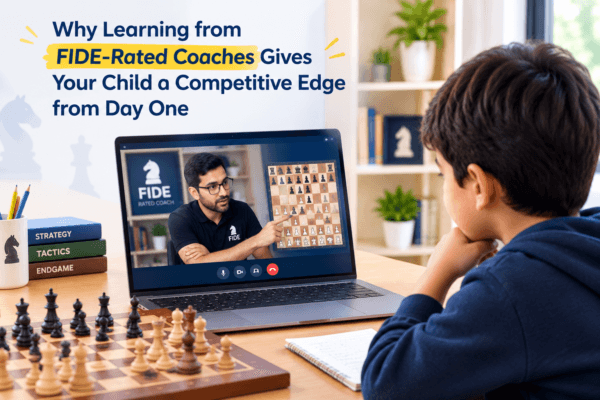
When you’re choosing online chess coaching for your child, one detail matters more than most parents realize who is actually teaching them. Competitive experience + teaching ability + experience with children = stronger coaching proposition. Look for a coach who has competed, studied, and been formally evaluated by the sport’s global governing body.That difference shows up early, in how quickly a child grasps ideas, how correctly they form habits, and how confident they feel at the board.
If you’ve been comparing a chess coaching online option to a local chess teacher near me, understanding what a FIDE rating signals can make that decision much easier.
What Makes a FIDE-Rated Coach Different from a Regular Chess Teacher
A FIDE rating is issued by the International Chess Federation (FIDE), the same body that governs World Championship events. It’s earned through rated tournament play and reflects a measurable, internationally recognised skill level, not a self-declared title.
This matters because a certified chess coach with a FIDE rating has been tested under real competitive pressure. They’ve had to calculate accurately, manage time, and recover from mistakes in front of an opponent and a clock. A regular hobbyist teacher, however well-meaning, hasn’t necessarily gone through that process.
For a young learner, this translates into three practical advantages:
- Accurate fundamentals. FIDE-rated coaches understand the “why” behind an opening move or an endgame technique, not just the “what.”
- Correct habit formation. Chess habits learned early are hard to unlearn. A qualified coach prevents your child from picking up patterns that later hold them back.
- Real competitive insight. Rated coaches know how tournaments actually feel, so they prepare children for pressure, not just theory.
This is one of the clearest markers of chess coaching quality, and it’s why many parents specifically look for it when comparing an online chess tutor.
How Expert Coaching Shapes a Child’s Learning Curve Early On
The first few months of learning chess set the tone for everything that follows. A child who’s taught clearly and correctly from the start tends to progress faster and enjoy the game more, because early wins build motivation.
Expert coaches structure this learning curve deliberately. Instead of throwing a child into random puzzles or games, they build understanding in layers: piece movement and value, basic tactics, simple checkmates, then opening principles. Each layer is reinforced before the next one begins.This sequencing does more than build chess skill. It mirrors how strong learning habits form in general.
Children coached by experienced instructors also tend to develop:
- Stronger concentration during longer tasks
- Better working memory, since they’re tracking multiple pieces and possibilities
- Improved decision-making under time pressure
- Growing confidence as their understanding compounds week over week
None of this requires a child to become a competitive player. The skills transfer directly to schoolwork, problem-solving, and everyday focus.
Why Early Exposure to Strong Coaching Prevents Bad Habits Later
Bad chess habits are surprisingly easy to pick up and surprisingly hard to fix. A child who learns to move pieces impulsively, ignore basic safety checks, or rely on memorised tricks instead of understanding can hit a frustrating plateau within a year or two.
This is where the gap between casual instruction and professional coaching becomes obvious. A coach without formal training might not notice these patterns forming until they’re deeply ingrained. A FIDE-rated or otherwise certified chess coach is trained to spot them early and correct courses before habits solidify.
Think of it the way you’d think about learning correct posture in a sport, or proper technique in music. Correcting a habit at week three is simple. Correcting it after a year of reinforcement is much harder, and can dent a child’s confidence in the process.
This is also where a competitive edge actually comes from. It’s not about pushing a child toward tournaments immediately. It’s about giving them a technically sound foundation so that if they do want to compete later, they’re not relearning basics under pressure.
How Kaabil Kids Ensures Every Child Learns from Verified, FIDE-Rated Coaches
At Kaabil Kids, coach quality isn’t left to chance. Every instructor goes through a structured verification process before they’re allowed to teach, and FIDE-rated credentials are a core part of that standard. This is deliberate: parents choosing online chess coaching deserve to know their child is learning from someone with a demonstrated, verifiable skill level, not just an enthusiastic volunteer.
Classes are conducted live, which allows coaches to observe a child’s thinking in real time, ask guiding questions, and correct small errors before they become habits. This live, small-group format is part of what separates a genuine online chess tutor relationship from passive video lessons.
Kaabil Kids also structures its curriculum in stages, similar to the layered learning approach outlined earlier, so that children build genuine understanding rather than memorised shortcuts. Progress is tracked over time, giving parents visibility into how their child’s thinking, focus, and confidence are developing, not just how many lessons they’ve completed.
For families comparing a local chess teacher near me against a structured online program, this verified-coach model is often the deciding factor. It offers the accountability of professional coaching with the convenience of learning from home.
Conclusion
Choosing the right coach is arguably the single most important decision in a child’s chess journey. A FIDE-rated coach brings tested expertise, correct fundamentals, and the ability to catch small mistakes before they become long-term habits. That foundation shapes not just how well a child plays chess, but how they concentrate, problem-solve, and approach challenges more broadly.
If you’re evaluating chess coaching online for your child, it’s worth asking directly about a coach’s credentials before enrolling. Programs like Kaabil Kids, which build verified, FIDE-rated coaching into their core structure, make that assurance simple to find rather than something you have to dig for. Book a chess trial class and see the difference in a single session.
FAQs
Q1. What does it mean if a chess coach is FIDE-rated?
It means the coach has earned an official rating from the International Chess Federation through rated tournament play, confirming a verified, internationally recognised skill level rather than a self-claimed one.
Q2. How do I know if an online chess coach is qualified?
Ask about their FIDE rating or title, teaching experience with children specifically, and whether their program verifies credentials. Reputable platforms will share this information openly.
Q3. Is online chess coaching as effective as in-person lessons?
Yes, when delivered live by a qualified coach. Live online sessions allow real-time interaction, feedback, and correction, which are the elements that make coaching effective, regardless of location.
Q4. Can a beginner child benefit from a FIDE-rated coach, or is that only for advanced players?
Beginners benefit the most. Starting with correct fundamentals from a qualified coach prevents the bad habits that are much harder to correct later at intermediate or advanced levels.
Q5. Why does chess coaching quality matter for young children specifically?
Young children are still forming foundational thinking patterns. Quality coaching at this stage shapes how they approach problems, handle mistakes, and build focus, skills that extend well beyond the chessboard.
Q6. When should a child start structured chess coaching?
Most children can begin structured coaching around age 5 to 6, once they can sit through a short lesson and follow multi-step instructions. Earlier starts simply require more game-based, less formal teaching methods.
Q7. Which is better for a child: group classes or one-on-one coaching?
Both have value. Group classes build social learning and healthy competition, while one-on-one coaching allows faster, more personalised correction. Many programs, including Kaabil Kids, offer live small-group formats that balance both benefits.
Q8. Does learning chess actually improve a child’s focus and academic performance?
Chess demands sustained attention, planning, and working memory, skills that overlap directly with academic tasks. While individual results vary, structured chess practice is widely recognised as a strong exercise for these cognitive skills.