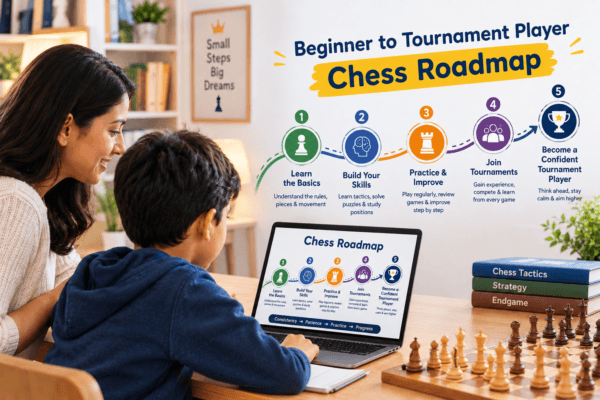
Every parent whose child falls in love with chess eventually asks a version of the same question: what next? A child who has learned how the pieces move and started beating family members at the board needs a very different kind of practice than one preparing for a rated tournament. Without a clear chess learning roadmap, many kids plateau at the casual-player stage, replaying the same habits without ever building the depth needed to compete.
This article maps out exactly how a child moves from complete beginner to tournament-ready player, and how structured online chess classes like the programmers at Kaabil Kids guide that journey stage by stage.
Where Every Child Starts: Building Strong Chess Fundamentals
What is the first stage of a chess learning roadmap for kids? Every roadmap begins the same way: mastering how each piece moves, understanding check and checkmate, and learning basic opening principles like controlling the centre and developing pieces early. This foundation stage isn’t about winning games, it’s about building reliable knowledge a child no longer has to stop and think about.
Skipping or rushing this stage is one of the most common reasons children plateau later on. A child who memorises a flashy opening trap without understanding why it works will struggle the moment an opponent deviates from the expected line. Well-designed chess classes for kids spend real time here, even when children are eager to jump ahead, because everything that follows depends on this stage being genuinely solid, not just completed.
How Kaabil Kids Structures the Journey from Basics to Strategy
How does the chess learning roadmap progress from beginner to advanced? A well-structured roadmap moves through four connected stages, fundamentals, tactics, opening principles, and endgame technique, each one building directly on the last rather than being taught as a separate topic.
At Kaabil Kids, this progression is sequenced by International Grandmaster Tejas Bakre and delivered live by FIDE-rated trainers, so a child moves from spotting simple forks and pins to understanding deeper positional ideas only once each earlier stage is genuinely solid. Classes are taught in small batches and age-bands for children aged 5 to 15, so a young beginner and an experienced 13-year-old are never taught at the same pace.
This is also why families researching a chess academy for kids should look past marketing claims and ask a direct question: is the curriculum sequenced, or is it a list of topics taught in a convenient order? That difference determines whether a child’s beginner to advanced chess progress compounds over time or stalls.
What It Takes to Move from Casual Play to Tournament Readiness
Can any child become a tournament-level player? Most children who practise consistently can reach a solid intermediate level, though how far a child progresses toward competitive, rated play depends on consistent practice and genuine interest in the game, not just talent.
Tournament readiness asks for more than knowing the rules well. A child needs a dependable opening repertoire, the calculation depth to see several moves ahead under time pressure, and the emotional resilience to recover from a loss without it affecting the next game. This is measured formally through the rating system maintained by FIDE, chess’s global governing body, which gives players and parents an objective benchmark for improvement over time.
When should a child start competing in chess tournaments? Most coaches recommend a child’s first tournament only once they can complete a full game independently and understand basic time management, typically after six months to a year of structured practice. Parents searching for chess training near me often discover that live online coaching, paired with regular online tournaments, prepares children for competitive play just as effectively as an in-person academy, without the added commute.
How Kaabil Kids Supports Children at Every Stage of Their Chess Journey
Long-term chess development needs more than good lessons, it needs consistent support around them. Kaabil Kids pairs its sequenced curriculum with monthly tournaments, doubt-clearing sessions, and regular webinars, turning a single weekly class into an ongoing learning environment rather than an isolated hour.
An in-house psychologist works alongside the coaching team to support focus, motivation, and confidence, particularly during the frustrating stretches every young player faces after a string of losses. Parents also receive visibility into how their child is actually progressing, stage by stage, rather than a generic attendance update.
Whether a child is just starting with online chess classes or working toward their first rated event, this consistent structure is what turns early enthusiasm into steady chess skill progression, the kind that carries a child from their first checkmate to their first tournament trophy.
Conclusion
A clear chess learning roadmap, one that moves deliberately from fundamentals to tactics to tournament readiness, is what separates children who plateau from children who keep improving year after year. Talent plays a smaller role than most parents expect; structure, consistency, and the right guidance at each stage matter far more.
If you’re looking for a programme that maps out this entire journey for your child, from their first lesson to their first tournament, explore what Kaabil Kids’ online chess classes offer and book a free trial class to see the roadmap in action.
Frequently Asked Questions
Q1. What is a chess learning roadmap for kids?
A chess learning roadmap is a structured sequence of stages, fundamentals, tactics, opening principles, and endgames, each building on the last so a child’s skills develop in a logical order rather than at random.
Q2. How long does it take for a beginner to become a strong chess player?
With consistent weekly practice, most children show noticeable improvement in strategy and focus within two to three months, while reaching a genuinely strong intermediate level typically takes a year or more of structured coaching.
Q3. Can any child become a tournament-level player?
Most children who practise consistently can reach a solid intermediate level. Reaching competitive, tournament-rated play depends more on sustained practice and genuine interest than on natural talent alone.
Q4. When should a child start competing in chess tournaments?
Most coaches recommend a child’s first tournament once they can complete a full game independently and manage their own clock, usually after six months to a year of structured practice.
Q5. Which skills matter most for long-term chess development?
Pattern recognition, calculation under time pressure, and the discipline to review one’s own mistakes matter most. These skills, built gradually through a structured roadmap, carry a child from casual play through to tournament readiness.